

You have spent years getting good at something. The course is nearly finished, the recordings are done, and then a small, cold thought arrives at two in the morning: am I actually allowed to do this? And the follow-up that stings a bit more — am I allowed to hand someone a certificate with my name on it?
Short answer: yes. In the EU, the UK and almost everywhere else you are likely to be selling, there is no law that says you need a permit, a teaching qualification or an accreditation to teach a subject or to award your own certificate of completion. The doubt is almost always bigger than the rule.
Three things are restricted, and they are worth knowing precisely rather than vaguely. You cannot award a credential that belongs to somebody else. You cannot present an unrecognised certificate as a recognised one. And once money changes hands, ordinary consumer law applies to you the same way it applies to a webshop — which mostly means clear terms, an honest checkout and getting the withdrawal right correct.
This is the whole picture, in the order the questions actually arrive: whether you may teach, what you may call the thing you hand out, what you must arrange when you sell it, how to make your own certificate genuinely worth something, and what the routes to formal recognition look like if you decide you want one.
One honest caveat before we start: this is general information written in September 2026, not legal advice. Rules differ by country and change. Where something is genuinely legal we link the official source so you can check it, and if you are dealing with a large B2B contract or a regulated field, spend an hour with a lawyer — it is cheap compared with getting it wrong.
Are you allowed to teach a course at all?
Yes. There is no law in the EU or the UK that protects the word “course” or restricts who may teach one. Nobody licenses course creators. If you know a subject well — because it has been your job for fifteen years, or because it is the thing you cannot stop reading about — that is enough to teach it.
Being allowed to and being ready to are different questions, though, and the second one is the one that decides whether anybody buys. Demonstrable experience helps. So does having thought about how people learn rather than just what you know. Students can feel the difference within the first two minutes of a video, and they choose the person who sounds like they have actually done the thing.
Do you need a teaching qualification or a diploma in your subject?
No. There is no formal education requirement for teaching a course. Your credibility comes from your track record and your ability to explain, not from a certificate on your own wall.
Where it flips is when the subject is regulated rather than the teaching. Teaching people about tax, medicines, law or investments is fine; presenting yourself as their accountant, pharmacist, solicitor or financial adviser generally is not, because those titles are protected in most jurisdictions. The European Commission keeps a searchable database of regulated professions for exactly this — if your field appears there, check what the protected title is in the countries you sell into and keep your marketing on the right side of it.
The practical version of this line: you can teach anyone how bookkeeping works. You cannot describe your course as making them “a qualified accountant”.
When does the subject itself bring extra rules?
Three families of topic carry their own regimes regardless of how you deliver them. Safety and compliance training — first aid, fire marshal, food hygiene, working at height, forklift operation — usually has a national certifying body, and a certificate that an employer will accept has to come through that body, not from you. Financial and insurance advice is licensed nearly everywhere. And anything aimed at children or run inside a school system tends to attract safeguarding and curriculum requirements.
If none of that describes your course, you are in the ordinary category, which is where the vast majority of online courses sit: teach it, sell it, certify it yourself.
What can you legally call the thing you hand out?
You can issue a document that records what someone learned and completed. What you cannot do is dress it up as a credential that carries official standing when it does not. The value of a certificate comes from who issued it and what had to be done to earn it — not from the word printed at the top.
It helps enormously to keep three things separate in your head, because your students and their employers do.
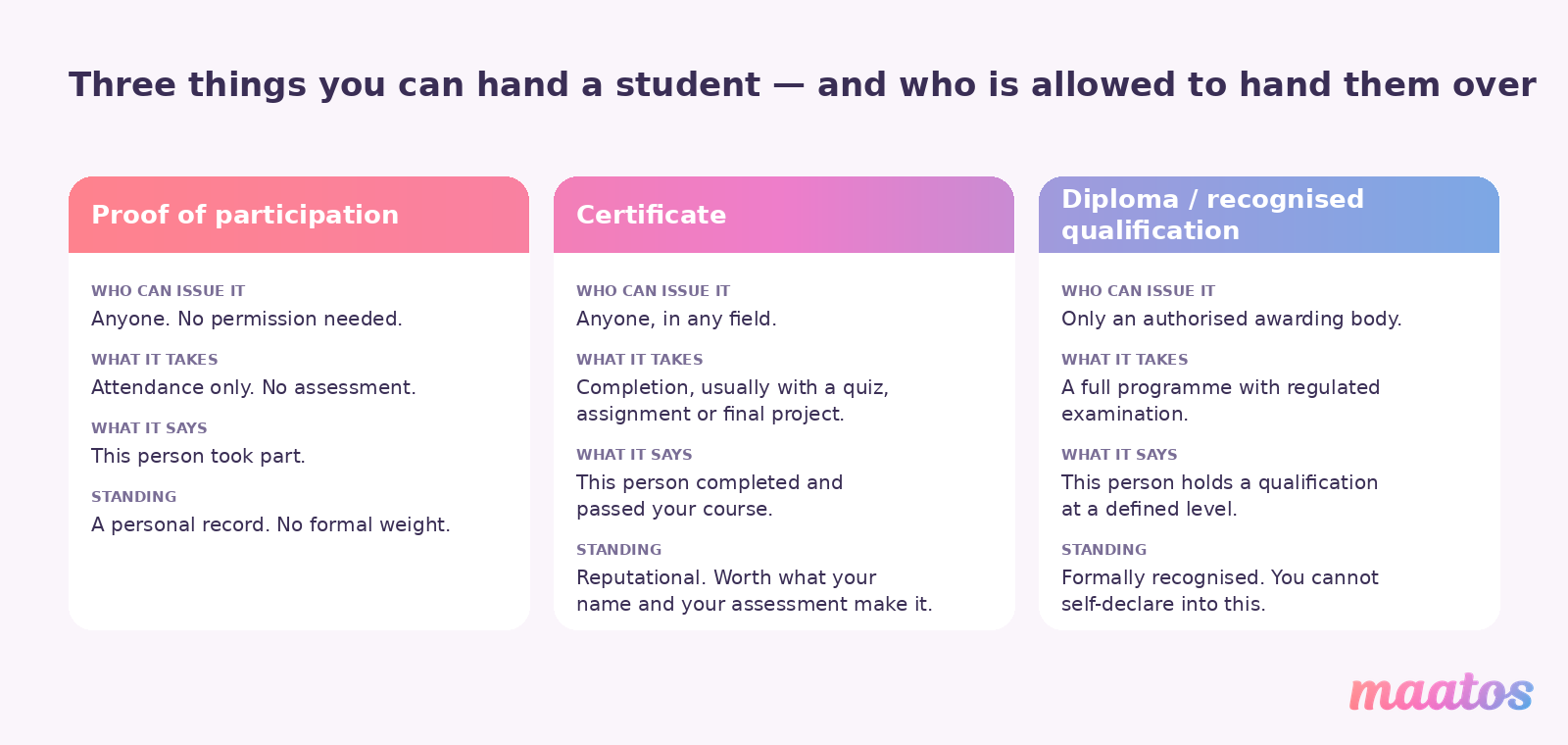
A proof of participation says someone was there. No assessment needed, no claim about competence. It is honest and it is easy, and for a two-hour workshop it is often exactly right.
A certificate says someone completed your course, usually having passed something — a quiz, an assignment, a final project. Anyone can issue one, in any field. Its weight comes from your reputation and from how hard it was to get.
A diploma or recognised qualification belongs to formal education and regulated frameworks. It follows a full programme, has regulated examination, and — the part that matters — can only be awarded by a body that has been authorised to award it. You cannot self-declare into this category, and issuing something you call a diploma when it is not can put you in the territory of misleading commercial practices.
The words to be careful with
Some words carry an implied claim. “Accredited”, “certified”, “qualified”, “licensed”, “Level 3”, “degree” and “diploma” all suggest a third party has checked something. If no third party has, using them is not just risky positioning — in the EU it can be an unfair commercial practice under the Unfair Commercial Practices Directive, and in the UK it falls under the misleading-actions rules of the Digital Markets, Competition and Consumers Act 2024.
Note that “certified” and “certificate” are not the same claim. Handing someone a certificate is a statement of fact about your own course. Calling them “a certified project manager” implies a recognised scheme somewhere behind it. The first is fine; the second needs one.
Safe phrasings that say something real: certificate of completion, course certificate, proof of participation, [Your Academy] certificate. Add one line on the certificate itself stating what it is and is not — see below, it does more work than you would expect.
Someone else’s certification is not yours to give
This is the trap that catches well-meaning people. Holding a certification yourself does not give you the right to award it to others.
You may be an Adobe-certified designer, an AWS-certified architect, a PMI-credentialed project manager. You are still not allowed to award Adobe, AWS or PMI certificates to your students. Those schemes are run by the vendor, awarded through their own examination, and — importantly — their names and logos are trademarks. Putting one on a certificate you issued is trademark infringement as well as a false claim, and vendors do enforce it.
What you can do is describe your course accurately: preparation for the AWS Solutions Architect Associate exam, with your own certificate for finishing your course, and the real exam sat with the vendor. That is honest, it is legal, and it sells perfectly well — people buying exam prep know the difference.
The same logic covers regulated safety certificates. Your fire-safety course can be excellent and still cannot produce the certificate an employer’s insurer wants, because that one comes from the national scheme. Say so plainly in your sales copy; a reader who discovers it after paying is a refund and a bad review.
What must you get right when you sell the course?
The moment you take payment from a consumer, you are a trader selling digital content, and a short list of ordinary obligations applies. None of it is exotic. It is a one-off afternoon of setup that then runs by itself.
There are three pieces: terms that say what you actually deliver, a checkout that discloses what it must before payment, and the withdrawal right handled correctly. Plus data protection, which we will come to.
Terms and conditions that do a real job
Terms are not a legal ritual, they are the written version of the deal — and on the day something goes wrong they are the only version anyone can point at. Yours should say, in plain language, what the course contains and what a student will be able to do afterwards; how long it runs and whether it has fixed start dates; what it costs, in which currency, and which payment methods you accept; how long access lasts and whether it ever expires; whether and how someone can cancel and what happens to money already paid; who owns the material and what students may do with it; and how you handle personal data.
Two small things make a disproportionate difference. Put the same answers in a plain FAQ on your sales page as well, because almost nobody reads terms and almost everybody reads an FAQ. And give a real contact route for complaints — an email address that a human reads is both a legal expectation and the cheapest way to stop a dispute becoming a chargeback.
How does the 14-day withdrawal right work for a digital course?
In the EU, a consumer buying online has 14 days to withdraw without giving a reason — and for a digital course that right only disappears if you did three specific things before access started. This is the single most misunderstood rule in online course selling, and getting it wrong is expensive in exactly the situation where you least want it to be.
Article 16(m) of the Consumer Rights Directive sets the exception. All three conditions have to be satisfied: the buyer gave prior express consent to performance starting inside the 14-day window; the buyer acknowledged that they thereby lose the right of withdrawal; and you confirmed that on a durable medium, which in practice means the order confirmation email. The Court of Justice reads exceptions like this one strictly, so “close enough” does not survive a complaint.
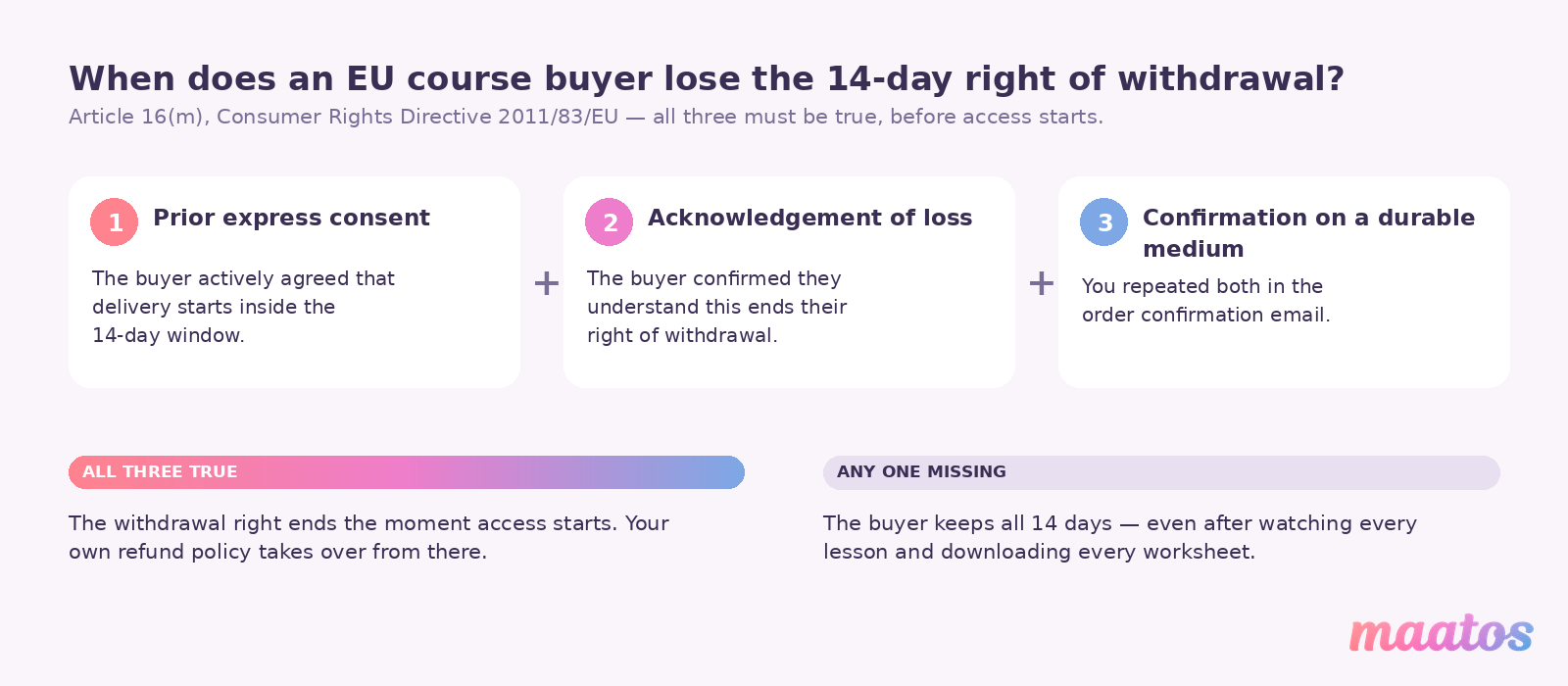
Miss any one of them and the buyer keeps the full 14 days — including someone who has already watched every lesson and downloaded every worksheet. That is the scenario worth spending twenty minutes preventing.
In practice it is a tick box at checkout with wording along the lines of “I want access immediately and I understand this means I give up my 14-day right of withdrawal”, unticked by default, repeated in your terms, and echoed in the confirmation email. The UK works the same way under the Consumer Contracts Regulations 2013; outside the EU and UK the rule may not exist at all, but a stated refund policy still does you nothing but good.
You can also simply choose not to use the exception — offer a genuine 14-day or 30-day money-back guarantee instead and say so loudly. It converts, it is easy to administer, and it removes the entire question. Whichever route you pick, decide deliberately rather than discovering your position during an argument.
What has to be visible before someone pays?
Before the buyer commits, the price including tax has to be visible, along with any unavoidable extra charges; who you are, with a real business identity and contact details; the main characteristics of what they are buying; how long access lasts and what any subscription costs per period; and the withdrawal position described above.
Surprises at the payment step are both a legal problem and the reason carts get abandoned. If tax is added at the end, say so before the end. Good course platforms handle this bit for you — on Maatos, VAT is calculated automatically and invoices go out to the student without you touching anything, which removes a whole category of small compliance mistakes.
Does any of this change for business customers?
Yes, in your favour. Consumer protection rules — including the withdrawal right and the pre-contract disclosure list — exist to protect consumers, so most of them do not apply when you sell to a company. B2B buyers are expected to read the contract.
That does not mean skip the paperwork. It means the paperwork changes shape: purchase orders, invoicing terms, seat counts, what happens when an employee leaves mid-course, and whether the client’s procurement team needs a data processing agreement. Selling ten seats to one employer is a contract negotiation; selling one seat to one person is consumer law. Know which one you are in, because the pricing, the invoicing and the VAT treatment all follow from it.
What does the GDPR mean for your course — and your certificates?
You will inevitably process personal data: names, email addresses, progress records, sometimes payment details. The GDPR asks for something fairly reasonable — collect only what you need, tell people what you do with it in a privacy notice they can actually find and read, keep it secure, and do not hold it longer than you have a reason to.
Certificates add a wrinkle most creators never think about. A certificate contains a name and often a date and a photo of achievement, which makes it personal data. If you publish a public verification page, you are publishing that data, so tell students in advance and let them choose. If you use a student’s certificate in your marketing, get permission. And when someone asks you to delete their account, decide in advance whether the certificate record survives — you usually have a legitimate reason to keep proof of what you issued, but you need to have thought about it and written it down.
A clear privacy notice and a genuine FAQ do double duty here: they keep you tidy legally and they visibly raise trust at exactly the moment somebody is deciding whether to hand you their card details.
How do you make your own certificate actually worth something?
A certificate is worth precisely what it took to get. Four things separate one a student proudly adds to LinkedIn from one they close and never open again.
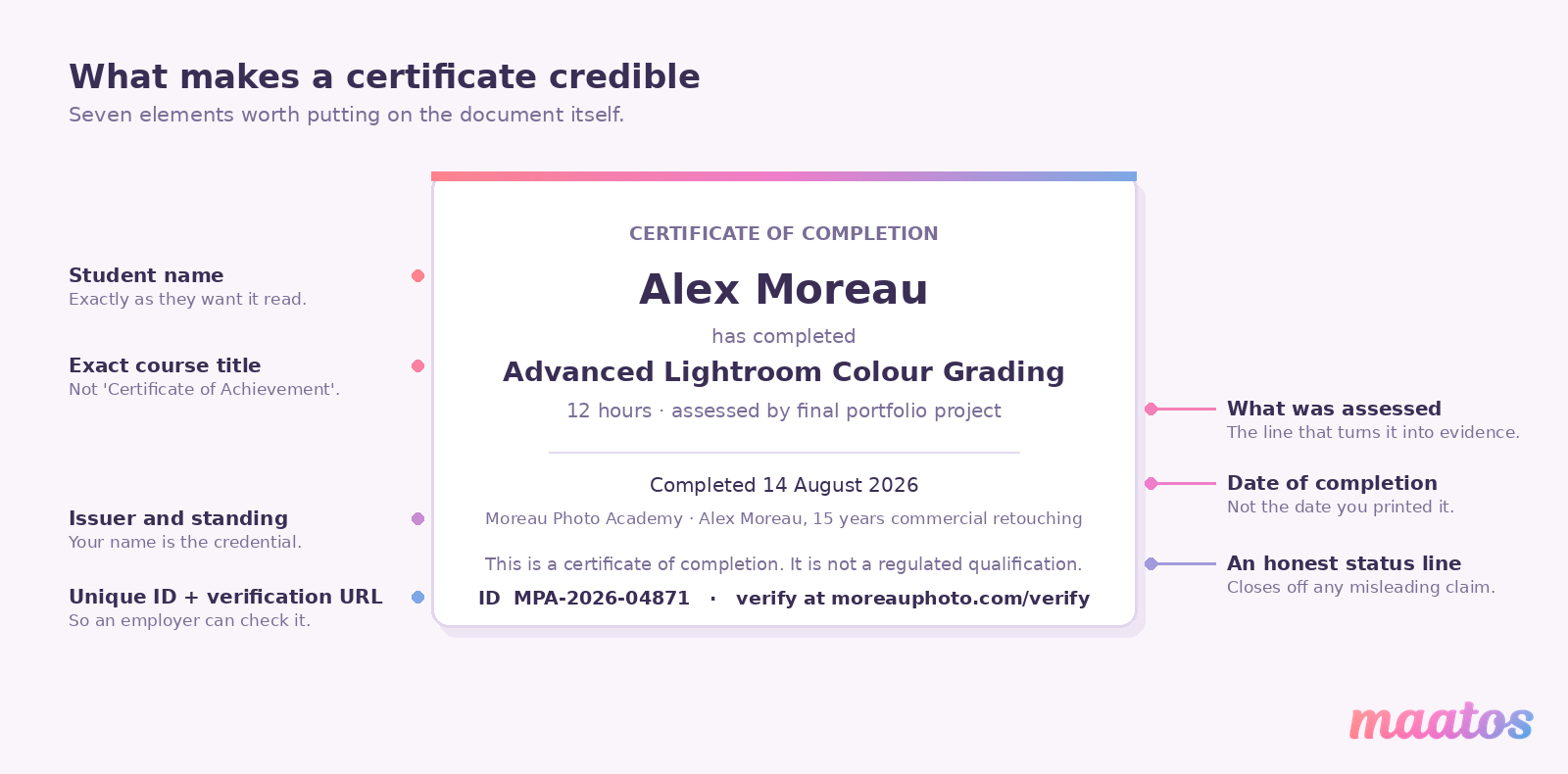
Assess something real. A certificate handed out for pressing play is a participation record wearing a costume. A final quiz, a practical assignment or a project that you actually review turns it into evidence. If you already build quizzes into your course, you are most of the way there — set a pass mark and gate the certificate behind it.
Say exactly what it certifies. “Completed Advanced Lightroom Colour Grading, 12 hours, assessed by final portfolio project” tells a hiring manager something. “Certificate of Achievement” tells them nothing. Name the skills, name the hours, name the assessment.
Say what it is not. One line — this is a certificate of completion issued by [Your Academy] and is not a regulated qualification — costs you nothing and buys a surprising amount of trust. It also closes the door on any misleading-practice question before it opens.
Make it verifiable. Give every certificate a unique identifier, and if you can, a page or QR code where an employer can check it against your records. Add the fields LinkedIn’s Add to profile button expects — issuing organisation, issue date, credential ID, credential URL — because a certificate that lands on a public profile keeps working for both of you. If your field takes credentials seriously, look at the Open Badges standard, which wraps the same information in a portable, machine-readable format.
And award it only when someone has genuinely finished. The temptation to hand certificates to everyone who bought is real and it hollows the thing out. Restraint here is what makes the next student’s certificate mean something.
Worth reading alongside this: our piece on the certificates students actually care about, which goes deeper into design and the moment of delivery.
What do you say when someone asks “is this accredited?”
You will get this question, usually from your most serious prospects, and the wrong answers are equally bad in both directions. Don’t bluff — “yes, it’s fully accredited” invites the follow-up “by whom?” and costs you the sale plus your reputation. Don’t apologise either; a flat “no, sorry” makes it sound like a defect.
Answer it straight and then redirect to what you actually offer: “It’s not a regulated qualification — it’s my own certificate, awarded after a graded final project, and it’s what people put on LinkedIn. If you need a regulated qualification for a specific job requirement, tell me which one and I’ll point you to the right awarding body.”
That answer converts, because it demonstrates you know the landscape. And it protects you, because it never claims anything you cannot back up. Put it in your sales-page FAQ verbatim and it will answer the question before it is asked.
Can you get your course formally recognised?
Yes, though far fewer creators need this than think they do. For most online courses a strong own-brand certificate is exactly right and the recognition routes are more cost and admin than they are worth. But they exist, and it is useful to know the ladder.
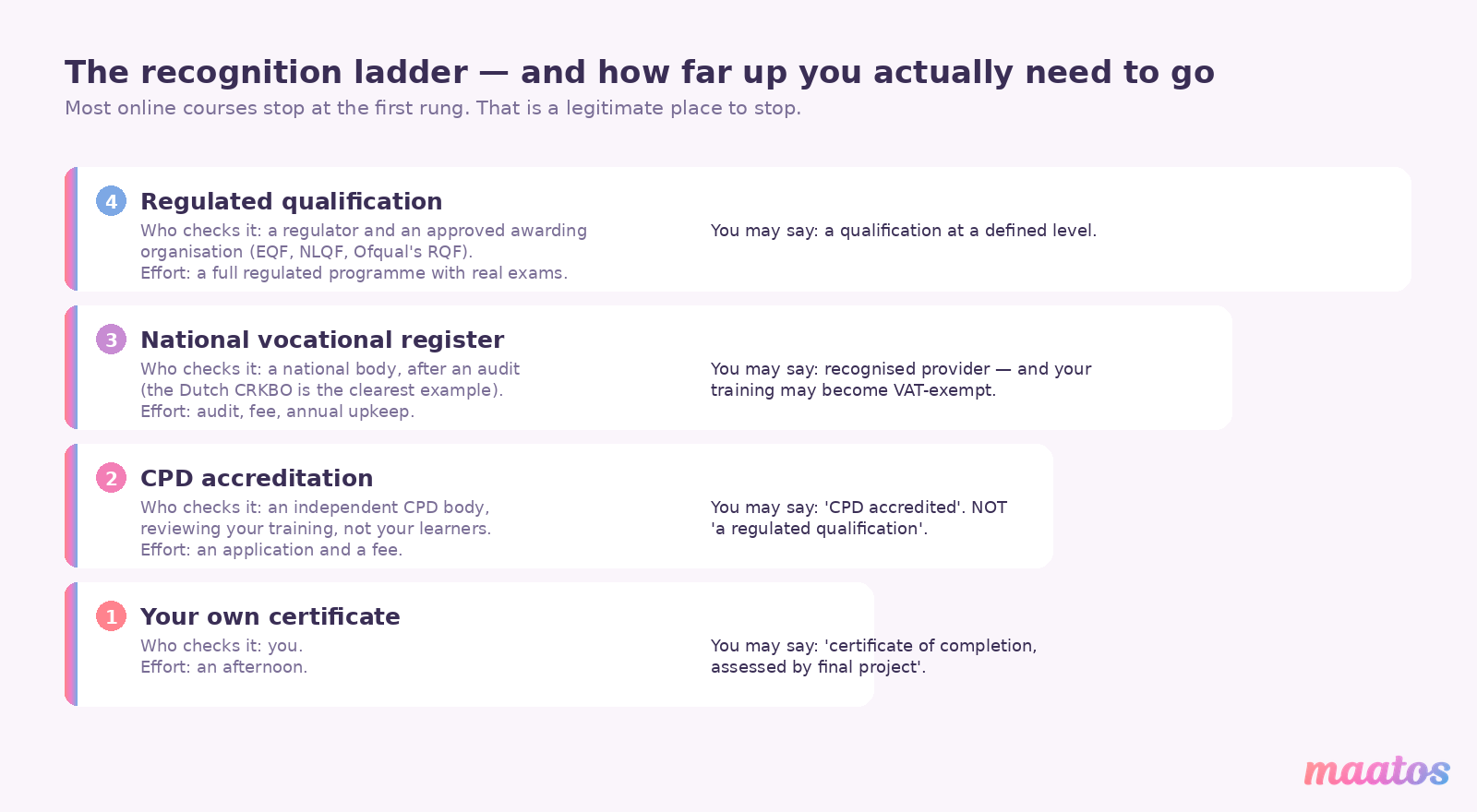
Qualification frameworks (EQF and national frameworks). The European Qualifications Framework is an eight-level scale that translates qualifications across countries, and national frameworks map onto it — the Dutch NLQF, the UK’s RQF, and their equivalents elsewhere. Levelling a programme means demonstrating clear learning outcomes, real examination and enough study load, which for a short online course is usually far too heavy. For a full vocational programme it can be transformative.
Regulated qualifications (the UK route). In England, Wales and Northern Ireland, a qualification is “regulated” when it is on Ofqual’s register and awarded by an approved awarding organisation. You can check any qualification against the register in seconds — as can your customers. The realistic path for an independent creator is not becoming an awarding organisation yourself but partnering with one that already offers a qualification in your field.
CPD accreditation. This is the middle rung, and the one most often misunderstood. CPD accreditation means an independent body has reviewed the quality of your training activity — it does not put your course on a regulated framework and it does not assess your individual learners. That is genuinely useful in professions where members log CPD hours, and it is honest as long as you describe it as what it is. Describing a CPD-accredited course as “a regulated qualification” is exactly the misleading claim discussed earlier.
National vocational registers — and the tax angle. Several countries run registers for short vocational education, and being on one can make your training VAT-exempt. The Dutch CRKBO is the clearest example: registration follows an audit, and once listed you may offer your courses free of VAT while showing a recognised quality mark. Comparable “eligible body” rules exist elsewhere in Europe, all descending from Article 132(1)(i) of the EU VAT Directive, which exempts vocational training delivered by bodies a member state recognises as having similar aims to public education. The catch is that “recognised” is defined nationally and most independent creators do not meet it — assume VAT applies unless you have checked.
That check matters enough to do properly, because it changes your pricing. Start with our overview of VAT on online courses in the EU, then the country page you actually sell into — we have them for Bulgaria, Croatia, Estonia, Finland and most of the rest of Europe.
What do you actually need to be able to do?
Legality is the easy half. The harder half is being good at it, and that comes down to three things: getting your knowledge across, handling enough technology to deliver it, and having somewhere to put it all. Only the third is genuinely outsourceable — though it happens to be the one people worry about most.
The teaching skills that matter
Teaching is a craft, and the good news is that it is learnable. Three habits carry most of the weight.
Build a logical structure with explicit learning outcomes, so a student always knows where they are and what they are working towards. Our guide to structuring a course students finish walks through going from a single learning goal to modules and lessons. Then build in something to do — a quiz, a poll, an exercise, a discussion prompt — because people learn by doing, not by watching. And learn to give feedback that motivates rather than deflates: specific about what worked, specific about the next improvement, never vague.
Use concrete examples relentlessly. Abstract theory slides straight off; the same point attached to a real situation sticks. This is the difference between a course people finish and one that quietly dies in module two.
The technical side
You need less than you think, but not nothing. You need somewhere to host and sell the course — a learning management system — that handles enrolment, progress, payments and certificates in one place. If you are still deciding what that even means, start with what an LMS is and then whether you need a CMS or an LMS.
Beyond that: something to make slides and visuals, something to edit video, and enough understanding of your own platform to see where students get stuck. Being able to read your own numbers is underrated — an analytics view of your course tells you which lesson people abandon, which is the single most useful piece of information you will get all year.
Have you ever taken a course where the tech kept failing? Then you know how quickly that erases goodwill. The technology does not have to be impressive; it has to be boringly reliable.
How much does video matter?
A lot. Video is what makes an online course feel like a person rather than a document. Two things matter more than production value: lighting that lets people see your face, and audio that does not make them work. Poor sound loses students faster than a mediocre picture ever will.
Start with accessible editing software — iMovie, DaVinci Resolve, or whatever came with your machine — and keep clips short and purposeful. Our guide to making course videos covers the setup in detail. If editing genuinely is not your thing, it is one of the easiest parts of the job to hand to somebody else.
What should your platform actually do?
Your platform is where the legal, the practical and the commercial all land in the same place, which is why the choice matters more than it looks. A course platform worth using should let you build and sell without touching code; take payments properly; keep student data in line with the rules; run quizzes and assessments so a certificate can mean something; and generate and issue certificates automatically when someone genuinely finishes.
Everything in this article has a home in that list. The withdrawal-right tick box lives at checkout. The VAT calculation and the invoice live in payments. The assessment that makes your certificate credible lives in the quiz engine. The certificate itself, with its name, date and unique reference, comes out the other end.
Maatos is built for exactly this: your own branded course website with the learning environment attached, Stripe or Mollie for payments, automatic VAT calculation and invoicing, quizzes, student management, and certificates issued on completion — all in one place, on your own domain, with hosting and updates handled for you. Plans start at €49 per month excluding VAT, and you can see the full breakdown on our pricing page. If you would rather not build it yourself at all, our done-for-you service sets the whole thing up for you — and the wider services page covers what else we can take off your hands.
None of this needs to be finished before you sell anything, either. If the whole picture feels like too much at once, the lean course MVP approach — build in seven days, launch in fourteen — is a saner way to find out whether people want the course before you invest a month in it.
Whatever you choose, own the relationship. A marketplace can take your students, your pricing and your customer data with it. Your own platform means the certificate carries your name, the student list is yours, and nobody changes the rules underneath you.
Where to start
The legal picture is calmer than the two-in-the-morning version. You may teach your subject. You may issue your own certificate. What you owe in return is honesty about what that certificate is, a checkout that tells people the truth before they pay, terms and a privacy notice that exist and match reality, and the withdrawal right handled deliberately rather than accidentally.
Do those, put a real assessment behind the certificate, and you have something that stands up — legally and in front of a hiring manager.
The technical half you do not have to solve alone. With Maatos you build your own course website, take payments, keep the tax right and issue certificates automatically, and you can try it free for 30 days with no commitment before deciding anything. Prefer to talk it through first? Get in touch — we are happy to look at your plan with you. And if you want to keep reading, the Selling Courses hub has the rest of the commercial and compliance side, and the blog has everything else.
Frequently asked questions
Am I allowed to give courses and issue certificates?
Yes. No law in the EU or the UK requires a permit, licence or teaching qualification to run a course or to award your own certificate of completion. The restrictions are narrow: you may not award someone else’s branded certification, you may not present an unrecognised certificate as a recognised qualification, and you may not use a protected professional title you do not hold.
Do I need to be accredited to issue a certificate?
No. Accreditation is optional and, for most independent course creators, unnecessary. An unaccredited certificate is perfectly legal as long as you describe it accurately. Accreditation only becomes important when your students need the credential to satisfy a specific employer, regulator or professional-body requirement.
What is the difference between a certificate and a diploma?
A certificate records completion of a course, usually with some form of assessment, and anyone may issue one. A diploma belongs to formal, regulated education: it follows a full programme with regulated examination and may only be awarded by an authorised body. The distinction is about who is permitted to issue it, not about how the document looks.
Can I issue a certificate for a course I completed elsewhere?
No — not in that scheme’s name. Holding an Adobe, AWS, Microsoft or PMI certification does not give you the right to award it to others; those names are trademarks and the exams belong to the vendor. You may run a preparation course and issue your own completion certificate for it, as long as your marketing is clear that the official exam is sat separately.
Does my own certificate have any legal value?
Not automatically. Its value is reputational, and it comes from your standing, your curriculum and how demanding the assessment was. If you need formally recognised value, the routes are a national qualifications framework such as the EQF or RQF, a regulated awarding organisation, or a national vocational register — all considerably heavier than issuing your own.
Does the 14-day right of withdrawal apply to my online course?
Yes, for EU consumers buying online, unless all three conditions in Article 16(m) of the Consumer Rights Directive are met before access begins: prior express consent to start within the withdrawal period, an explicit acknowledgement that the right is thereby lost, and confirmation on a durable medium. If even one is missing, the buyer keeps the full 14 days even after completing the course.
What if a student demands a refund after finishing the whole course?
Check your own paperwork first, because the answer usually lives there. If you satisfied all three Article 16(m) conditions at checkout, the statutory withdrawal right no longer applies and your stated refund policy governs. If you did not, the buyer is within their rights and arguing is a losing position. Either way, log the outcome and fix the checkout wording the same day.
Do I have to charge VAT on my online course?
Usually yes. Online courses are typically taxable, and in the EU the place-of-supply rules mean VAT is generally due where your consumer is. Exemption exists under Article 132(1)(i) of the VAT Directive for vocational training delivered by a body a member state recognises — the Dutch CRKBO register is the clearest example — but most independent creators do not qualify. Assume VAT applies and check your own country’s rules.
Do I need a website of my own to sell courses legally?
Not legally, no. Commercially it is a different question. Your own course platform means you control your price, your branding, your student data and your certificate, rather than operating on terms a marketplace can rewrite. It also makes the compliance side easier, because the checkout disclosures, tax handling and privacy notice are all yours to set.
What has to be on the certificate itself?
There is no legally prescribed format. What makes one credible in practice: the student’s name, the exact course title, what was assessed and how, the date of completion, who issued it and their qualifications, a unique reference number, and one honest line stating that it is a certificate of completion rather than a regulated qualification.
Is this legal advice?
No. This is general information, accurate to the best of our knowledge in September 2026, with official sources linked so you can verify anything yourself. Rules vary by country and change over time. For a regulated field, a large B2B contract or anything where the stakes are meaningful, ask a qualified lawyer in your own jurisdiction.