
You’ve built the course. The lessons are recorded, the quiz is set, and now you’re hovering over the “add a certificate” button wondering whether anyone will actually care about the PDF that pops out the other end — or whether it’ll be forgotten in a downloads folder ten minutes after they finish.
Fair question. Most course certificates are forgettable, and students can smell a participation trophy from a mile off. But a certificate students genuinely value isn’t about a fancy border or a gold seal. It’s about three plain things: it names a real skill they can now do, it’s credible enough that they’d put it in front of an employer or client, and it’s easy to show off. Get those right and the certificate stops being a formality — it becomes a reason to finish your course and a small piece of marketing that follows your students around.
This piece is written for you, the creator, not the student. We’ll look at what actually makes a certificate worth having, pull three real, well-designed examples apart for the lessons you can borrow, walk through the anatomy of a certificate students will happily share, and show how you can create and issue one on your own branded course platform without touching a line of code. If you’re just here for the mechanics, jump to the anatomy section — but the “why” is what stops you making a pretty certificate nobody respects.
What makes a certificate students actually care about?
A certificate students care about proves they can do something specific, comes from a source the reader trusts, and is easy to verify and share. Everything else — the design, the wording, the seal — is in service of those three jobs. When a certificate fails, it’s almost always because it does none of them: a generic “Certificate of Completion” with a name and a date says the student sat through some videos, and nothing more.
It helps to remember why your students want a certificate in the first place. They’re rarely collecting them for fun. Usually one of these is true:
They want proof of a specific, current skill. Job markets move faster than degree programmes, and learners reach for short, focused credentials precisely because they fill a gap a diploma doesn’t. A certificate that names the exact competency — “wrote and shipped a 5-email welcome sequence”, not “completed Email Marketing 101” — is worth far more than one that just confirms attendance.
They want an employability signal. For a lot of learners a certificate is a line on a CV or a badge on a profile that tells an employer or client “I took the initiative and I can do this now.” Surveys of hiring managers increasingly show that a verifiable online credential is treated as a legitimate signal, especially for practical, role-specific skills — but only when it’s verifiable and recent. A certificate from two years ago with no way to check it is close to worthless; one earned this quarter that a recruiter can click and confirm reads as an active, learning professional.
They want something to aim for. This one’s quietly in your interest too. Self-paced online courses are notorious for people drifting off halfway through, and a certificate at the end gives students a finish line — a concrete reason to get through module four instead of abandoning it. If you care about completion (and you should, because people who finish are the ones who leave reviews, renew, and refer), the certificate is one of the cheapest motivators you have. Pair it with quizzes that measure real progress rather than create anxiety and the credential at the end starts to mean something.
They want to stack it toward something bigger. Learners increasingly like building expertise in manageable pieces — a short credential now, another next quarter, adding up to real depth over time. If your course is one of several you (or your niche) offer, designing certificates that visibly build on each other gives students a reason to come back.
So the test for any certificate you design is simple: does it name a real skill, would a stranger trust it, and can the student prove it’s real and put it somewhere people will see? Hold that up against the examples below.
Real examples worth stealing from
You don’t need to copy a university to learn from one. These three programmes are well-designed credentials, and each one does something you can lift straight into your own course — whatever you teach.
A niche skill with a clear career line: Companion Animal Welfare (University of Illinois)
The University of Illinois runs a Companion Animal Welfare and Care certificate — a compact, roughly one-semester programme that deliberately blends online study with hands-on experience. It’s aimed at people who want to work in animal care and covers animal health, nutrition and behaviour, welfare assessment and ethics, and the practical techniques you’d use in a shelter, clinic or pet business. It maps straight onto real roles: veterinary support, shelter and rescue work, grooming and training.
What you can borrow: the ruthless focus on one clearly-defined audience and the roles they’re heading into. It isn’t a “certificate in animals” — it’s a certificate for a specific person with a specific next step. When you write the outcome on your own certificate, name the job or task, not the topic. And notice the hybrid delivery: pairing self-paced theory with something concrete to practise makes the credential feel earned rather than watched.
Evidence-based and role-specific: Trauma-Informed Care (University of Minnesota)
The University of Minnesota offers a fully-online Trauma-Informed Care certificate built on an evidence-based curriculum, aimed at professionals in counselling, social work, healthcare and education. It teaches people to recognise trauma responses and apply informed, effective practices in their day-to-day work — and it’s ridden a genuine, rising demand as awareness of trauma’s impact on mental health has grown.
What you can borrow: it’s fully online yet nobody would call it thin, because it’s anchored in a real body of knowledge and pointed at real jobs. If you teach a “soft” or judgement-heavy subject, this is the model — cite what your advice is grounded in, tie every module to a decision the student will actually make at work, and the online-only format stops being a weakness. Demand matters too: this certificate rides a trend people are already searching for. Design yours around a skill the market is actively asking for, not one you wish it wanted.
Modular and stackable: Harvard Extension School
Harvard Extension School takes a different route with stackable credentials that run from short microcredentials up to graduate-level certificates, with credits that can feed into a full master’s. The whole system is built so a working professional can build qualifications in increments — pick the competencies most relevant to their current role, keep their job, and accumulate credits that add up to something larger if and when they choose. The Harvard name does a lot of the trust work, but the structure is the clever part.
What you can borrow: the stack. You almost certainly can’t lend a student Harvard’s reputation, but you can design a sequence — a foundational certificate, then an advanced one, then a capstone — so finishing one course naturally sets up the next. That’s better for your students (clear progression) and better for you (a built-in reason to buy the follow-up). Even a solo creator with three courses can offer a “pathway” certificate for completing all three.
The thread running through all three: each names a specific skill, points at a real outcome, and fits into a busy life. None of them is a generic PDF — and that’s precisely why students care.
The anatomy of a certificate students will show off
A certificate students will actually share includes seven things: the student’s name, the exact course title, the specific skill or outcome they can now demonstrate, the completion date, you (or your brand) as the named issuer, a unique verification ID, and a clean, professional design. Miss the middle three and you’ve made a receipt; include them and you’ve made a credential.
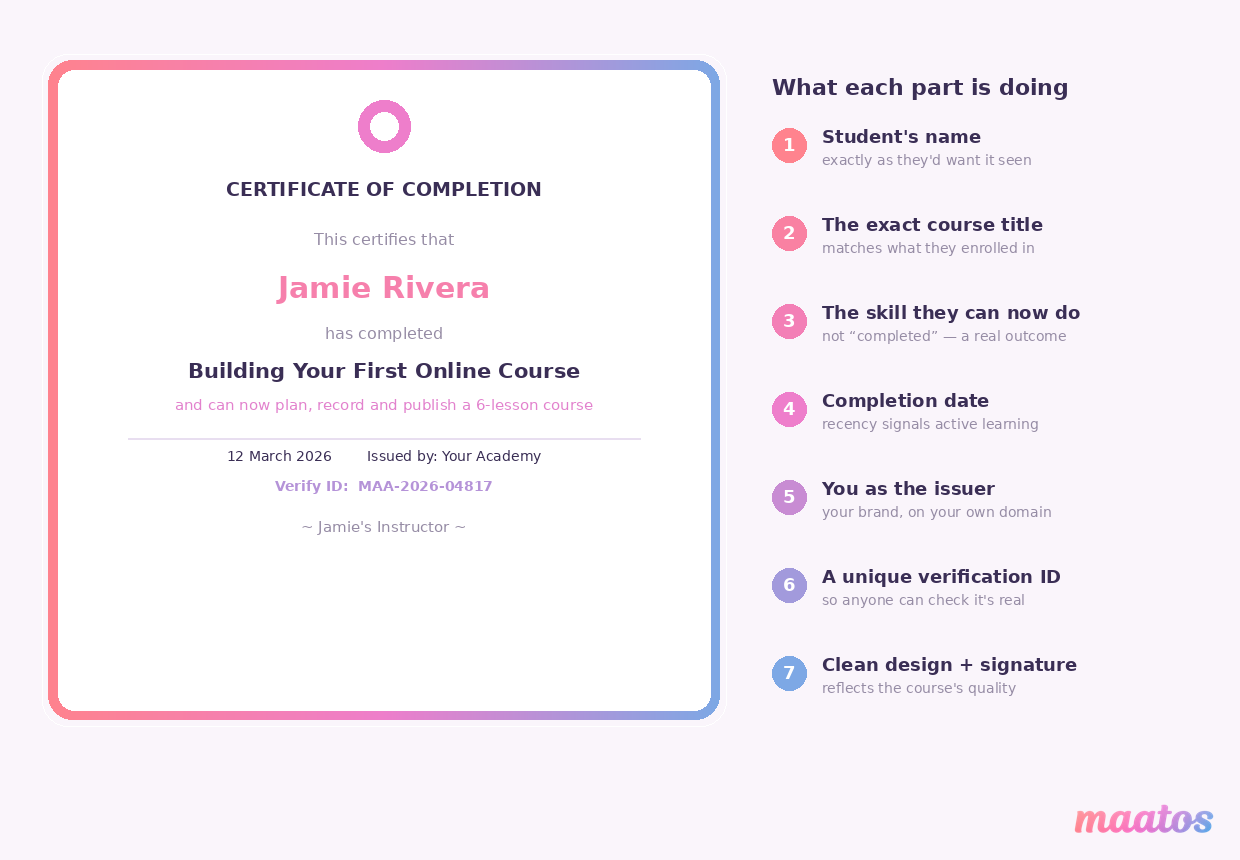
Here’s what each element is doing, and where creators usually go wrong:
The student’s name — spelled exactly as they’d want it on a professional profile. Obvious, but automate it from their account so you’re not typing names into a template at 11pm.
The exact course title — matched to what they enrolled in, so the certificate lines up with anything else they can point to (your sales page, your reviews).
The skill or outcome — this is the one everyone skips. Don’t just say “completed the course.” Say what they can now do: “planned, recorded and published a 6-lesson online course,” or “built a branded course website and took first payment.” A line like that is what turns a certificate into a talking point in an interview instead of a fridge magnet.
The completion date — gives the credential context. A recent date signals current, active learning; that recency is a real part of why employers pay attention. It also lets you (or a curious third party) place the credential in time.
You as the issuer — your name, or better, your brand and logo. The certificate is quietly doing your marketing every time it’s shared, so it should look unmistakably like it came from you, on your own domain, not from a generic marketplace where your name disappears into the platform’s. Your branding on the certificate is the difference between “some online course” and “the [Your Name] certification.”
A unique verification ID — the single biggest upgrade you can make. A code (or a link) that lets anyone confirm the certificate is genuine is what separates a credible credential from a Canva file anyone could fake. We’ll come back to this because it matters most.
A clean, professional design — reflecting the quality of the course. Not gaudy; just tidy, legible, and consistent with your brand. A genuine signature (yours or your organisation’s) adds a human touch that a bare template lacks.
Get those seven right and you’ve closed most of the gap between a certificate that gets shared and one that gets deleted.
Make it verifiable, not just pretty
The thing that makes a modern certificate credible is verifiability — a way for someone to confirm it’s real without taking the holder’s word for it. A beautiful PDF proves nothing; a certificate with a unique ID or a verification link proves a lot. If you do one thing beyond the basics, make yours checkable.
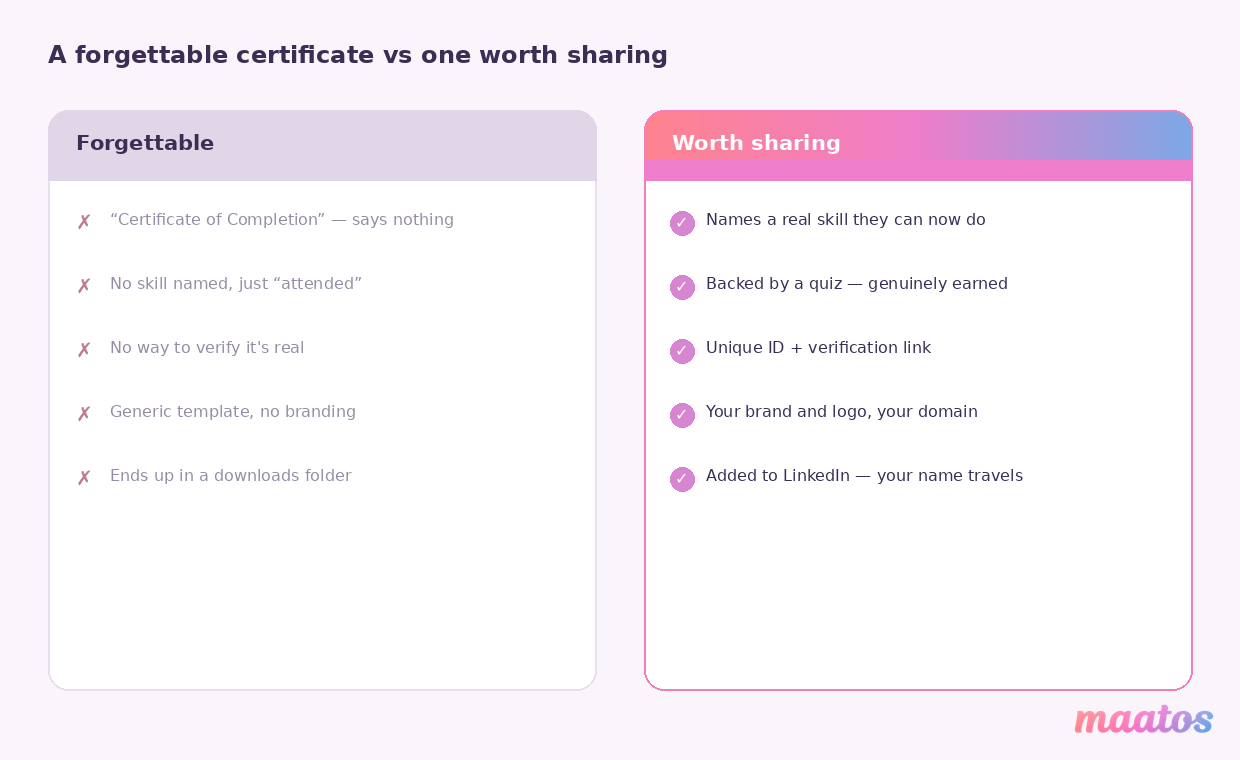
There are a few levels to this, and you can pick the one that fits your course:
At the simplest level, give every certificate a unique ID and keep a record (even a spreadsheet) of who earned what and when. If someone asks “is this real?”, you can answer. It’s low-tech but it already puts you ahead of most solo creators.
A step up is a verification page or link — a URL that shows the certificate is genuine, ideally hosted on your own site. This is what turns “trust me” into “click here.” Platforms that issue certificates automatically usually handle the record-keeping for you, which both saves you the manual work and makes the credential more trustworthy because completion was tracked, not self-declared.
At the top end sit verifiable digital credentials — think the Open Badges standard, a widely-used open format for digital badges that carry their own tamper-evident proof of who issued them and for what. You don’t need this for a small course, but it’s worth knowing the direction the whole field is moving: away from static files, toward credentials that verify themselves.
Verifiability also opens up the other thing students want — shareability. The place most people show a course credential today is LinkedIn, in the Licenses & certifications section of their profile (and, if they’re smart, pinned to the Featured section, which gets far more views). A certificate that’s specific, dated and verifiable is one a student will actually add there; a vague, unverifiable one they quietly won’t. And every time they do, your course name appears in front of their network. That’s the quiet payoff of getting this right: your students’ pride in the credential becomes your marketing.
One honesty check while we’re here: a certificate of completion is not the same as an accredited or regulated qualification, and you shouldn’t imply it is. If your field has formal accreditation or legal requirements around what you can call a credential, get that right first — we’ve written separately about issuing courses and certificates legally, and it’s worth a read before you promise anything you can’t back up.
The common threads that make certificates appealing
Step back from the individual examples and the certificates students value share a handful of traits. Worth checking yours against all four.
They offer targeted expertise for a specific outcome. Each strong credential hones in on a well-defined skill directly useful for a role or task, so students feel their time converts into real capability rather than a vague “I learned some stuff.” Precision beats breadth.
They fit a busy life. Flexible, often fully-online or hybrid delivery lets people study around work and family without feeling they’ve compromised on quality. That accessibility is a feature of the credential, not just the course — students choose programmes they can actually finish.
They carry credibility that boosts employability. A recognised, verifiable certificate is tangible proof of specific training, and it complements (rather than competes with) formal qualifications by highlighting current, practical skills. Credible is the operative word — see the verification section above.
They track what the market actually wants. The best credentials evolve with their field, updating as tools and standards change, so a graduate stays relevant. If your subject moves quickly, plan to refresh both the course and the certificate’s stated outcome rather than letting it drift out of date.
None of this requires a university behind you. It requires you to be specific, current, credible and easy to share — all of which a solo creator can absolutely pull off.
How to create and issue a certificate with Maatos
If you build and sell your course on your own platform, issuing a proper certificate is a feature you switch on, not a project you outsource. This is exactly the kind of thing Maatos is built for: it’s a tool for creating your own branded course website and running the whole thing — lessons, payments, students and certificates — in one place, on a domain that’s yours.
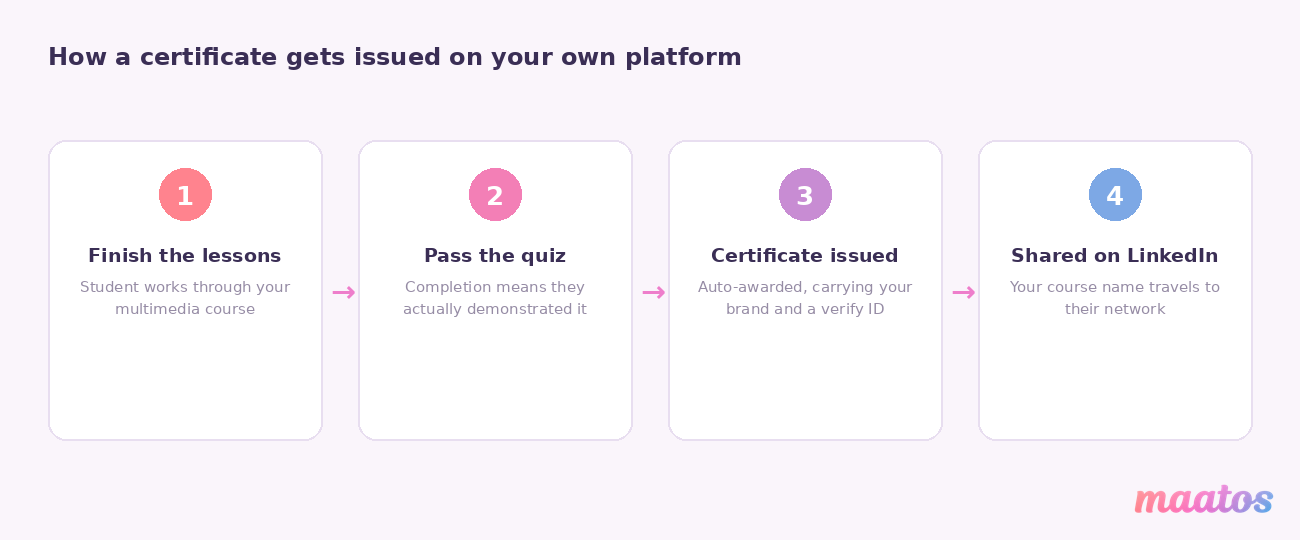
In practice, issuing a certificate students value looks like this. You build the course with a drag-and-drop editor and multimedia lessons — no coding — so the experience already feels professional. You add quizzes and questions so completion means the student actually demonstrated something, not just clicked “next” to the end; that’s what gives the certificate its weight. When a student finishes, Maatos lets you create a course certificate and award it to participants who’ve completed the course — carrying your branding, on your domain, so the credential unmistakably comes from you rather than getting lost in a generic marketplace. Student management gives you a single overview of who’s enrolled, who’s progressing and who’s finished, so you know exactly who’s earned it and where people get stuck along the way.
Because it’s your own platform, the commercial side stays in your hands too. Maatos integrates with both Stripe and Mollie, so students can pay by card, Apple Pay, Google Pay or a range of local methods, and you get paid directly — Maatos takes a 0% platform commission (you still pay your payment provider’s standard transaction fee, but there’s no extra cut on top). VAT is calculated automatically and invoices are sent for you, which quietly removes a real admin headache. Plans start at €49/month excl. VAT with a 30-day free trial and no card required, so you can build the whole thing — course, quizzes and certificate — and see it working before you pay anything. If you’d rather not build it yourself, the done-for-you service will set it up for you, and it’s fine to just get in touch with questions first.
The point isn’t the feature list — it’s that owning the platform means the certificate is genuinely yours: your brand, your verification, your relationship with the student, and no marketplace standing between you and the credential you’ve built. (If you’re weighing that against the cost side of running your own site, our guide to course pricing models that convert and the wider Maatos services are good next reads, as is the rest of the creating courses hub.)
Frequently asked questions
Do online course certificates actually matter?
Yes — when they’re specific and verifiable. Learners use them as proof of a current, practical skill, and employers increasingly treat a verifiable online credential as a legitimate signal, particularly for role-specific abilities. A vague, unverifiable “certificate of completion” matters much less than one that names a real skill and can be checked.
What should a course completion certificate include?
The student’s name, the exact course title, the specific skill or outcome they can now demonstrate, the completion date, you or your brand as the named issuer, a unique verification ID, and a clean, professional design (ideally with a genuine signature). The skill statement and the verification ID are the two elements creators most often skip and the two that matter most.
How do I make my certificate credible and not look fake?
Make it verifiable. Give every certificate a unique ID and keep a record of who earned what, ideally with a verification link on your own site. Put a real, demonstrated outcome on it (back it with a quiz or project, not just video views), add your branding, and date it. Verifiable and specific beats pretty every time.
Can students add my course certificate to LinkedIn?
Yes. Students add credentials in the Licenses & certifications section of their LinkedIn profile, and many pin standout ones to the Featured section for more visibility. A specific, dated, verifiable certificate is one they’ll actually add — which puts your course name in front of their professional network for free.
Should I offer a certificate for a free course?
You can, and it’s a good completion motivator, but keep the claim honest — a free intro course should award a certificate that reflects what was actually covered. Save your strongest, most detailed credential (with assessment behind it) for your paid, in-depth courses so the certificate’s value tracks the effort.
Does Maatos let me issue certificates?
Yes. Maatos lets you create a course certificate and award it to participants who complete your course, on your own branded platform. Combined with quizzes to verify learning and student management to track who’s finished, you can issue credentials that are genuinely earned rather than automatic.
Is a certificate of completion the same as an accredited qualification?
No. A certificate of completion confirms someone finished your course; an accredited or regulated qualification is recognised by an official body and often carries legal weight. Don’t imply one is the other. If your field has accreditation or legal requirements, sort that out first — see our guide on issuing courses and certificates legally.
Your certificate is a small promise — make it one you can keep
A certificate students care about isn’t a design problem, it’s a substance problem. Name a real skill, make it verifiable, put your brand on it, and give students something they’ll be proud to share — and the credential at the end of your course starts pulling its weight, motivating people to finish and quietly marketing you every time it lands on a profile.
When you’re ready to build one into your own course, you can start free on Maatos and have the course, the quizzes and the certificate working before you pay a cent.