

The first time you sell a course to someone in another EU country, nothing dramatic happens. The money lands, the student gets access, and you get on with your day. The awkward part arrives months later, when you try to work out whether the €97 you charged a buyer in Lisbon included Portuguese VAT, Dutch VAT, or no VAT at all — and whether anyone is owed the difference.
Here is the short version. For most online courses sold to consumers in the EU, VAT is due in the buyer’s country, at that country’s standard rate, and you report it through the One Stop Shop. Standard rates run from 17% in Luxembourg to 27% in Hungary. Sell to a business in another EU country that gives you a valid VAT number, and you charge nothing and reverse-charge instead. The education exemption exists, but it was written for schools and accredited training providers, and a self-paced video course almost never qualifies.
Everything below is the long version: who has to register and when, the four different €-thresholds that people constantly mix up, what actually counts as a “digital service”, the 2026 rate for every member state, and the parts of this that a platform can genuinely take off your plate.
A word before we start. We build course platforms, not tax returns. This is a practical explanation of how the rules work, not advice for your situation, and your own tax authority has the final say. For anything that touches your numbers, talk to an accountant who knows digital services. Every rule below is current as of 17 September 2026, and the load-bearing ones link to the legislation or to the Commission’s own guidance so you can check them yourself.
Why EU VAT on courses is genuinely confusing, and not just badly explained
VAT on online education is hard because two sets of rules sit on top of each other and disagree.
The first is the EU layer: the VAT Directive and its implementing regulation, which decide *where* a sale is taxed and whether your course is a “digital service” at all. Those rules are the same in all 27 countries, and they are the reason a Dutch seller can end up owing Portuguese VAT.
The second is the national layer. Each country sets its own rates and — crucially — decides which providers count as exempt education. EU law actually *requires* member states to exempt public-interest education; what it leaves to them is the part that matters, namely which organisations they recognise as providing it. So Germany, Ireland and Poland each drew the line somewhere different, and a course that is exempt in one of them can be fully taxable in the next.
The practical result is that three things vary by country: the rate, the exemption criteria, and how strictly the tax office reads them. What *doesn’t* vary is the place-of-supply rule. That is the one you can actually build a process around, and it’s where we’ll spend most of our time.
One more thing that trips people up: this has nothing to do with income tax. VAT is money you collect on behalf of a government and pass on. It isn’t yours, it isn’t revenue, and it shouldn’t feel like a cost — though it does change what you can charge, which we’ll come back to.
Can you sell an online course as a private individual?
You can technically take a payment the moment a payment provider is connected to your academy. Whether you *should* sell as a private individual rather than a registered business is a different question, and in most countries the answer stops being yes quite quickly.
The rough shape of it, which holds across most of Europe:
- A one-off sale with no profit intent often doesn’t require you to register a business at all. Selling a recording of a talk you gave once is not a trade.
- Regular sales with profit intent are a business, whatever you call them. Tax offices look at repetition, intent and scale, not at whether you’ve filled in a form.
- Income is declarable either way. Not being registered doesn’t make the money invisible to your tax return.
The catch is that if you’re not registered for VAT you can’t charge it — and you can’t reclaim it either. Worth being precise here, because the wording misleads people: VAT turns on whether you’re a *taxable person* carrying on an independent economic activity, not on whether you’ve filled in a form. Trade regularly enough and you may be *required* to register whether or not you ever set up a business entity. Once you are registered, the costs of the thing you just built (camera, microphone, editing software, platform subscription, the designer who made your landing page look like it wasn’t made at 2am) become deductible. For most people that flips the maths towards registering within the first few months.
There’s also a practical wall. Serious payment providers want a registered business before they’ll onboard you properly, and so does anyone buying from you on a company card. Registering a sole trader is usually a same-week, low-cost job. It is rarely the thing worth putting off.
Is an online course a “digital service”? The answer decides everything
This is the question the rest of the article hangs on, and most guides skip it.
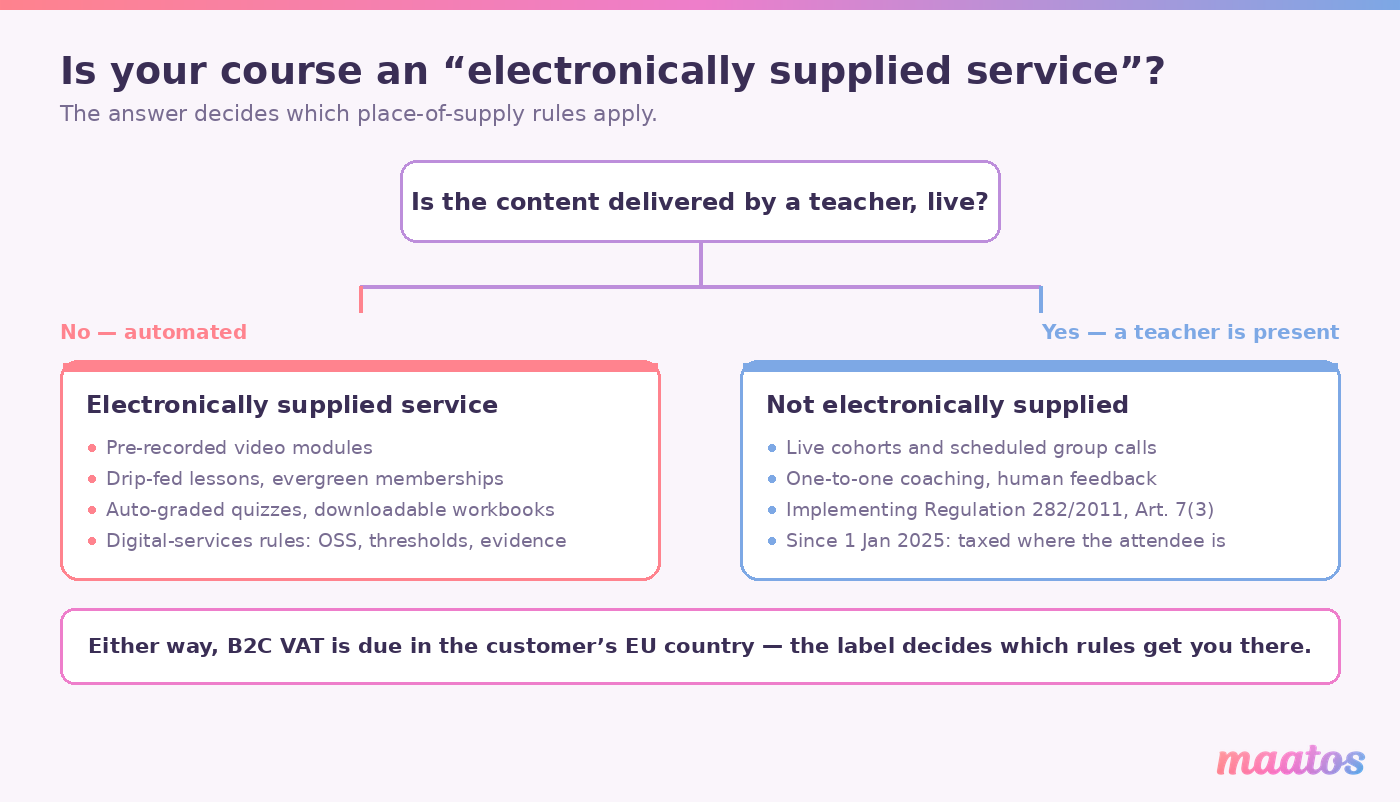
Under EU VAT law, a service is *electronically supplied* when it’s delivered over the internet, is essentially automated, needs minimal human intervention, and couldn’t exist without the technology. A pre-recorded video course with auto-graded quizzes is a textbook example.
But the implementing regulation is explicit about the other side of it. Teaching is not an electronically supplied service where the course content is delivered by a teacher over the internet. If you show up and teach, the internet is the delivery pipe, not the product. Automated distance learning that depends on the internet to function is a digital service; a live lesson over a video call is not.
So you have two categories, and a lot of real courses sit across both:
Usually a digital service (automated): pre-recorded video modules, downloadable workbooks, drip-fed lessons, evergreen memberships, automatically marked quizzes, anything a student can buy and complete at 3am without you knowing it happened.
Usually not a digital service (a teacher is present): live cohorts, scheduled group calls, one-to-one coaching, workshops you actually run, feedback and assessment that a human gives.
Why does the label matter if both end up taxed in the buyer’s country anyway? Two reasons. Automated courses fall under the digital-services regime with its thresholds, evidence rules and OSS mechanics. Live teaching follows different place-of-supply articles, and until recently that meant live online events were sometimes taxed where *you* were. That changed.
Live and hybrid events: what changed on 1 January 2025
Since 1 January 2025, virtual attendance at an event is taxed where the attendee is, not where the event is held or streamed from. Council Directive (EU) 2022/542 amended Article 54 so that where services are streamed or otherwise made virtually available to a consumer, the place of supply is where that consumer lives. For business attendees, virtual admission was carved out of Article 53 and falls back to the general B2B rule, which also lands on the customer’s country.
For anyone running live cohorts or paid webinars across borders, the practical effect is that the destination principle now covers essentially your whole catalogue — recorded, live, or the hybrid in between. That’s arguably simpler than what came before, but it did quietly widen the net, and it is the single change most 2023-vintage guides still haven’t absorbed.
If a course of yours mixes recorded modules with live calls, don’t try to split it. A bundle sold for one price is generally treated as a single composite supply, and it follows the character of the whole thing rather than being sliced into parts.
Where is the VAT due, and how much?
For business-to-consumer sales of online courses in the EU, VAT is due in the country where your customer lives, at that country’s rate. That’s the destination principle, and it applies whether you’re in Berlin, Dublin or Denver.
Three things follow from it, and they’re the whole job:
You have to apply the right rate per country — which means the rate has to be in your checkout, not in a spreadsheet you update twice a year. You have to be able to prove where the customer was. And you have to report the VAT to the country it belongs to, which is what the One Stop Shop is for.
The €10,000 threshold (EU-established sellers only)
If your business is established in one EU country and your total cross-border B2C sales of digital services to other EU countries stay under €10,000, you may keep charging your own home country’s VAT on all of them. No OSS, no 27 rates, no drama.
Cross the €10,000 mark and the destination rule takes over from that sale onward, for every country. Most people register for the OSS at that point rather than registering for VAT in each country separately.
Four things about this threshold catch people out, and all four are expensive:
- It’s EU-wide and cumulative, not per country. €4,000 to Belgium and €7,000 to Spain is €11,000, and you’re over.
- It looks backwards as well as forwards. You have to be under €10,000 in the current calendar year *and* have been under it in the previous one. A good year doesn’t reset in January.
- It counts more than courses. Cross-border distance sales of goods go in the same €10,000 bucket, so shipping a printed workbook to another member state eats the same allowance.
- It’s for EU-established sellers only. From outside the EU your threshold is zero: VAT is due on the very first sale to an EU consumer.
You can also opt into destination taxation voluntarily before you hit the threshold — worth doing if you’re close and would rather not switch mid-year — but the choice binds you for at least two calendar years.
And one boundary that almost every guide misses: the €10,000 threshold applies to automated digital services, not to live teaching. Virtual attendance at an event now sits under Article 54, which is outside the threshold provision. So a small seller who is comfortably under €10,000 and correctly charging home-country VAT on recorded courses must still charge the customer’s national VAT from the very first cross-border ticket to a live webinar. If you sell both, the two halves of your catalogue follow different rules at this point.
How the One Stop Shop actually works
The OSS is the good news in all of this. Instead of registering for VAT in every country where you have a customer, you register once, in one member state, and file a single quarterly return. You pay one tax authority, and it distributes the money to the others.
One detail that catches people: the Union scheme return covers your sales into countries where you are *not* established. Sales to consumers in your own country — or in any country where you have a business or fixed establishment — still go on that country’s ordinary domestic VAT return. The OSS sits alongside your normal return, it doesn’t replace it. (For non-EU sellers using the non-Union scheme, there’s no domestic return to worry about, so everything goes through the OSS.)
If you’re established in the EU, you register in your own country (the Union scheme). If you’re outside it, you pick any one EU country and register there (the non-Union scheme). Returns are quarterly and due, with the payment, by the end of the month following the quarter — 30 April, 31 July, 31 October and 31 January. (If you remember a 20-day deadline, that was the old MOSS rule, replaced when the OSS launched in July 2021.)
What the OSS does *not* do is choose the rate for you. It’s a reporting and payment channel. Getting Hungarian VAT right on a Hungarian sale is still your side of the fence, and it’s the part that belongs in software rather than in your head.
Proving where your customer was
Because the rate follows the customer, you have to be able to show where the customer was. The general rule is two items of non-contradictory evidence. The implementing regulation lists what counts: the billing address, the IP address, bank details including the location of the account, the mobile country code of the SIM on a phone purchase, the location of a fixed landline, and other commercially relevant information.
There is a genuine simplification for smaller sellers that’s worth knowing about. Under Article 24b, if your cross-border B2C digital turnover stays under €100,000 in the current and preceding calendar year, one item of evidence is enough. The catch: it has to come from someone other than you or the customer — an IP lookup or the bank — not from something the buyer typed into a form. Like the €10,000 figure, this simplification is written for automated digital services, so don’t lean on it for live sessions.
If you’re in the OSS, keep the underlying records for ten years from the end of the year of the transaction. Outside the OSS you fall under your own country’s retention rules, which are commonly five to seven. Either way it’s long enough that the evidence wants capturing automatically at checkout rather than reconstructing later.
Selling to businesses: the reverse charge
Selling a course to a company in another EU country works differently, and mostly in your favour.
A sale is B2B when the customer is a taxable person, gives you a valid EU VAT identification number, and is buying for their business. When all three hold, the reverse charge applies: you charge no VAT, and the customer accounts for it in their own country. No collection, no remittance, no cash-flow drag.
Validate the VAT number, every time
The reverse charge is only available if the number is valid *at the time of the transaction*. That means collecting it at checkout or onboarding, checking it against the EU’s VIES database, and keeping proof that you checked.
If the number is missing, wrong, or can’t be verified, the sale is a B2C sale and local VAT is due. If you didn’t charge it, the difference comes out of your margin, not the customer’s. This is the most common way a course business quietly loses money on B2B sales: an invalid number accepted at face value, VAT never charged, and a correction two years later.
What a reverse-charge invoice has to say
A reverse-charged invoice needs your VAT number, the customer’s VAT number, and no VAT amount. It also needs the words “Reverse charge” on it — that phrase is the mandatory element under Article 226(11a) of the VAT Directive, not a stylistic choice, and the Court of Justice has held that leaving it off can’t simply be patched up afterwards. Many sellers add the legal basis too (“VAT reverse-charged under Article 196 of the EU VAT Directive”), which is good practice but doesn’t substitute for the two words themselves.
One thing worth saying plainly, because it surprises people: education exemptions rarely help you on B2B sales. Where a national exemption exists, it’s generally aimed at public-interest education delivered to individuals, not at commercial training sold to a company’s L&D budget. Cross-border B2B course sales lean on the reverse charge, not on being “education”.
If you’re selling training into companies, that’s a whole business model of its own — worth reading alongside building an academy for your business, because the VAT treatment is the easy half.
Practically, at your checkout
Separate business buyers from consumers before payment, not after. Validate the number while they’re still on the page. Treat a failed validation as a consumer sale and charge VAT. Keep the records. Four steps, and they remove most of the risk.
The education exemption: real, narrow, and usually not yours
EU law *obliges* member states to exempt educational services that serve the public interest — Articles 132(1)(i) and (j) of the VAT Directive say member states shall exempt them. That sounds generous until you read who qualifies: education provided by bodies governed by public law, or by other bodies the member state concerned recognises as having similar objects, plus private tuition given by teachers covering school or university education. The obligation is EU-wide; the recognition is national, and member states may attach further conditions of their own under Article 133. That is where the variation comes from.
Read that again with a commercial course in mind and you can see the problem. It was drafted for schools, universities and recognised vocational training providers. It was not drafted for a self-paced video course sold from a Stripe checkout.
What tax authorities typically weigh:
Accreditation or formal recognition by a national education authority or professional body — usually the decisive factor. The legal status of the provider: publicly funded, non-profit, or on an official register of education providers. The structure of the course: defined learning objectives, a curriculum, real assessment. Who it’s for: vocational and retraining programmes qualify far more often than hobby and leisure courses.
Delivery method, notably, is mostly *not* decisive. Online, blended and in-person education can all be exempt if the underlying criteria are met. A beautifully produced online course doesn’t qualify just because it teaches something.
Two nuances worth carrying with you. Several countries make the exemption depend on whether interaction between teacher and participant is possible — which is how a purely recorded on-demand course ends up taxable even in a system that exempts the same content taught live. And an exemption in your own country does not travel. A course exempt at home can be fully taxable when sold to a customer two borders away, because the customer’s country applies its own criteria.
So: don’t assume the exemption. Confirm it, in writing, with the relevant authority or an accountant, before you build it into your prices. Undercharging VAT is a bill you pay later out of money you’ve already spent.
VAT rates for online courses in the EU, 2026
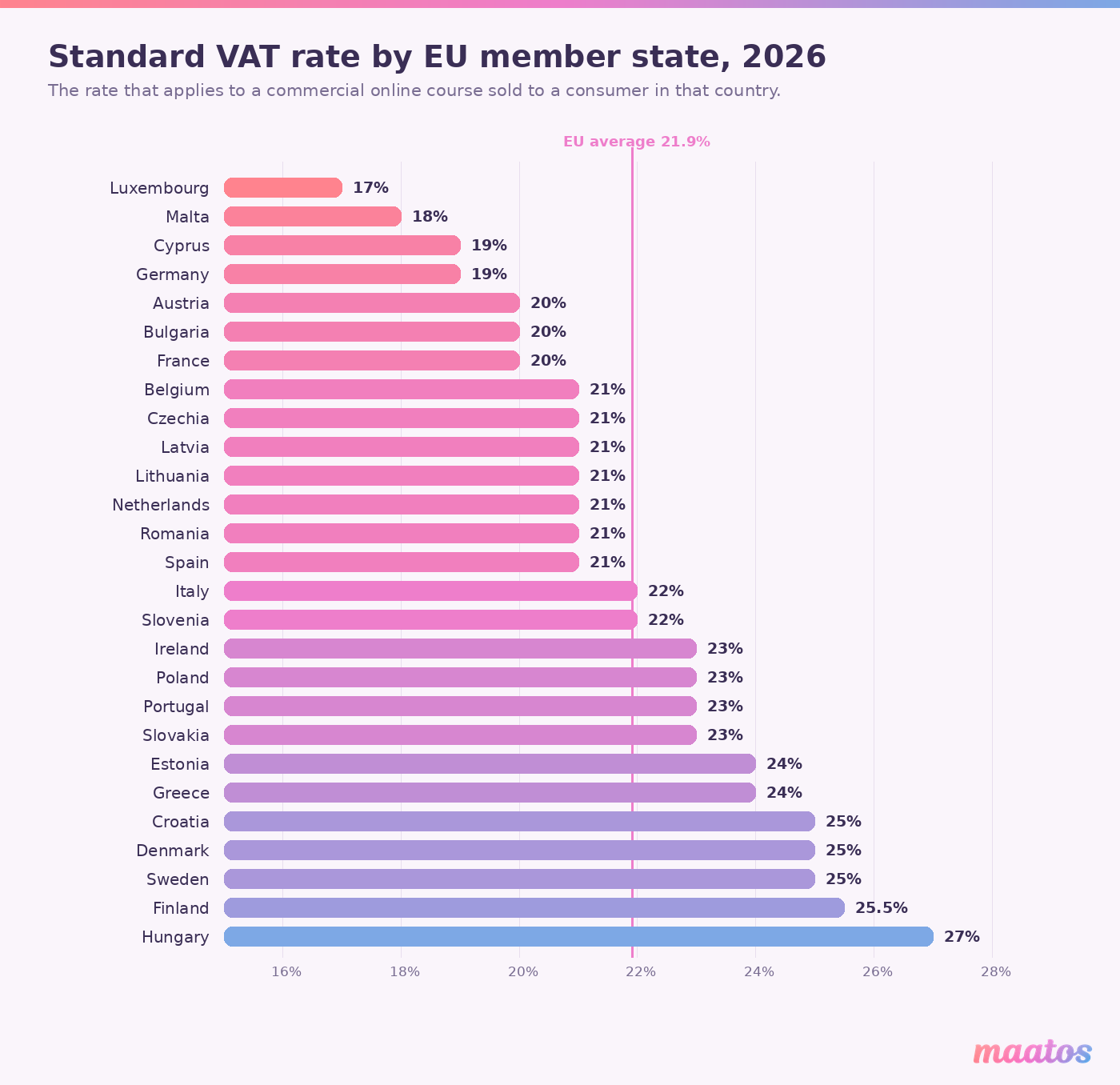
The standard rate is the one that matters for online courses. Reduced rates are real, but they’re written for things like food, books and passenger transport — and as the next section explains, a course is almost never a “digital publication”. So this table gives the 2026 standard rate for each member state, plus a link to our country guide where the local exemption rules and detail live.
Rates below are the standard rates in force at the start of 2026, cross-checked against two separate 2026 datasets that both draw on the Commission’s Taxes in Europe Database. Rates change mid-year; the country pages are where we keep up with them, and your customer’s own tax authority is the final word.
| Country | Standard rate (2026) | Country guide |
|---|---|---|
| Austria | 20% | Austria |
| Belgium | 21% | Belgium |
| Bulgaria | 20% | Bulgaria |
| Croatia | 25% | Croatia |
| Cyprus | 19% | Cyprus |
| Czechia | 21% | Czech Republic |
| Denmark | 25% | Denmark |
| Estonia | 24% | Estonia |
| Finland | 25.5% | Finland |
| France | 20% | France |
| Germany | 19% | Germany |
| Greece | 24% | Greece |
| Hungary | 27% | Hungary |
| Ireland | 23% | Ireland |
| Italy | 22% | Italy |
| Latvia | 21% | Latvia |
| Lithuania | 21% | Lithuania |
| Luxembourg | 17% | Luxembourg |
| Malta | 18% | Malta |
| Netherlands | 21% | Netherlands |
| Poland | 23% | Poland |
| Portugal | 23% | Portugal |
| Romania | 21% | Romania |
| Slovakia | 23% | Slovakia |
| Slovenia | 22% | Slovenia |
| Spain | 21% | Spain |
| Sweden | 25% | Sweden |
Three standard rates have moved since the start of 2025, and if your checkout was configured before that, these are the ones to check: Slovakia went from 20% to 23% on 1 January 2025, Estonia from 22% to 24% on 1 July 2025, and Romania from 19% to 21% on 1 August 2025 (also folding its 5% and 9% brackets into a single 11% reduced rate). Finland trimmed a *reduced* rate from 14% to 13.5% for 2026, which is a change you’ll see quoted elsewhere but which doesn’t touch courses. Hungary remains the EU’s highest standard rate at 27%; Luxembourg the lowest at 17%.
Selling into Germany specifically? There’s a second, non-tax hurdle that catches training providers off guard — ZFU registration for distance-learning courses — and it has nothing to do with VAT. Selling into Belgium? Structured e-invoicing is now a live obligation there; we cover it in using Peppol in Belgium.
What a ten-point rate spread does to your pricing
Here’s the part almost nobody writes about, and it’s the part that actually affects what you earn.
If you show one price to everyone — €97, the same in every country — then VAT comes out of that price, and the amount left over changes with the buyer’s location. At Luxembourg’s 17%, a €97 gross sale leaves you €82.91. At Hungary’s 27%, the same €97 leaves you €76.38. Same course, same checkout, €6.53 less in your pocket, roughly 8% of your net.
You have three honest options.
Show one gross price everywhere and absorb the difference. Simplest, kindest to conversion, and the most common choice for consumer courses. Just price with the spread in mind rather than pricing off your home rate and being surprised.
Show prices excluding VAT and add it at checkout. Standard for B2B, where buyers reclaim it anyway and expect the ex-VAT number. Poor for consumers, who read it as a price rise at the worst possible moment.
Set a net price and let the gross vary by country. Protects your margin exactly, at the cost of a Hungarian buyer paying more than an Austrian one for the same thing. Defensible, occasionally awkward.
None of these is wrong. What *is* wrong is not knowing which one your checkout is doing. If you’re revisiting your numbers anyway, our guide to course pricing models that convert covers the rest of that decision, and payment plans for online courses covers what happens when a single sale becomes several instalments.
The small-business route most course creators have never heard of
Since 1 January 2025 there’s a genuinely new option, and it’s the most useful thing in this article for anyone still in their first year or two.
The EU’s SME scheme lets a small business sell VAT-exempt not only at home, but in other member states too. Before 2025, a national small-business exemption stopped at your own border: a French seller could use France’s exemption and you, selling into France, could not. Once you passed €10,000 you were into the destination rules while your French competitor was still exempt. That asymmetry is gone.
How it works, from the Commission’s own SME portal:
The ceiling is €100,000 of total annual turnover across all 27 member states, in the current and the previous calendar year. Go over it and the exemption stops. Separately, each member state sets its own national threshold, capped at €85,000, and your sales in any one country can’t exceed that country’s domestic threshold.
You register once, in your member state of establishment, and receive a single identifier — an “EX” number — that works in every country where you use the exemption. Instead of VAT returns you file one quarterly report of your turnover per member state. Invoicing is simplified too.
Three conditions to be clear about. The scheme is optional — you choose it, and choosing it means giving up the right to deduct VAT on your costs, which is a bad trade if you’re buying a lot of equipment. It only works in countries that have actually implemented it in national law. And it is only for businesses established in the EU: the Commission states explicitly that businesses in the United Kingdom, including Northern Ireland, count as non-EU here.
Don’t confuse this €100,000 with the other one. The Article 24b figure is about how many pieces of *location evidence* you need. This one is about whether you charge VAT at all. Different rules, same number, endless confusion.
Selling into the EU from outside it
If your business is established outside the EU — the UK, the US, Canada, Australia, anywhere — the rules are simpler and stricter.
There is no threshold. The €10,000 allowance is for EU-established sellers only, and the SME scheme is closed to you. VAT is due on your first sale to an EU consumer, at that consumer’s national rate.
The mechanism is the non-Union OSS: pick any one EU member state, register there, charge each customer their own country’s rate, and file a single quarterly return. You don’t need an establishment in the EU to do it.
B2B works the same as it does for everyone: get a valid VAT number, validate it, reverse-charge, keep the proof.
UK sellers have the extra wrinkle that Brexit put EU VAT and UK VAT on separate tracks, each with its own registration, thresholds and rules — we cover the UK side in selling online courses in the UK and VAT.
Do reduced rates ever apply to a course?
Occasionally, but much less often than people hope, and the reason is worth understanding.
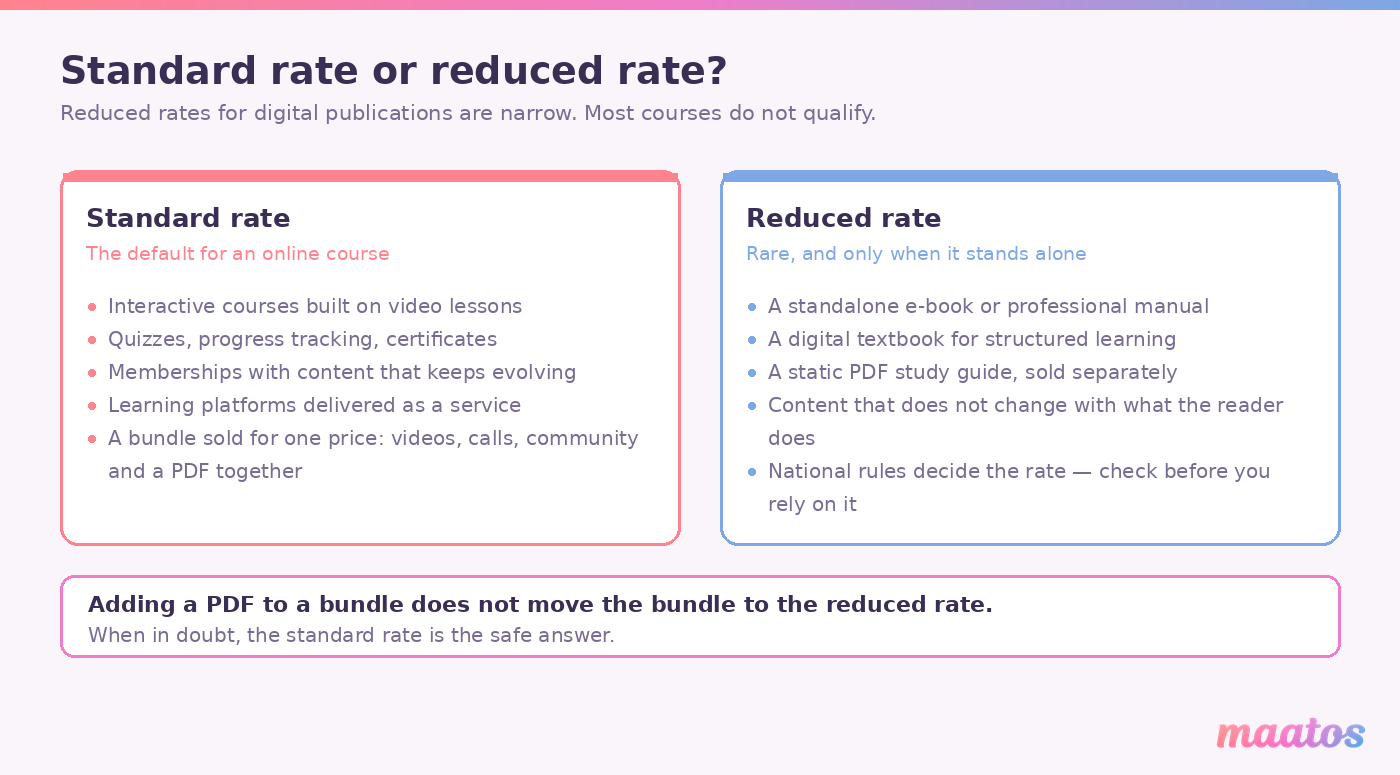
EU law lets member states apply reduced rates to digital publications, so that an e-book isn’t taxed more heavily than the paper book beside it. Where that applies, it typically covers products that are textual, static and publication-like: standalone e-books and professional manuals, digital textbooks, downloadable study guides and PDFs whose content doesn’t change based on what the reader does.
What generally falls outside it: interactive courses built around video, quizzes and progress tracking; memberships giving ongoing access to content that keeps evolving; learning platforms where the content is delivered as a service; and anything with a substantial audiovisual component, even with written material attached. Those are electronically supplied services, and they get the standard rate.
The trap is the bundle. If you sell videos, live sessions, community access and a downloadable workbook for one price, that’s generally one composite supply, and the presence of a PDF doesn’t drag the whole thing down to the reduced rate. A reduced rate belongs only to a digital product that genuinely stands alone as a publication — sold separately, priced separately, capable of existing on its own.
When in doubt, the standard rate is the safe answer. Charging too much VAT is an awkward conversation; charging too little is an invoice from the tax office.
If selling standalone materials alongside your course is something you’re considering, selling digital downloads alongside courses walks through how that works in practice.
What’s coming: ViDA, and why you don’t need to panic
The EU adopted its VAT in the Digital Age package on 11 March 2025 — Directive (EU) 2025/516 plus an accompanying regulation and implementing regulation. It’s a ten-year programme, and the headlines for a course business are:
1 July 2028 — single VAT registration expands, reducing the cases where you need a local registration in another member state, alongside new deemed-supplier rules for certain platforms (member states may defer that platform piece to 1 January 2030).
1 July 2030 — structured e-invoicing and near-real-time digital reporting go live for cross-border B2B transactions.
1 January 2035 — member states with their own domestic real-time reporting align to the EU standard.
Nothing here changes what you do this quarter. The direction of travel is clear enough, though: fewer separate registrations, more structured data, less tolerance for invoices assembled by hand. Belgium’s e-invoicing mandate is an early preview of that world, and it lands alongside the other shifts reshaping this market — the ones we track in the digitisation of education.
What Maatos handles, and what it doesn’t
Let’s be specific rather than reassuring, because this is exactly the kind of section where software companies overpromise.
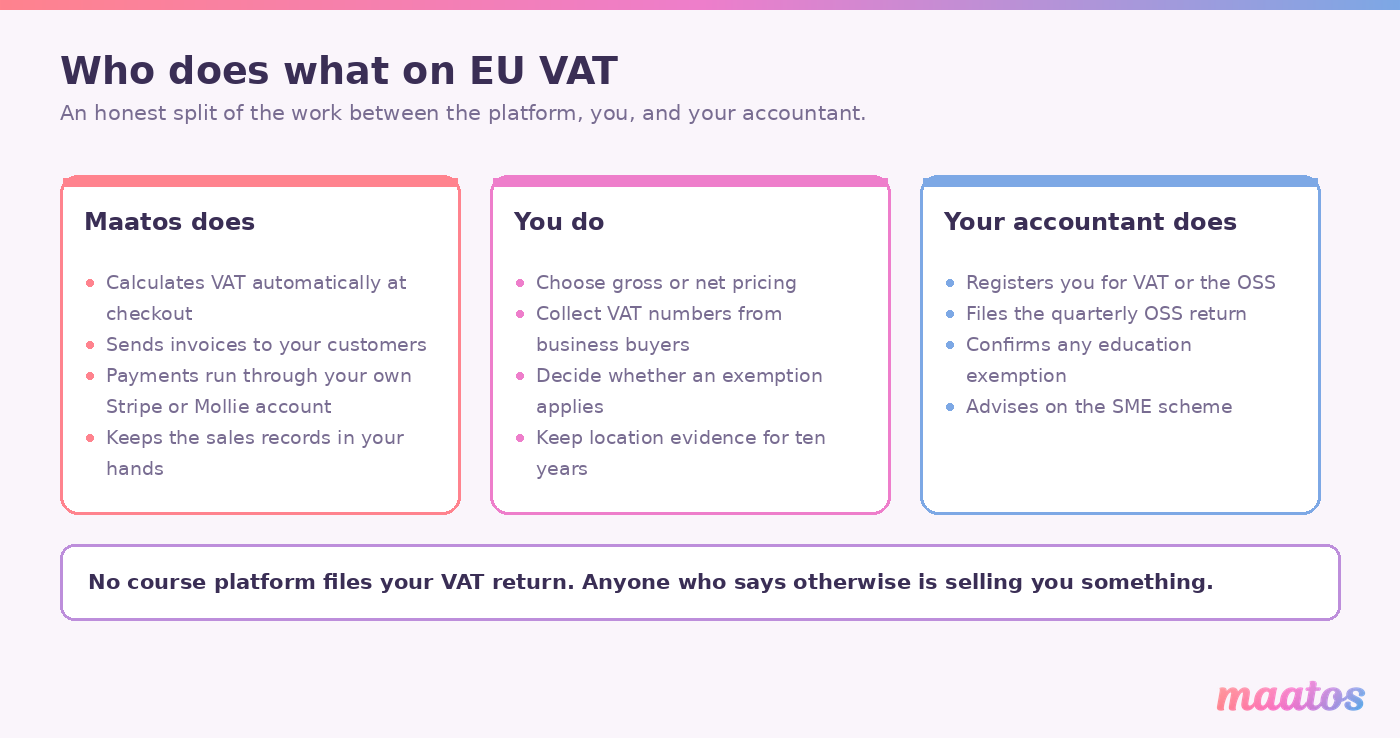
What the platform does. Maatos calculates VAT automatically and sends invoices to your customers without extra work on your side — that’s the part that otherwise eats an afternoon a month and generates most of the errors. Payments run through your own Stripe or Mollie account, so the money and the transaction records are yours from the start, not a platform’s to pass on later. Students can pay by card, Apple Pay, Google Pay and local methods depending on their country. Every plan includes unlimited video storage and no limit on student numbers; the number of *courses* does depend on the plan, with Basic covering up to three.
What it doesn’t do, and we’d rather say so. We don’t register you for VAT and we don’t file your OSS return. We don’t decide for you whether a sale is B2B, whether an exemption applies, or whether you’ve crossed a threshold. You configure your VAT settings to match your situation and you get clear overviews of what you’ve sold; turning those into a filed return is an accountant’s job, and so is the advice about which scheme you should be in. Anyone telling you a course platform files your VAT returns is selling you something.
Why owning the stack matters here. When VAT rules move — and they moved in 2025 and will move again in 2028 — you want to be somewhere you can change a price, a tax setting or an invoice template yourself, on your own domain, with your own payment account. That’s a different position from renting space on a marketplace that decides for you. It’s the argument we make in the long-term benefits of owning your course website, and tax is where it gets concrete.
If you’d rather not build any of it yourself, our done-for-you service builds the platform and the design for you, and the wider services page covers what else we can take on. Plans start at €49 per month excluding VAT (or €40.83 a month billed annually), and every plan starts with 30 days free — the current breakdown is on the pricing page.
For the day-to-day mechanics of charging tax in your own shop rather than the law behind it, how to handle VAT and sales tax for digital courses is the operational companion to this piece, and setting up Stripe for courses without the usual pitfalls covers the payment side. If you’re weighing up how any of this fits a growing catalogue, the rest of the selling courses hub is next door.
Frequently asked questions about EU VAT on online courses
Are online courses subject to VAT in the EU?
Yes, in most cases. A commercial online course is normally treated as a taxable service, at the standard rate of the customer’s country. The education exemption exists but requires formal recognition or accreditation under national rules, which a self-paced course sold by an independent creator rarely has.
How much VAT do I charge on an online course in the EU?
The standard rate of the country where your customer lives, for consumer sales — between 17% (Luxembourg) and 27% (Hungary) in 2026. If your business is EU-established and your cross-border B2C sales stay under €10,000 a year, you may charge your own country’s rate instead.
Is VAT based on where I am or where my customer is?
Your customer’s. For B2C sales of online courses in the EU, the place of supply is the customer’s country, so their national rate applies and the VAT is owed to their tax authority. The main exceptions are the €10,000 threshold for EU-established sellers and the SME scheme.
Do I have to register for VAT in every EU country?
No. The One Stop Shop lets you register in one member state and file a single quarterly return for your cross-border EU B2C sales. EU-established sellers use the Union scheme in their own country — sales to consumers at home still go on the ordinary domestic return — while non-EU sellers pick any member state and use the non-Union scheme. Returns are due by the end of the month after each quarter.
Do I charge VAT when I sell a course to a company in another EU country?
No, provided the customer gives you a VAT number that is valid at the time of sale. You reverse-charge instead: no VAT on the invoice, an explicit reverse-charge statement on it, and the customer accounts for VAT at home. If the number can’t be validated, treat it as a consumer sale and charge VAT.
What is the new EU SME scheme, and can I use it?
It’s an optional scheme, live since 1 January 2025, that lets a small business sell VAT-exempt in other member states as well as at home. You need total EU-wide turnover of €100,000 or less, an establishment in the EU, and a member state that has implemented it. You get an “EX” number and file one quarterly report. Choosing it means giving up VAT deduction on your costs.
Do reduced VAT rates apply to online courses?
Almost never. Reduced rates for digital publications are aimed at e-books and static digital textbooks. An interactive course with video, quizzes and progress tracking is an electronically supplied service and takes the standard rate — and a bundle isn’t reduced-rated just because it includes a PDF.
Can my online course be VAT-exempt as education?
Only if it meets the national criteria in the customer’s country, which usually means accreditation, recognised provider status, or qualifying private tuition. Some countries also require that interaction between teacher and participant is possible, which rules out purely recorded courses. Exemption at home does not extend to sales abroad.
Does VAT apply to live online courses and webinars?
Yes. Since 1 January 2025, virtual attendance at an event is taxed where the attendee is. Live teaching is not an “electronically supplied service” in the technical sense, but the place of supply still lands in the customer’s country for both consumers and businesses.
Do I need to charge EU VAT if my business is outside the EU?
Yes, from the very first sale. Non-EU sellers get no threshold and can’t use the SME scheme. Register for the non-Union OSS in any one member state, charge each consumer their own country’s rate, and file quarterly.
How long do I need to keep VAT records?
Ten years for the customer-location evidence behind digital-services sales. That’s long enough that it needs to be captured automatically at the point of sale rather than reconstructed from old invoices.
What happens if I charge the wrong VAT rate?
You’re liable for the difference, not your customer. If you undercharged, the shortfall comes out of your margin, potentially with interest and penalties. That’s why the rate belongs in your checkout and the evidence belongs in your records — both automatically.
A short checklist before you sell across borders
Work out whether each product is automated or teacher-led, and write it down. Decide whether you show gross or net prices, and make the checkout match. Find out where you sit against the €10,000 threshold — remembering it covers automated courses but not live sessions — and check whether the SME scheme is a better fit than the OSS for your first couple of years. Get VAT-number collection and validation into your checkout before you make your first B2B sale, not after. Make sure location evidence is captured automatically and retained for ten years. And have one conversation with an accountant who has done this before — an hour of their time is cheaper than a correction.
Then go back to making the course. That’s the part only you can do.
Ready to sell from a platform you actually own? Start your 30-day free trial and build your course site on your own domain, with your own payment account and automatic VAT and invoicing from day one. Want to see the whole feature set first? Take a look at what’s included.