


In June 2025 a German business mentor lost a court case they had probably never expected to be in. They had sold a nine-month mentoring programme for €47,600, to a buyer who was most likely acting as an entrepreneur, with online meetings, recorded videos and a Facebook group for questions. The Federal Court of Justice ruled that the programme was distance learning under German law, that it needed state approval it never had, and that the contract was therefore void. The mentor had to pay back everything received so far: €23,800.
If you sell online courses or coaching to people in Germany, that ruling is about you too. The short answer: if your offer is paid, mostly delivered at a distance (recordings count) and gives your learners any way to have their progress checked, even just the right to ask you questions about the material, Germany’s Distance Learning Protection Act (Fernunterrichtsschutzgesetz, FernUSG) probably applies. Then the course needs approval from the ZFU (Staatliche Zentralstelle für Fernunterricht) before you sell it, and since 2025 that also goes for courses sold to businesses, not only to consumers.
There is a twist this autumn. In August 2026 the German education ministry published a draft bill to scrap the approval requirement from 1 July 2027 and repeal the whole law on 30 June 2028. It is a draft. Today, the law applies in full, and the ZFU says so on its own FAQ page.
This guide walks you through when the law applies, what approval costs (with the official fee schedule, not a guess), what happens if you skip it, what changes if the repeal goes through, and which choices are realistic for a small course business. Every legal statement is based on the law, the court decision or the authority’s own page, all checked on 8 October 2026 and listed at the end. It is not legal advice: if Germany matters to your business, have a German lawyer look at your specific offer.
What is the ZFU and why does it exist?
The ZFU is the authority that supervises and approves distance-learning courses under the FernUSG on behalf of all sixteen German states. It is based in Cologne and, according to its own key figures page, works with 658 providers and 4,960 distance-learning courses and degree programmes.
The FernUSG dates from 1976 and was written with a clear consumer-protection goal. The lawmakers assumed that people who learn remotely are in a weaker position than people in a classroom. They cannot easily judge the quality of a course in advance, they see little of the teaching method, and they usually pay before they know whether the content and the support live up to the promise.
To fix that imbalance, Germany chose a stricter route than most countries: control before the sale. Certain courses must be reviewed and approved before they may be sold. In practice, ZFU oversight is meant to make sure that a distance-learning offer:
- describes its content, scope, workload and duration clearly and accurately
- uses fair, transparent contract terms that respect the law
- avoids misleading promises, particularly about results, certificates or income
- gives learners predictable learning conditions and clear cancellation rights
The ZFU does not judge whether your course is good or bad. It checks whether the offer is transparent, consistent and fair to the learner, and whether the teaching plan can actually deliver the stated goal.
So ZFU approval is not a quality label, an accreditation or a voluntary certificate, whatever some approved providers suggest in their marketing. Approval does not mean the German state endorses your content or guarantees outcomes. It is a legal precondition: if your course falls under the FernUSG, you may not sell it without one.
When does an online course fall under the FernUSG?
Section 1(1) of the FernUSG defines distance learning as the paid teaching of knowledge and skills on a contractual basis, where teacher and learner are exclusively or predominantly separated in space, and where the teacher or someone on their behalf monitors the learning success. All three elements must be present. If one is missing, the law does not apply.
What makes the test tricky is that courts and the ZFU look at how your offer works in practice, not at what you call it. Here is each element, with what the courts have said about it since 2025.
1. Knowledge or skills are taught for payment
This element is deliberately broad. It covers any paid offer whose main purpose is to pass on knowledge, skills or competences. In practice that includes:
- online courses and training programmes
- structured coaching or mentoring programmes
- skill-based education delivered digitally
- programmes that promise professional, personal or business development
The subject does not matter, whether it is technical, creative, personal or business. Neither does the name. Calling something a “course”, “bootcamp”, “mastermind”, “mentoring” or “coaching programme” does not change what it is if the substance is teaching.
There is one real limit, and it matters for coaches. In January 2026 the Federal Court of Justice (BGH) held that whether a coaching or mentoring contract falls under the law “cannot be answered in the abstract” (III ZR 80/25, ECLI:DE:BGH:2026:150126UIIIZR80.25.0). It depends on whether the focus of the contract is teaching knowledge and skills, or individual advice and support. A one-to-one coach who mainly helps a client think through their own situation is in a different position from a “coaching programme” built around modules, videos and assignments.
2. Teacher and learner are mostly separated
The second element is about how you deliver. For a classic self-paced video course it is always met. For live online teaching it is more nuanced than the old version of this article said, because the BGH has drawn a line in a series of decisions since 2025.
In the June 2025 ruling (III ZR 109/24) the court held that online teaching involves spatial separation “at least when asynchronous teaching outweighs” the live part. Recorded videos and downloadable material count as asynchronous, and so do recordings of live sessions that make attending live unnecessary.
In February 2026 the court went one step further the other way (III ZR 137/25): when teaching runs through real-time, two-way communication in which the learner can reach the teacher as easily as in a classroom, there is no spatial separation in the sense of the law. But it is not just a matter of counting hours. In III ZR 73/25 (12 February 2026) the court said the content and weight of the live and recorded parts also count, and that a provider cannot shift the balance simply by adding lots of video calls. Recordings that make attending live unnecessary count as recorded teaching. In III ZR 142/25 (7 May 2026) it again sent a case back to establish the ratio.
The ZFU explains its approach on its FAQ page for providers: it compares teaching hours, and if the distance parts (recordings, on-demand video, one-way livestreams without interaction) outweigh live two-way teaching, there is separation; in exceptional cases the content weight decides. Recordings count as distance parts when they can be watched at any time and make attending live unnecessary. So a cohort programme with weekly live calls is not automatically safe. If you also publish the recordings and a video library, the scales can tip.
3. Learning success is monitored
This is the element most course creators misjudge, and since 2025 it is clearly where most online courses get caught.
Monitoring learning success does not require exams, grades or certificates. The BGH confirmed in 2025, following its own 2009 decision (III ZR 310/08), that the term is interpreted broadly. It is enough that the learner has a contractual right to an individual check of what they have learned, for example by asking the teacher questions about the material. A single check is enough. In the mentoring case, the right to ask questions in online meetings, by email and in a Facebook group was sufficient.
Typical examples that meet this element:
- mandatory homework, exercises or tasks
- assignments you review or correct
- personal written, spoken or recorded feedback on a learner’s progress
- quizzes and tests, including multiple-choice quizzes graded automatically by your learning platform
- certificates based on performance or a passed check
- coaching programmes where progress is checked against agreed goals or milestones
- a promised Q&A channel (live chat, email, a community group) where learners can ask you about the content
What matters is not how intensive the checking is, but whether the learner is entitled to it. If participants can submit work, get feedback on it, pass checkpoints or ask you questions about the material, this element is very likely met.
That has an awkward consequence: the things that make an online course good are exactly the things that trigger the law. Well-designed practice exercises with feedback are one of the best ways to help people actually learn, and in Germany they are also one of the clearest signs of monitoring.
If all three elements are present, your offer is distance learning under the FernUSG and needs ZFU approval before you sell it in Germany.
Does the law also cover coaching sold to businesses?
Yes. For decades many providers assumed the FernUSG only protected consumers, so a programme sold to entrepreneurs, freelancers or companies was outside it. The BGH ended that in June 2025: the law applies “not only to consumers within the meaning of section 13 of the Civil Code, but also to entrepreneurs within the meaning of section 14” (III ZR 109/24, headnote b).
The court has decided a run of cases on online coaching and mentoring since:
| Decision | Offer | Outcome |
|---|---|---|
| III ZR 109/24, 12 June 2025 | 9-month business mentoring programme, €47,600 | No approval, contract void, provider must repay €23,800 |
| III ZR 173/24, 2 October 2025 | “E-Commerce Master Club”, €7,140 | No approval, provider’s claim for its fee dismissed |
| III ZR 80/25, 15 January 2026 | Business coaching and mentoring | Depends on the focus of the contract; here void, refund upheld |
| III ZR 137/25, 5 February 2026 | Online programme with live teaching | Real-time two-way teaching is not “separation”; sent back |
| III ZR 74/25, 5 February 2026 | “Blockchain Masterclass” sold to an entrepreneur, €2,975 | The lower court had ruled the law out because the buyer was a business; the BGH disagreed, sees good reasons the approval rule is constitutional, and sent it back to hear the provider’s claim for the value of what was delivered |
| III ZR 73/25, 12 February 2026 | Online mentoring | Sent back: the content and weight of live and recorded parts count, not only the hours |
| III ZR 142/25, 7 May 2026 | “Business Class Mentoring”, €16,000 | Sent back to establish the live versus recorded ratio |
All seven decisions are in the BGH’s decision database; the court issued no press releases for them, so treat blog summaries (including this one) as a pointer, not as the source.
If you sell high-ticket business programmes, masterminds or “done-with-you” mentoring to German entrepreneurs, this is the part to take seriously. The idea that B2B means “no consumer law” does not hold for distance learning in Germany.
Why so many online courses need approval without anyone noticing
Many international course creators assume the FernUSG only applies to schools, universities or state-recognised education. That assumption is understandable, and it is wrong.
The law does not care about technology or format. A 1970s correspondence course and a 2026 membership with a video library are judged by the same three questions: are you paid to teach, is it mostly at a distance, and can learners have their progress checked?
That is why approval is so often relevant for online businesses that do not think of themselves as part of the education sector at all. It regularly applies to models like these:
- self-paced video courses with assignments or exercises
- cohort-based programmes with a fixed curriculum and milestones
- online coaching or mentoring programmes where participants complete tasks
- hybrid models that combine recorded lessons with individual or group feedback
- memberships with a content library plus a Q&A channel
What these have in common is not the label but the structure: a set learning path, and some way for learners to check how they are doing. Renaming a course as “coaching”, “mentoring” or “a programme” does not take it out of scope if the elements are there.
So courses that feel informal, practical or business-like from an international perspective can still be regulated distance learning under German law. Accountability, feedback and progress tracking are best practice in online education, and they are exactly what the FernUSG looks for.
A self-check: does your course probably need ZFU approval?
Here is a simple way to check your own offer. Answer these five questions about the course as it actually runs, not as your sales page describes it.
- Do people pay for it? Free courses are outside the law. A free course that leads into a paid programme is judged on the paid programme.
- Is the main purpose to teach knowledge or skills? If it is mainly individual advice on the client’s own situation (one-to-one consulting rather than modules and lessons), the law may not apply, but courts look at the whole contract.
- Do the distance parts outweigh the live two-way teaching? Count videos, downloads, text lessons, one-way livestreams and recordings that replace attending on one side, real-time two-way teaching on the other. Courts also weigh what each part contributes, not only the hours.
- Can learners have their learning checked? Quizzes (automatically graded ones count too), assignments, feedback, certificates based on performance, or simply a promised right to ask you questions about the content.
- Is it purely for leisure? A watercolour, hobby cooking or chess course with no professional purpose only needs to be registered (see below), not approved.
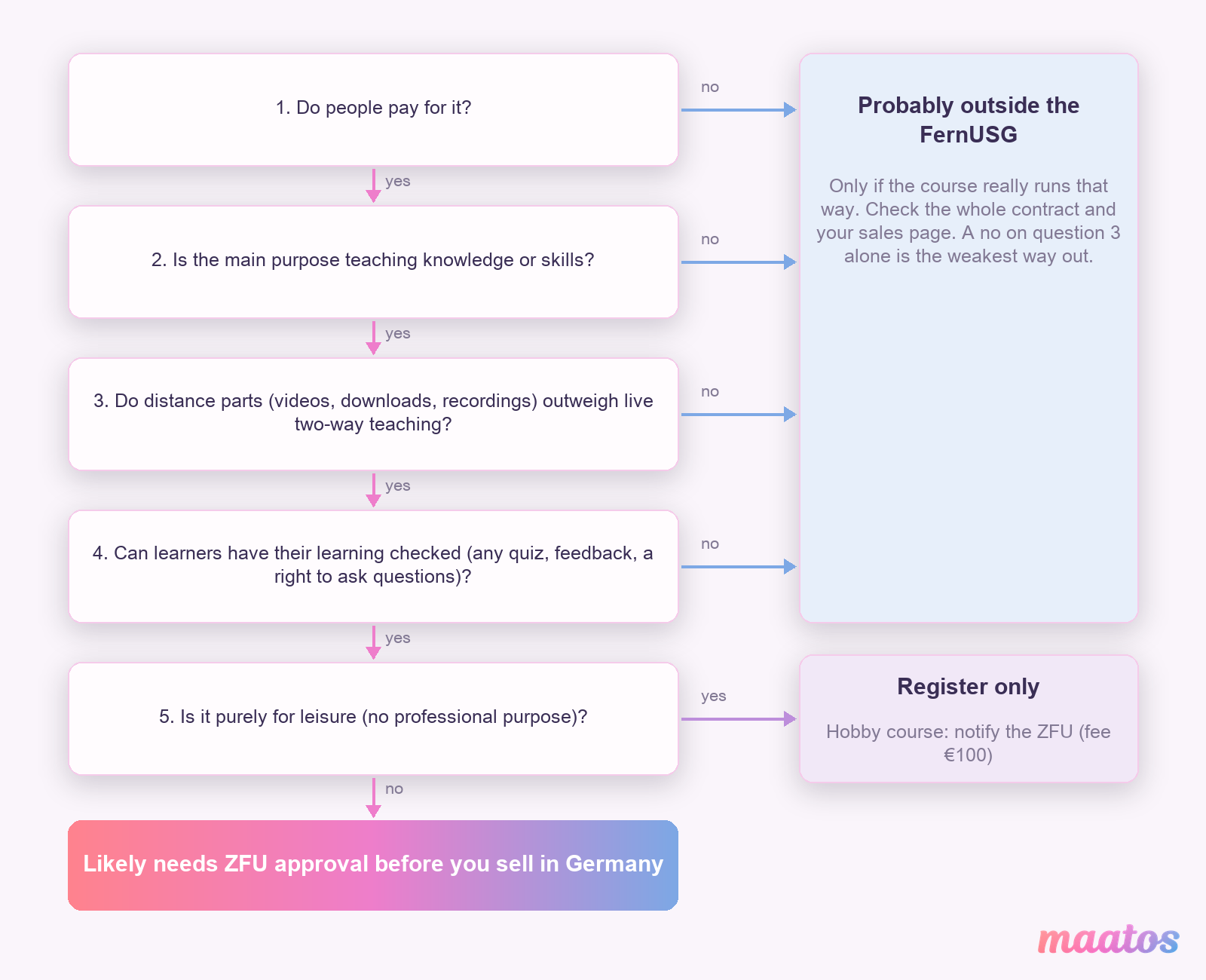
If you answered yes to questions 1 to 4 and no to question 5, assume the FernUSG applies until a German lawyer tells you otherwise. A clear “no” in questions 1, 2 or 4 means you are probably outside it, provided the course really runs that way. A “no” on question 3 alone is the least reliable way out, because the courts are still drawing that line.
Examples: what is usually in scope and what usually is not
Typically in scope (ZFU approval required)
- a pre-recorded course plus mandatory homework with feedback
- an online programme with graded quizzes or a final assessment
- a coaching programme that requires submissions or evaluations
- a certificate programme based on demonstrated learning outcomes
- a recorded course with a community group where you answer questions about the content (this is the 2025 ruling’s scenario)
Often out of scope (ZFU approval usually not required)
- live two-way teaching in real time, without recordings that replace attending or a self-study library, where learners can talk to you as in a classroom (the February 2026 line, still being tested in the lower courts)
- a course with no predefined curriculum or learning path
- a recorded course with no assignments, no quizzes or tests of any kind and no promised right to ask questions about the material
- optional live Q&A sessions that are not part of a structured course
- one-to-one consulting focused on the client’s own situation rather than on teaching
Leisure courses form a third group. A course that, by its content and aim, serves only leisure or entertainment needs no approval, but selling it must be notified to the ZFU (section 12(1) FernUSG). The ZFU charges €100 for the registration and €50 for a review of a registered hobby course. The moment a course has a professional purpose, such as helping people earn money, it is no longer a hobby course.
One warning that the old version of this article also gave, and that still holds: a disclaimer in your terms (“this is not distance learning”) does not change anything. The question is how the course actually works. If your contract or your sales page promises feedback or Q&A, that promise is the monitoring.
How does ZFU approval work?
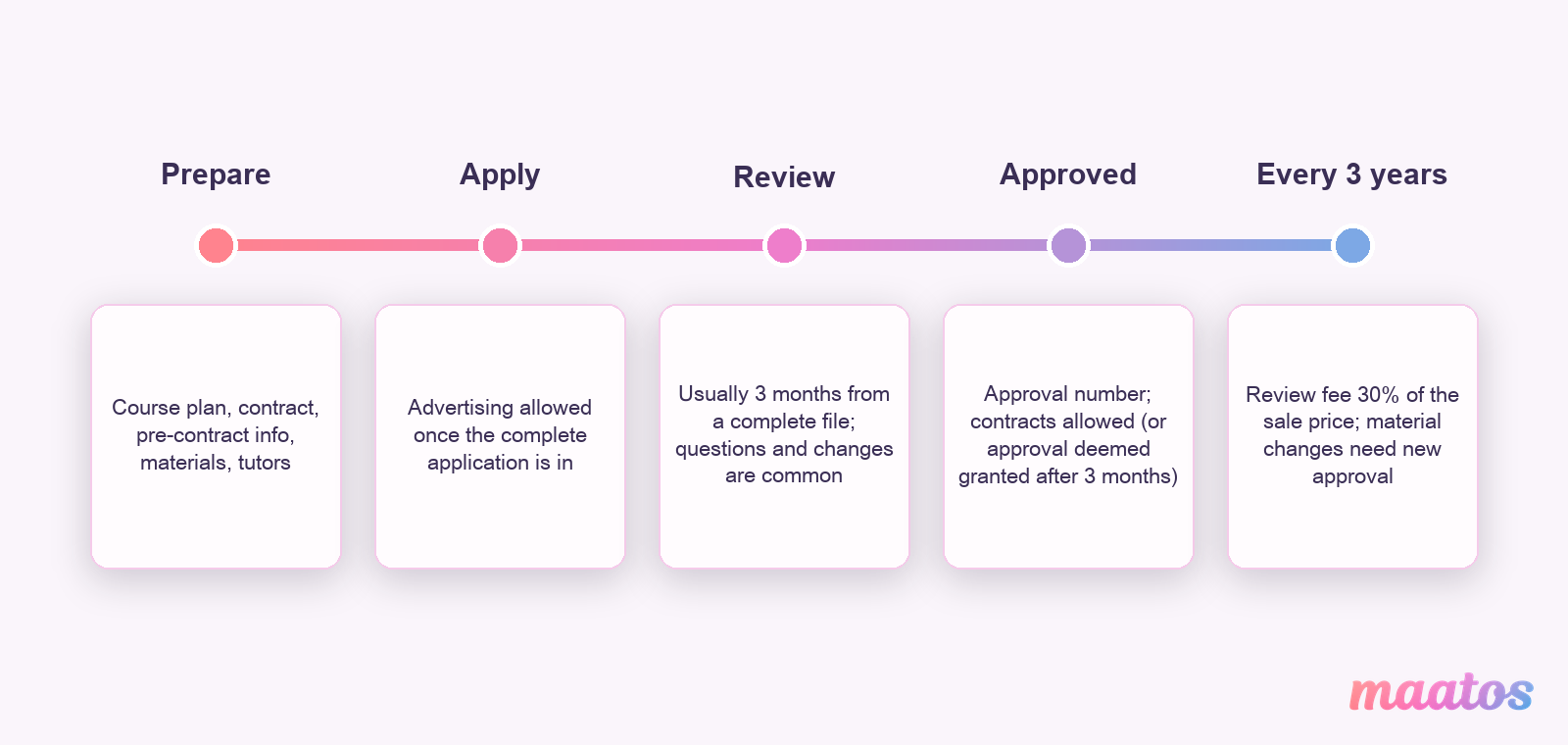
ZFU approval is a formal administrative procedure, and you must complete it before you sell the course in Germany. Approval is granted:
- per course or programme, not per company or platform
- in advance; you cannot sell first and fix it later (contracts signed before approval stay void)
Each course is assessed on its own. Even small differences in structure, duration or assessment can mean that a variant counts as a separate course with its own approval. Material changes to an approved course need approval too (section 12(1)).
What the ZFU looks at
The review covers two areas: the teaching structure of the course, and the contract and consumer-law framework under which it is sold.
The ZFU does not decide whether your course is worth the money or academically sophisticated. It checks whether the material, the teaching plan and the contract fit together and whether the stated learning goal is reachable. The way you deliver matters here: drip, cohort or self-paced are not only choices about engagement and completion. In Germany a cohort format with live two-way sessions shifts the ratio of live to recorded teaching; drip and self-paced delivery do not, because drip lessons are still recorded material.
What you send in
According to the ZFU’s provider FAQ, an application includes:
- your contract and terms and conditions
- the pre-contract information you give learners, including the withdrawal notice
- a completed course plan (modules, lessons, sequence, workload, duration)
- forms listing your tutors and the learning materials
- the complete learning material, including the learning checks and their solutions, or access to your learning platform
In practice it also helps to have a clear course description, learning objectives that match the content, information about the instructors and their qualifications, and the price, payment terms and access duration written out. The ZFU checks whether all of this is consistent: promised outcomes must match the curriculum, and the contract must match how the course really runs.
Section 3 of the FernUSG sets requirements for the contract itself. The learner’s declaration must be in text form (an email or a confirmed online form, no wet signature needed), and you must tell learners about key features such as the type and recognition of any qualification, the place, length and frequency of accompanying live teaching, and how often material is delivered.
Payment and cancellation rules that come with approval
Approval is not only paperwork, it also shapes how you may charge. Under section 2(2) FernUSG, the fee for a distance-learning course is paid in instalments covering at most three months each; larger instalments and payment in advance may not be agreed or demanded. Under section 5, the learner may cancel without giving reasons, first at the end of the first six months with six weeks’ notice, and after that at any time with three months’ notice. The ZFU names the payment arrangement as one of the typical obstacles to approval. So a programme you currently sell for one upfront payment will usually need a new payment structure for German buyers, and that is worth knowing before you apply. If you want to see how instalments work in practice, our guide to payment plans for online courses covers the basics.
Revisions and follow-up questions
It is normal for the ZFU to ask for clarifications or changes. That does not mean your application has failed. Providers are often asked to:
- clarify the course description or learning objectives
- adjust wording that could mislead
- bring the contract terms in line with the FernUSG
So the process tends to go back and forth, especially for a first application.
Approval number and later changes
An approved course gets an official ZFU approval number. It shows that the course meets the FernUSG requirements, and it is commonly mentioned in the contract and the pre-contract information, and often on the sales page.
Approval is not a one-off. The ZFU reviews approved courses every three years. Minor changes (updated text, a new price) only have to be reported; material changes to the curriculum, the assessments or the delivery format need a new approval and get a new number.
What does ZFU approval cost?
The old version of this article quoted “approximately €1,000 to €2,500 per course” without a source. The real rule is simpler and in some cases a lot more expensive, because the fee is tied to your course price.
The ZFU charges under the North Rhine-Westphalia fee schedule (tariff 13.2, also published as the ZFU fee sheet):
| What | Fee |
|---|---|
| Approval of a course | 150% of the sale price, minimum €1,050 |
| Approval after a provisional approval | 200% of the sale price, minimum €1,050 |
| Material change to an approved course | 50% of the approval fee, minimum €525 (the full approval fee if more than half the course changes) |
| Review of an approved course (every three years) | 30% of the sale price |
| Registration of a hobby course | €100 (review: €50) |
No maximum is listed. A few worked examples, using one course at one price:
- A €300 course: 150% is €450, so the minimum of €1,050 applies.
- A €2,000 programme: 150% is €3,000.
- The €47,600 mentoring programme from the 2025 case: 150% would be €71,400.
That last number explains why so many high-ticket programmes never applied. It also explains why a creator with a €97 course and a handful of German buyers may find the cost out of proportion. The ZFU’s online fee calculator is, in its own words, non-binding, and the actual fee can differ. The ZFU FAQ adds that a reduction or waiver is possible in specific cases under the North Rhine-Westphalia fee rules, so if the minimum is out of proportion to your course price, ask the ZFU before you apply rather than assuming either way.
Indirect costs that are easy to underestimate
On top of the ZFU fee, budget for:
- a legal review of your contract, terms and cancellation policy for FernUSG compliance
- rewriting course descriptions and marketing copy that could count as misleading under German consumer law
- adjusting the course structure, for example making learning objectives explicit
- your own time preparing the documents and answering the ZFU’s questions
For a first application, one or more revision rounds are common, which adds advisory costs as well as time.
Ongoing compliance
ZFU approval is not set and forget. There is no annual fee, but plan for:
- the review fee every three years
- a new approval when you change the structure, assessments or delivery significantly
- legal checks as German law changes (and in 2026 it is changing)
So treat approval as an investment in a market, not a one-off admin fee. For a provider with a strong German customer base, legal certainty is often worth it. For a small or experimental offer, the sums need a harder look, especially now.
How long does approval take?
The law gives a firm number. Under section 12a(2) FernUSG, if the ZFU has not decided within three months, the approval is deemed granted. The ZFU’s FAQ says a decision usually takes no longer than three months.
Three things stretch that in practice:
- The clock only starts once your application is complete and consistent. Missing documents mean the three months have not begun.
- In exceptional cases the ZFU can extend the period once.
- Each round of questions or changes adds time, particularly when it touches the course structure, the contract or the learning objectives.
Applications get slower when the documentation is incomplete or inconsistent, when marketing language has to be rewritten, when learning checks need to be described precisely, or when several modules or target groups are involved.
One practical detail: according to the ZFU FAQ, you may advertise a course once your application has been received, but you may only sign contracts after approval (or after the three months have passed). For a first application, plan on a lead time of several months from the first draft of your documents to your first German sale. If Germany is an important market for you, build that into your launch plan from the start.
What happens if you sell without approval?
The consequences are more serious than most creators expect, and they do not depend on your intentions or on how happy your learners are.
1. The contract is void
Section 7(1) FernUSG is short: a distance-learning contract concluded by a provider without the required approval is void. Not “can be challenged”, void. That does not depend on bad faith; an honest mistake about the law has the same effect.
2. Customers can reclaim what they paid, mostly
If the contract is void, the learner can claim back what they paid, even after finishing the course. The full picture is more nuanced than “everything back”.
Under German enrichment law, the provider can in principle claim the value of what was actually delivered (Wertersatz). The BGH spelled out the limits in 2025: the value is what the learner saved by not having to buy a comparable service elsewhere, it is capped at the agreed price, and the provider has to prove it. In the 2025 case the provider failed to prove anything, so the full refund stood. In one of the February 2026 cases the court sent the matter back so the provider could make that argument.
So it is not quite “you lose everything”. It is “you carry the burden of proving what your course was worth, in a German court, for every buyer who asks for a refund”. That is still a risk you cannot easily limit in advance, and it reaches back over every sale you have made in Germany.
3. Fines and action by others
Selling a course that needs approval without one, or selling a materially changed course without a new approval, is an administrative offence. Section 21 FernUSG sets the maximum fine at €10,000. Failing to register a hobby course can cost up to €1,000.
Because the rule protects buyers, others can act on it too. Customers can assert their rights, and consumer associations can act too: Germany’s Injunctions Act (Unterlassungsklagengesetz, section 2) lists the FernUSG among the consumer-protection laws they may enforce, which is why the 2026 draft bill has to amend it. Disputes with German customers are heard by the courts where the learner lives (section 26 FernUSG). So enforcement is not just theory.
4. Business disruption
Beyond the legal exposure, selling without approval can mean:
- having to stop sales to German customers at short notice
- emergency changes to the course structure or delivery
- reputational damage with customers and partners
- time and money lost to disputes and fixing things
For businesses that rely on automated funnels or subscriptions, this can escalate fast. Where the FernUSG applies, ignoring it means carrying a legal and financial risk that grows with every sale.
Does this apply if your business is outside Germany?
According to the ZFU, yes. Its provider FAQ says the FernUSG also applies to foreign companies if their distance-learning offers are aimed wholly or partly at the German market. You do not need a German company, office or staff for the law to be relevant. What counts is where your buyers are and whether you are targeting them.
The law itself has no clause on foreign providers. In practice the question is whether your offer is directed at Germany, and that is judged on the overall picture. Indicators that courts and authorities commonly look at:
- German-language websites, landing pages or sales material
- prices in euros with no exclusion of Germany
- accepting German customers without technical or contractual restrictions
- references to German law in your terms
- advertising aimed at German users
An English-language course can still be in scope if German buyers are clearly welcome. Many platforms sell worldwide by default, and from a German perspective that can already be enough if nothing excludes Germany.
There is a wrinkle here. The ministry’s own 2026 draft bill says the approval requirement in practice “does not reach international providers”, and it uses that as an argument for repealing it: German providers carry the cost while foreign competitors sell without approval. That tells you enforcement against a non-German creator is harder. It does not make your contracts with German learners valid, and a German learner can still sue you in a German court.
For a foreign creator this becomes a strategic question: invest in approval, design the offer so it falls outside the law, or deliberately exclude German buyers. What is risky is assuming that being based abroad is a safe harbour. It is not.
The 2026 repeal draft: what changes, and what does not
On 27 August 2026 the Federal Ministry for Education, Family, Seniors, Women and Youth (BMBFSFJ) published a draft “Act to modernise and reduce bureaucracy in distance learning” (draft bill, PDF, working version of 17 August 2026). If it passes as drafted:
- the approval and registration requirements, and the special contract rules including the “void without approval” rule, end on 1 July 2027
- approvals granted before 1 July 2027 stay valid until the law expires
- providers can apply for a certificate where other laws (for example funding rules) still require proof of approval
- the FernUSG expires completely at the end of 30 June 2028
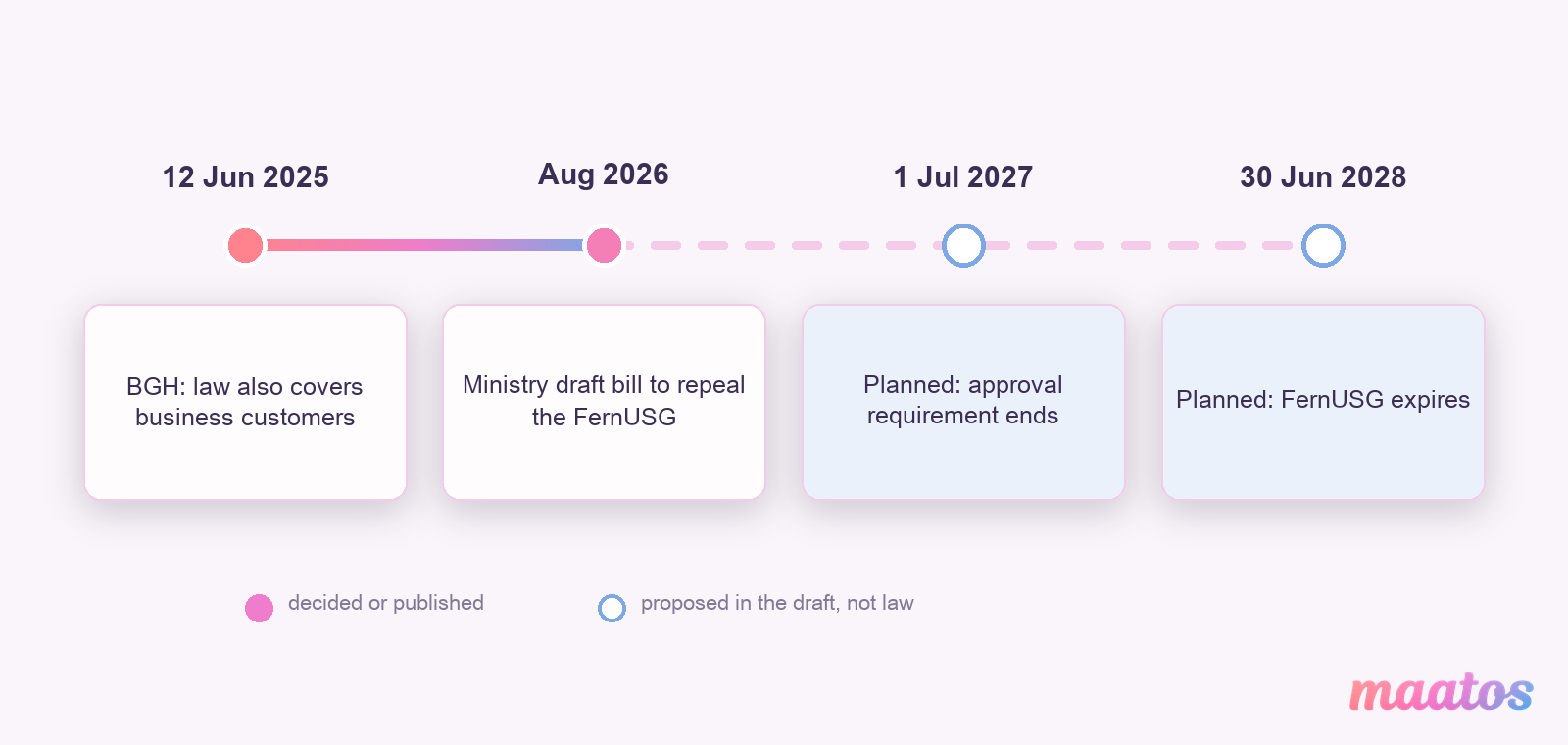
What it does not do, and this matters more than the headline: it does not change anything today. The ZFU’s FAQ states that the draft has no effect yet, that the legislative process including the Bundesrat is not finished, and that approval is still required (status September 2026). We found no cabinet decision. A separate repeal bill from an opposition party (Bundestag document 21/8374, 6 October 2026) is just that, an opposition bill. The ministry still has to weigh the responses to its draft, and the Bundesrat has its say, so the final shape is open.
The draft also contains no clause that retroactively validates contracts signed without approval. Our reading, not a statement in the draft: sales you make before the change will still be judged under the current law.
So what should you do with this? If you are about to sell a structured course into Germany now, the law as it stands is what counts. If you were about to apply, the calculation has changed: you would pay at least €1,050 for an approval that may be needed for less than a year. For some creators, waiting for the outcome while structuring the offer to fall outside the law, or pausing German sales, will now make more sense than applying. For others, especially those who need approval for funding schemes, the certificate route in the draft keeps approval useful. We will update this article when the bill moves.
Your realistic options as a course creator
Once you know the FernUSG exists, the question shifts from “does this apply to me?” to “what do I do about it?”. There is no single right answer. Most course businesses end up on one of these paths.
Option 1: structure the offer outside the FernUSG
Some providers deliberately design their offer so that one of the three elements is missing. In practice that usually means one of these:
- live two-way teaching in real time, with no recordings that replace attending, so that the live part carries the course in hours and in substance
- no learning checks at all: no assignments you review, no quizzes or tests of any kind (automatic ones included), no performance-based certificate, and no promised right to ask questions about the material
- an offer focused on individual advice for the client’s own situation rather than teaching a curriculum
This can work well for:
- workshops, talks and discussion-based formats
- community-based learning without assessment, as long as the community is not a promised Q&A channel on the course content
- coaching that is genuinely about conversation rather than instruction
- in-person workshops sold through your course website, which are not distance learning at all
The catch is that the structure has to match reality. Since 2025 even a promised Q&A channel counts as monitoring, so removing the word “homework” while still answering every content question in a group does not get you out. And it costs you something real: feedback and questions are good teaching. Decide whether that trade is worth it for your German buyers.
Option 2: get ZFU approval
For a genuinely structured programme where Germany is a real market, approval is the cleanest route. It usually makes sense when:
- the course has a defined curriculum and learning objectives
- assignments, feedback or assessments are central to the experience
- Germany is a meaningful or growing market for you
- your buyers need approval for something else, such as funding
The upfront effort and cost are higher, but you get legal certainty, room to grow in Germany, and no refund risk hanging over past sales. With the repeal draft on the table, check the timing first (see above).
Option 3: start lean and decide on Germany later
If you are still testing whether anyone wants your course, you do not need to solve Germany on day one. A lean course MVP that you build in 7 days and launch in 14 lets you validate demand with a small first group. You can run that first version in a format that is more likely to fall outside the law (live, two-way, no recordings, though the courts are still testing that line), or with buyers outside Germany, and make the approval decision once you know the course sells and how it will be structured. That also keeps you from paying 150% of a price you have not tested yet.
Option 4: get help with the platform, not with the law
The old version of this article claimed that a done-for-you website service takes care of FernUSG and ZFU compliance. That was wrong, and we are correcting it here. Our Done-for-You Service designs and sets up your course website: an intake call, a first design within two weeks, the payment and marketing integrations, and a pre-launch check, for a one-time fee of €499 excluding VAT (price on that page on 8 October 2026). It does not review your course for the FernUSG, it does not prepare a ZFU application, and nobody at Maatos can tell you whether your course needs approval.
What a well-built platform does help with is the part the ZFU actually inspects: a clear course plan, consistent course descriptions and sales pages, and a learning environment you can give the ZFU access to. You can see what is included on the features page and in the wider services we offer. For the legal side, you need a German lawyer.
Plans for selling courses start at €49 per month excluding VAT (Basic, up to 3 courses), as listed on the pricing page.
Option 5: exclude Germany as a market
Some providers decide the compliance effort is not worth it commercially. That can mean:
- blocking German buyers at checkout
- explicitly excluding consumers and businesses in Germany in your terms and checkout
- declining registrations with a German address
This reduces your legal exposure but costs you the largest market in the EU. It also only works if you enforce it consistently, both technically and in your contract. A line in your terms while you run German-language ads would not convince a court. Check what your platform and payment provider can actually enforce.
Choosing the right path
The right approach depends on:
- how structured and ambitious your course is
- how important Germany is for your sales
- how much refund and enforcement risk you can carry
- the time and money you have for legal review and compliance
- how much you want to bet on the repeal draft
What is rarely wise is doing nothing. Selling a structured course into Germany without approval, without a plan, leaves you open to refund claims on every past sale. A conscious, documented choice, whichever one it is, is the professional route.
Where Maatos fits, and where it does not
We build course platforms, so here is what that means for this topic. Maatos gives you quizzes, certificates, a course forum and student progress tracking. Those are the tools that make a course work, and in Germany they are also exactly the features that can count as monitoring learning success. Using them is a teaching choice and, for German buyers, a legal one. We do not handle ZFU approval and we do not give legal advice; if you change how you deliver a course for German buyers, for example dropping quizzes and Q&A or switching certificates off, you make that call with your lawyer.
If you are weighing whether certificates are worth that trade-off, our guide on issuing course certificates legally covers what a certificate may and may not claim. If refunds worry you more generally, see what drives refund rates and how to bring them down.
Selling across Europe: the tax side
The FernUSG is a German law with no EU equivalent; VAT is the part that is harmonised. If you sell to Germany you also deal with VAT on online courses in Germany, and our guide to VAT on online courses in the EU explains the One-Stop Shop and which courses count as electronically supplied services.
If your buyers come from all over Europe, the country guides cover the local details, for example Bulgaria, Estonia, Finland, Greece, Hungary, Luxembourg, the Netherlands, Poland and Portugal. None of those countries has an approval regime like Germany’s. Outside the EU, see selling online courses in the UK. All our guides on this are collected under selling courses.
Frequently asked questions
Do I need ZFU approval for a self-paced video course with no assignments?
Probably not, as long as learners have no contractual right to have their learning checked. Watch out for the details: a promised Q&A by email, a community where you answer content questions, or a quiz (even one graded automatically) can each be enough for the monitoring element.
Does the FernUSG apply to coaching?
It can. Since January 2026 the BGH says it depends on the focus of the contract: teaching knowledge and skills (in scope if delivered mostly at a distance with learning checks) or individual advice and support (outside it). Structured “coaching programmes” with modules and videos have repeatedly been treated as distance learning.
Does it apply if I sell only to businesses?
Yes. Since the BGH ruling of 12 June 2025 (III ZR 109/24), the FernUSG protects entrepreneurs as well as consumers.
How much does ZFU approval cost?
150% of the course’s sale price, with a minimum of €1,050 per course, under the official fee schedule. A material change costs 50% of that (minimum €525), the review every three years 30% of the sale price, and registering a hobby course €100.
How long does ZFU approval take?
If the ZFU has not decided within three months of receiving a complete application, the approval is deemed granted (section 12a(2) FernUSG); in exceptional cases the period can be extended once. Clarification rounds and incomplete documents make it longer in practice.
Is the FernUSG being abolished?
Possibly. A ministry draft from August 2026 would end the approval requirement on 1 July 2027 and repeal the law on 30 June 2028. It is not law yet, and until it is, approval is required.
Sources and further reading
Everything in this article was checked against these primary sources on 8 October 2026:
- the Distance Learning Protection Act (FernUSG), consolidated text on the federal justice ministry’s legal portal Gesetze im Internet
- the ZFU, its FAQ for providers and its fee sheet
- the BGH decisions III ZR 109/24 (12 June 2025), III ZR 173/24 (2 October 2025), III ZR 137/25 (5 February 2026), III ZR 142/25 (7 May 2026) and III ZR 310/08 (15 October 2009); III ZR 80/25 (15 January 2026), III ZR 74/25 (5 February 2026) and III ZR 73/25 (12 February 2026) are in the BGH decision database under their case numbers
- the ZFU key figures, section 2 of the Injunctions Act and Bundestag document 21/8374
- for Maatos itself: our features, pricing and Done-for-You Service pages
- the BMBFSFJ draft bill to modernise distance learning (working version 17 August 2026) and its project page
- the European Commission on EU consumer contract law, which sets the 14-day withdrawal right for consumers buying online (business buyers have no statutory withdrawal right)
- the EU VAT One-Stop Shop, for the tax side of selling digital courses across the EU
Because whether the FernUSG applies depends so much on how your specific course is built, get advice from a German lawyer before you rely on any general guide, this one included.
Build it so you can show how it works
Whichever path you pick for Germany, it starts with a course whose structure you can explain in one page: what is live, what is recorded, what learners can ask and what you check. That is easier on a platform you control, where the course and its sales page sit side by side. You can try Maatos free for 30 days and build that course first, then decide on Germany with the real thing in front of you.