
Nobody starts an online course because they’re excited about VAT. You start one because you’re good at something and you’d like to teach it — and then, somewhere between your first sale and your fiftieth, a quiet little worry shows up: am I supposed to be adding tax to this? The short answer for most UK course creators is reassuring. If your total sales are below £90,000 a year, you don’t have to register for VAT at all, and you can sell your course without charging a penny of it. The moment you cross that line — or start selling to buyers in the EU — the rules change, and it pays to know them before HMRC does.
This is a plain-English guide to how VAT, income tax and getting paid actually work when you sell online courses from the UK, current as of July 2026. It isn’t formal tax advice — your situation may have wrinkles this can’t see, so treat it as a map, not a verdict, and check anything important with HMRC or an accountant.
Do you have to charge VAT on online courses in the UK?
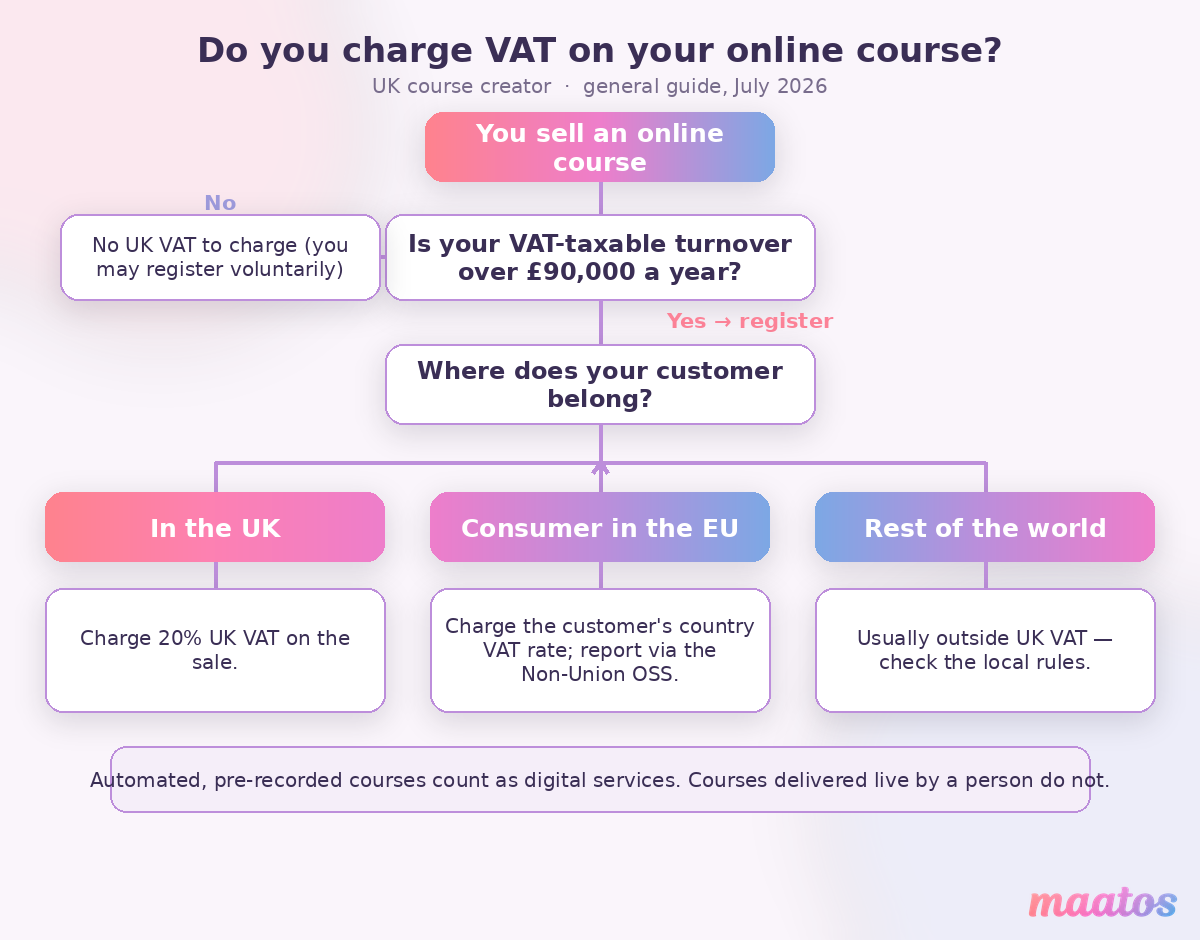
You only have to charge VAT once you’re VAT-registered, and you only have to register once your VAT-taxable turnover goes over £90,000 in any rolling 12-month period. That threshold has held at £90,000 since 1 April 2024 and is still £90,000 in 2026. Below it, registration is optional. Above it, it’s the law — you must register, add 20% VAT to your prices, and pass that money on to HMRC.
So for a solo creator selling a £99 course, the honest reality is that VAT probably isn’t your problem yet. You’d need to be turning over more than £90,000 a year from your taxable activity before registration is compulsory. Plenty of course businesses never reach that point, and plenty deliberately keep an eye on it as they grow.
There’s a catch worth flagging: the £90,000 test looks at your whole VAT-taxable turnover, not just course sales. If you also freelance, consult, or sell other digital products through the same business, it all counts towards the same threshold. It’s the business that registers, not the individual product.
Are online courses exempt from VAT as “education”?
This is the hopeful question every course creator asks, and the honest answer is: usually not. UK VAT law does exempt education from VAT — but only when it’s supplied by what HMRC calls an eligible body. That means universities, schools, certain non-profits, and a handful of similar organisations. A commercial course creator selling through their own business almost never qualifies.
There’s also a narrow exemption for private tuition, but it’s narrower than it sounds. It applies when an individual teacher personally teaches a subject that’s ordinarily taught in a school or university, on their own account and at their own risk. A retired maths teacher running one-to-one lessons might fit. A creator selling a pre-recorded “grow your Instagram” course through a limited company almost certainly does not.
The practical takeaway: assume your course is standard-rated at 20% unless a professional confirms otherwise. Betting on an exemption you don’t actually qualify for is one of the more expensive mistakes in this corner of tax.
Automated course or live teaching? Why HMRC cares
Here’s the distinction that trips people up, and it’s genuinely useful to understand. HMRC treats a fully automated, pre-recorded online course as a digital service — what the rules call an “electronically supplied service.” A course delivered by a real person in real time — a live webinar you host, coaching calls, marking and feedback you give personally — is not a digital service, because an actual human is doing the delivering.
Why does that matter? Because the digital-service label changes where the VAT is due when you sell across borders, which we’ll get to in a moment. Within the UK it makes little practical difference — if you’re VAT-registered, a UK buyer pays 20% either way. But the more your course leans on automation with minimal human involvement, the more firmly it sits in “digital service” territory, and the more the international rules apply to you.
Most self-paced courses fall squarely on the automated side. If yours mixes recorded lessons with live Q&A sessions and personal feedback, the picture is more nuanced — another good reason to get a second opinion before you scale.
Selling to EU customers: the post-Brexit rule that surprises people
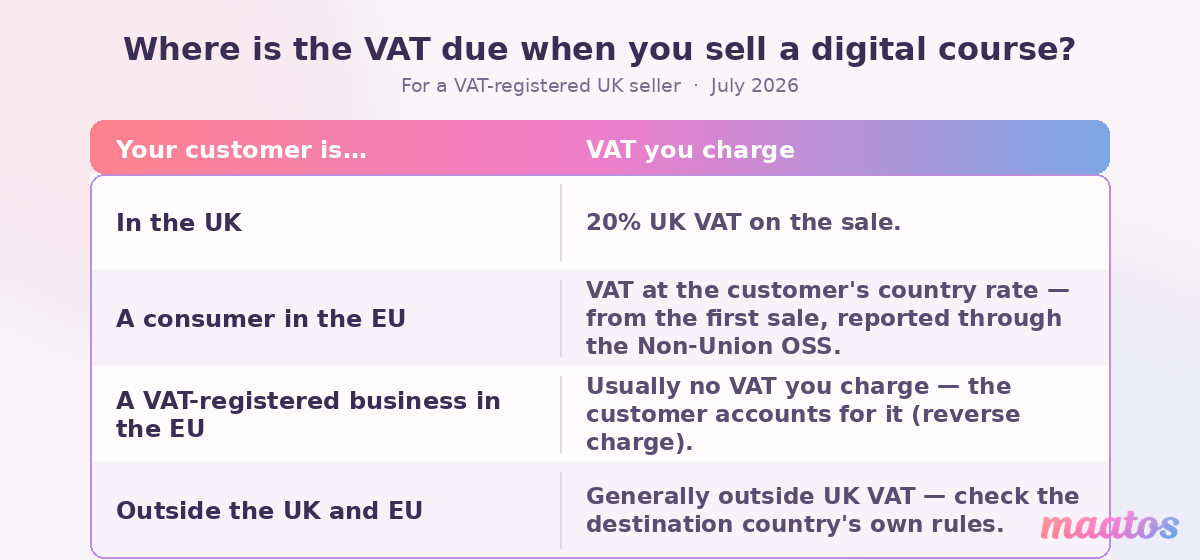
If you sell a digital course to a consumer in the EU, you’re expected to charge VAT at their country’s rate — and you’re expected to do it from the very first sale. There’s no grace amount. Since Brexit, the old £8,818 cross-border threshold that once let small UK sellers off the hook no longer applies to UK businesses, and you can no longer use the UK’s Mini One Stop Shop to report those sales.
That sounds alarming, but the mechanism is manageable. For business-to-consumer digital sales, the place of supply is where the customer belongs, so a buyer in Germany owes German VAT and a buyer in Ireland owes Irish VAT. To avoid registering separately in every country, you register once for the Non-Union One Stop Shop (OSS) in a single EU member state of your choice, then file one return that covers all your EU sales. It’s one registration standing in for twenty-seven. We’ve written a fuller walkthrough of how EU VAT works for online courses if the EU is a real market for you, and a broader piece on handling VAT and sales tax on digital courses more generally.
A couple of things soften this in practice. If you sell through a third-party marketplace that sets the terms of sale, that platform is often the one responsible for accounting for the VAT, not you. And selling on your own platform doesn’t have to mean doing the VAT maths by hand — more on that next. If you’re eyeing specific European markets, some carry extra local rules worth knowing early; Germany’s ZfU registration for distance-learning courses is a good example of a rule that catches people out.
Who actually handles the VAT — you or your platform?
When you sell on a big marketplace, the marketplace is frequently the merchant of record, which means it collects and remits the VAT and you just receive your cut. Convenient — but you also inherit its fees, its branding, its rules, and its ownership of your customer relationship. When you sell on your own platform, you’re the merchant of record: you keep the whole relationship and the whole payment, and the VAT is yours to calculate, charge and report.
That trade-off is exactly where good software earns its keep. On Maatos, VAT is calculated automatically and compliant invoices are sent to your customers without any extra work on your side — so owning your platform doesn’t mean owning a spreadsheet nightmare. You connect Stripe or Mollie, get paid directly, and the tax admin runs quietly in the background. It won’t file your VAT return for you — that’s still your job or your accountant’s — but it removes the fiddly per-sale calculation that makes creators dread going VAT-registered in the first place. You can see how the plans handle this on the pricing page; the entry plan starts at €49/month excluding VAT, with a 30-day free trial.
Income tax and getting paid: the part that isn’t VAT
VAT is only one tax, and for most new creators it isn’t even the first one to think about. The money your course earns is income, and income is taxable whether or not you’re VAT-registered. If you sell as a sole trader, you’ll report your course profits through Self Assessment; if you run a limited company, the profits fall under Corporation Tax. Either way, keep clean records from day one — HMRC’s Making Tax Digital rules increasingly expect digital record-keeping, and it’s far less painful to start tidy than to reconstruct a year of PayPal notifications in a panic each January.
“Getting paid” is the happy part. In practice it means connecting a payment processor — Stripe and Mollie are the two most course-friendly options for UK and European sellers — so customers can pay by card and the popular local methods, and the money lands in your account. Whatever platform you build on, make sure it lets you keep your own payment relationship rather than routing every sale through someone else’s account and fees. Owning that pipe is one of the quiet long-term advantages of running your own course business instead of renting space on a marketplace.
Frequently asked questions
Do I charge VAT on online courses in the UK?
Only if you’re VAT-registered. You must register once your VAT-taxable turnover exceeds £90,000 in any rolling 12-month period; below that, registration and charging VAT are optional. Once registered, most commercial online courses are standard-rated at 20%.
Are online courses VAT-exempt as education?
Usually not. The education exemption applies to “eligible bodies” such as universities and certain non-profits, plus a narrow private-tuition exemption for individual teachers of school- or university-type subjects. A typical commercial course sold through a business is standard-rated, not exempt.
Do I have to charge EU VAT if a customer in the EU buys my course?
Yes. For digital courses sold to EU consumers, you charge VAT at the customer’s country rate from the first sale — the old £8,818 threshold no longer applies to UK sellers after Brexit. Register for the Non-Union OSS in one EU member state to report all EU sales in a single return.
Does the EU VAT MOSS still apply to UK businesses?
Not the UK version. Since Brexit you can’t use the UK’s Mini One Stop Shop. UK sellers instead register for the Non-Union OSS scheme in an EU member state of their choice.
Is a live webinar treated differently from a recorded course?
Yes. A course delivered live by a real person isn’t a “digital service” in HMRC’s eyes, whereas an automated, pre-recorded course with minimal human involvement is. The difference mainly affects the cross-border place-of-supply rules rather than UK sales.
Do I pay income tax on course sales even if I’m not VAT-registered?
Yes. VAT and income tax are separate. Course profits are taxable through Self Assessment (sole trader) or Corporation Tax (limited company) regardless of your VAT status.
Where to go from here
VAT feels like a wall when you’re standing in front of it and a doorway once you’ve stepped through. For most UK course creators the story is simple: sell freely under £90,000, keep tidy records, and get ready to register cleanly the day you grow past it — or the day the EU becomes a serious market. The one thing worth sorting early is the plumbing, so that when VAT does arrive it’s a setting, not a scramble. If you’d like the tax admin to look after itself while you focus on teaching, start a free 30-day trial of Maatos and build your course on a platform that handles VAT and invoicing for you.