

Somewhere between deciding to build your course and actually building it, you hit a question nobody warned you about: how should people work through it? All at once, in a group, or drip-fed week by week? It sounds like a technical detail. It isn’t. The delivery format you choose shapes your price point, your workload, your students’ completion rate, and whether the course ever feels finished or perpetually half-done.
This guide walks you through all three formats — self-paced, cohort-based, and drip — so you can make a clear decision rather than defaulting to whatever your platform does out of the box. We’ll look at what each model actually is, who it suits, the honest trade-offs, and how Maatos supports all three.
What are the three course delivery formats?
Before you can choose, it helps to be clear on what each format actually means — because “drip” and “cohort” get used loosely, and some platforms blur the lines.
Self-paced learning: total access from day one
A self-paced course gives students everything the moment they enrol. Every lesson, every module, every worksheet — all unlocked, no schedule, no deadlines. Students move at their own speed: some sprint through in a weekend, some dip in and out over six months. You build it once, they use it whenever.
This is the model behind most courses on platforms like Udemy or Coursera. It’s also what most first-time course creators build by default, partly because it’s the simplest to set up.
Cohort-based learning: moving through together
A cohort-based course runs on a fixed calendar. A group of students enrols together, starts on the same date, and progresses through the material as a collective — typically with weekly live sessions, shared assignments, group discussions, and real deadlines. When it ends, it ends. Then you open enrolment again for the next cohort.
Think of it like a class at university: you’re part of a year group, you move through the curriculum together, and the experience only works because everyone is in the same place at the same time.
Drip content: scheduled release on autopilot
Drip is a middle path. Students enrol individually (not as a group), but they don’t get all the content at once. Instead, lessons unlock on a schedule you set in advance — week one reveals module one, week two reveals module two, and so on. No live sessions required; the pacing is baked into the platform.
Drip sits closer to self-paced than to cohort — it’s asynchronous, students progress alone — but it adds a guardrail: you control the speed. It’s particularly useful for skills that genuinely need to be practised sequentially, or when you want to discourage students from skimming ahead and then abandoning the course.
How do these formats compare? The honest picture
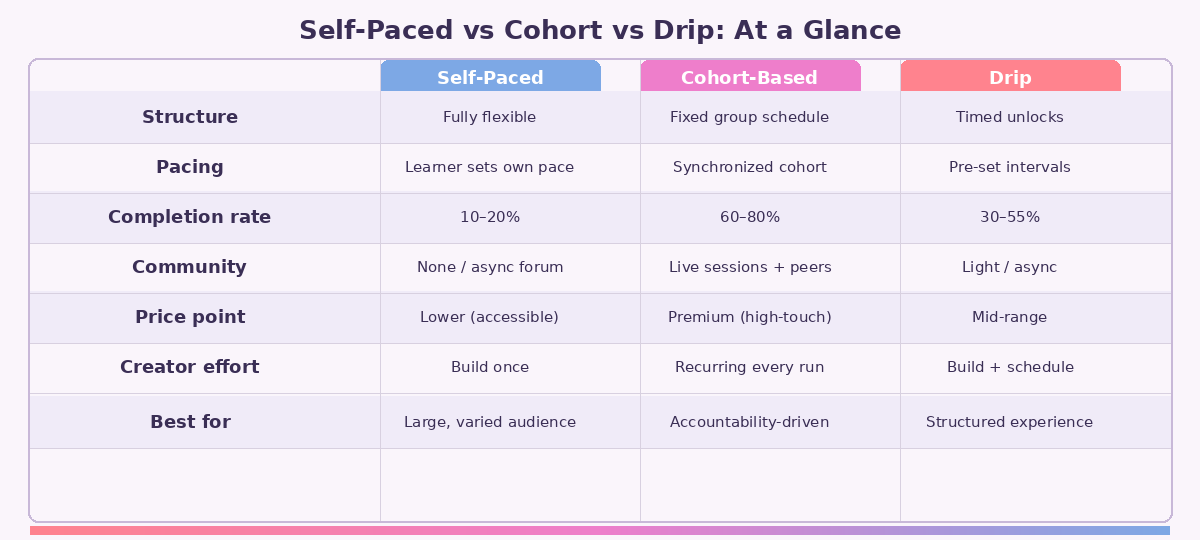
The table gives you the shape. What it can’t show you is the reasoning behind the numbers — so let’s go through the factors that actually move the needle for course creators.
Completion rates: the uncomfortable truth
Self-paced courses see average completion rates of 10–20%. Cohort-based courses regularly reach 60–80%. Drip lands somewhere in between, typically 30–55%, depending on how well the schedule is designed and whether there’s any community element bolted on.
These numbers matter more than they might seem. If you’ve promised students a transformation — a new skill, a business result, a certification — completion rate is a direct proxy for whether you’re delivering it. Low completion isn’t just a vanity metric problem; it’s a refund-request problem and a word-of-mouth problem.
The reason cohorts win here isn’t mysterious. When your classmates are watching, when there’s a live call on Thursday, when the group chat is active — you show up. Deadlines created by other people are more motivating than deadlines you set for yourself. That’s not a weakness in your students; it’s just human psychology.
If completion rate is critical to you — because your transformation promise depends on people actually finishing, or because your price point demands it — this single factor probably settles the question.
Pricing: what the market will bear
A self-paced course on the same topic as a cohort-based course will almost always sell for less. Not because the content is worse, but because the perceived value of live access, accountability, and community is genuinely higher. A self-paced course might sell for €200–400. A cohort-based version of the same material, with weekly live calls and peer interaction, can command €1,000–2,500 or more.
Drip sits in the middle. You can charge more than a flat self-paced course (there’s a structured experience to sell), but you can’t match cohort prices without adding live elements.
This is worth thinking through before you choose. If you want to reach a large audience at an accessible price, self-paced scales beautifully — no extra time from you per student. If you want to charge premium prices and genuinely need the revenue to be worth your time, cohort is usually the right answer. Going cohort on a topic where people expect a low-priced course, or going self-paced on a topic where people expect live coaching, both feel off to buyers.
Your time as a creator: ongoing vs. once-and-done
This trade-off is starker than most guides admit. Self-paced and drip are both “build once” models. Yes, you’ll update the material occasionally, but once the course is live, your marginal time per student is close to zero. That’s genuinely attractive if you want to scale, or if your time is already fully committed.
Cohort-based courses are different. Every time you run a cohort, you’re back in the room — preparing lessons, hosting live calls, answering questions in real time, managing the group dynamic. Experienced creators running weekly cohorts estimate at least four hours of prep for every hour of live session. Do the maths on four cohort runs per year before you commit.
That said, many creators find the cohort model creatively energising in a way that recording solo videos isn’t. The feedback you get from a live group makes your course better faster than any amount of solo iteration. Some creators deliberately run a live cohort first — refining the material through real-time student reactions — and then release the recordings as a self-paced product afterwards. You end up with both.
Community and connection: built-in vs. bolted on
Cohort-based courses have community as a structural feature. Students start together, struggle together, and often stay connected long after the course ends. That “you come for the content but stay for the community” experience — if it happens in your course, it’s one of the strongest retention and referral forces in the business.
Self-paced and drip courses can have community elements — a forum, a Slack group, a comments section — but building genuine connection among students who join at different times and move at different speeds is genuinely harder. The community can feel cliquey to latecomers, or ghost-town quiet when enrollment is slow.
If community and peer connection are central to your transformation promise (a course on building habits, navigating a career change, or launching a business — where accountability from peers matters), cohort is a much better fit. If your topic is more skills-based or informational (learning a software tool, understanding tax rules, developing a craft), community is a nice-to-have and self-paced or drip works fine.
What the decision actually comes down to: five questions
Rather than a framework that tries to do everything, here are the five questions that tend to make the choice obvious.
1. Does your transformation require accountability?
Some course topics work fine in isolation. Others genuinely need the social pressure of a group, a deadline, and an instructor who knows your name. Be honest about which yours is. A course on writing your first course script probably doesn’t require weekly coaching calls. A course on building a consulting practice almost certainly does.
If your students reliably need external accountability to get the result you’re promising, build that accountability into the structure — which means cohort, or at minimum drip with community elements. Don’t design a self-paced course and then wonder why nobody finishes.
2. How big is your current audience?
Cohort-based courses require a critical mass of students to feel like a cohort. A group of five can work, but the group dynamic is fragile — one person drops off and it changes everything. If you’re launching to a small audience, a cohort with too few people enrolled can feel disappointing for everyone, including you.
Self-paced courses work with any audience size. One student is fine. Drip works at any size too. If you’re still building your audience, self-paced or drip lets you start generating revenue immediately without needing to fill a cohort first.
3. How much time do you have to deliver?
Be realistic. If you’re running a cohort twice a year with eight live sessions each run, that’s a real recurring commitment — and if life gets in the way during a cohort, your students suffer. Self-paced and drip separate your delivery time from your students’ learning time, which is a genuine advantage when your schedule isn’t fully predictable.
4. What price point do you need?
Work backwards from the economics. If you need the course to generate €5,000 per run at 20 students, that’s €250 per student — achievable with self-paced. If you need €50,000 per year from courses at 20 students per cohort, you’re looking at €2,500 per student, which requires the premium feel of a cohort or high-touch programme. Neither is wrong; they just require different structures.
5. Is the topic sequential by nature?
Some subjects genuinely need to be learned in order — each lesson builds directly on the previous one, and skipping ahead creates confusion. These topics suit drip well, because the scheduled release prevents students from racing ahead into material they’re not ready for, then getting lost and disengaging.
For topics where the order matters less, or where students benefit from exploring what’s most relevant to them first, unrestricted self-paced access is friendlier and less frustrating.
The hybrid approach most experienced creators end up using
Here’s something the format comparison guides don’t usually say clearly: most experienced course creators don’t stay in one model. They evolve.
A common path: run the course live as a cohort first. The feedback from real students — what confuses them, what lands, what’s missing — is worth more than any amount of solo planning. Then take those recordings and release them as a self-paced product. You end up with a tested, polished course, testimonials from real students, and two revenue streams from one body of content.
Another option: self-paced content with cohort-based coaching wrapped around it. The video library is always available; the live calls open enrollment two or four times a year and create the accountability burst that helps students actually use the material. This is a popular model for skills courses where the content ages slowly but the coaching adds fresh value on each run.
Drip can layer over either model. You can drip content to cohort students to prevent skipping ahead, or drip to self-enrolment students to create a more guided experience without adding live sessions.
The formats aren’t mutually exclusive — they’re ingredients. If you’re still deciding, start with the simplest version that still delivers the transformation you’re promising. You can always add structure later; removing it is harder.
How Maatos supports all three formats
We built Maatos to support whichever model fits your course — not to nudge you towards the one that’s easiest to build on the platform. Here’s what that looks like in practice.
For self-paced courses, students get immediate full access from enrolment. You control which modules are visible, set prerequisites if you want a logical order without strict drip timing, and let students revisit any lesson as many times as they like.
For drip courses, you set a release schedule per lesson or module — days after enrolment, or fixed calendar dates — and the platform handles the unlocking automatically. Students get notified when new content is available. You don’t have to be there for it to happen.
For cohort-based courses, you open enrollment for a set window, set a cohort start date, and run your live sessions using whatever video call tool you prefer — Zoom, Google Meet, anything. The course platform holds the recorded lessons and materials; the live component sits on top. Between sessions, students can revisit content, complete quizzes, and interact in discussion threads.
If you want to explore how lesson length and format affects engagement in any of these models, that’s worth reading alongside this. And if you’re still at the stage of planning the structure, our guide to building a course outline students actually finish walks through the sequencing logic that works across all three delivery formats.
Frequently asked questions
What is the difference between drip and cohort courses?
Drip courses release content on an automated schedule — students enrol individually and receive new lessons over time, with no live sessions. Cohort-based courses run on a shared calendar, with a group of students starting and progressing together, typically including live instruction and peer interaction. Drip is asynchronous and scales easily; cohort is synchronous and creates stronger community and accountability.
Which course format has the highest completion rate?
Cohort-based courses consistently produce the highest completion rates — typically 60–80% — because of built-in accountability, peer pressure, and live deadlines. Self-paced courses average 10–20%. Drip courses fall in between, around 30–55%, depending on how much community support is included.
Can I offer a self-paced course and a cohort version of the same content?
Yes, and many experienced creators do exactly this. A common approach is to run the course live as a cohort first, then release the recordings as a self-paced product. This gives you tested content, real testimonials, and two different price points serving two different audiences.
Is drip content better for beginners?
Drip can be useful for beginners on topics where the learning sequence genuinely matters — where jumping ahead would cause confusion or undermine earlier lessons. For topics where order matters less, or where motivated students benefit from exploring freely, drip can feel unnecessarily restrictive and frustrating. Use it where the pacing serves the learning, not just because the platform supports it.
How does self-paced learning affect course pricing?
Self-paced courses typically command lower prices than cohort-based alternatives because they lack the live access, accountability, and community that justify premium pricing. That isn’t a flaw — it’s a feature if you’re aiming for accessibility and scale. If you want to charge premium rates (€1,000+), you generally need to include live components that create the high-touch experience buyers expect at that price.
Do I need different software for different course formats?
Not necessarily. A good course platform should support all three models without requiring you to switch tools. On Maatos, you can set a course to self-paced, enable drip scheduling, or configure cohort start dates — all within the same platform. The format is a setting, not a different product.
What is a hybrid course model?
A hybrid course combines elements of two or more delivery formats. The most common version pairs self-paced video content with periodic live coaching calls — students work through recorded lessons on their own schedule, but the cohort element (a live call every two weeks, for example) provides accountability and community. Hybrid models let you reach a wider audience than a pure cohort while offering more support than a pure self-paced product.
Which format is right for you?
If your transformation needs accountability and you can run a course live regularly — cohort. If you want passive, scalable income or your audience is too diverse for a group model — self-paced. If your topic is sequential and you want to guide students without being present for every session — drip. And if you’re not sure, starting with a small cohort run and then releasing the recordings is rarely the wrong move.
Once you know the format, the real work begins: writing clear learning outcomes that match what your chosen model can actually deliver, building quizzes that support completion rather than creating anxiety, and designing a structure your students will actually see through to the end. More guides on all of that in our Creating Courses section.
When you’re ready to build it, try Maatos free — you can set up a self-paced course, configure drip scheduling, or run your first cohort, all without a credit card.