

Here’s a confession we hear from course creators all the time: “I know I’m too cheap. I just can’t make myself change it.” The price went up on the spreadsheet months ago. It never made it to the sales page, because the moment you picture the email to your list, your stomach does a small somersault.
So let’s take the fear out of it. You can raise your course price safely when you know three things: how many sales you can afford to lose, who is affected by the change, and how you’ll announce it honestly. For a digital course, a 25% price rise only costs you money if it scares off more than one in five buyers. Your existing students usually keep what they paid for. And the announcement is one short, honest email with a real deadline. The rest of this article walks through each of those, with the maths, the rules, and the wording.
How do you know it’s time to raise your course price?
It’s time to raise your price when the signals point at demand, not at your nerves. Most creators wait for a feeling of “being ready” that never arrives, so look for evidence instead.
The clearest signal is buyers telling you. If people say “that’s a steal” on a sales call, or if nobody ever asks about a discount, your price isn’t doing any filtering. A price that never gets a single objection is usually a price that’s too low. A few “hmm, that’s a lot” replies are healthy; that’s the sound of a price doing its job.
The second signal is that the course has changed and the price hasn’t. You’ve added modules, re-recorded the shaky early videos, built quizzes, added a certificate, or started answering questions in a forum. Every one of those made the course worth more, and the price tag is still quoting the first version.
The third is capacity. If your cohort fills up weeks before the start date, or if support is eating your evenings, a higher price is a perfectly sensible way to get fewer, more committed students. That isn’t greed. It’s how you keep the course good.
And finally, time. If your price hasn’t moved in a year or more while your tools, your platform and your own rent went up, you’ve quietly given yourself a pay cut. Not one of these signals is proof on its own. Two or three together? That’s your answer.
How many sales can you lose and still earn more?
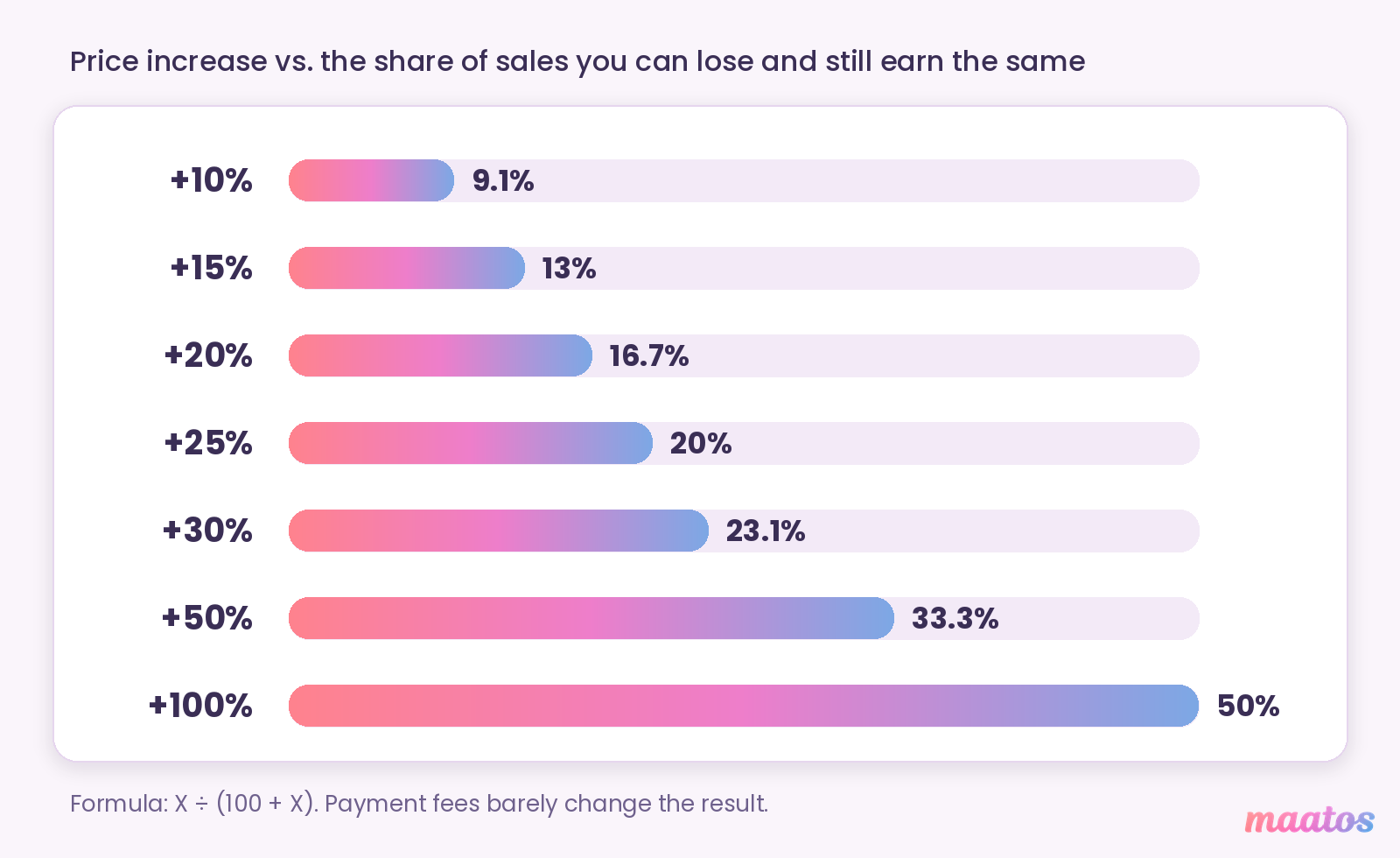
For a digital course, you can lose a surprisingly large share of buyers before a price rise costs you money. Because your cost per extra student is close to zero (apart from payment fees), the break-even is simple: if you raise the price by X%, you can lose up to X ÷ (100 + X) of your sales and still earn the same.
In plain numbers: a 10% rise breaks even if you lose about 9% of your buyers. A 25% rise can lose 20%. A 50% rise can lose a third. Double your price and you only need half your old buyers to stand still on revenue, while you support half as many people.
That’s why we’re rarely fans of tiny 3% or 5% nudges. They’re awkward to announce, they barely move your income, and they’re too small to teach you anything about how your audience reacts to price. A step of roughly 15 to 30% is big enough to matter and small enough to test. If your gut says the course is worth double, get there in three steps of about 25% rather than one leap.
Two honest caveats. Payment fees scale with the price, so they barely change the break-even point. And if a course comes with lots of live coaching hours, each extra student does cost you time; there, fewer students at a higher price is usually a win on two fronts.
What does a price rise look like in real numbers?
The number that tells you whether a price rise worked isn’t the number of sales. It’s revenue per sales-page visitor. Sales count alone will almost always drop a little, and that’s fine.
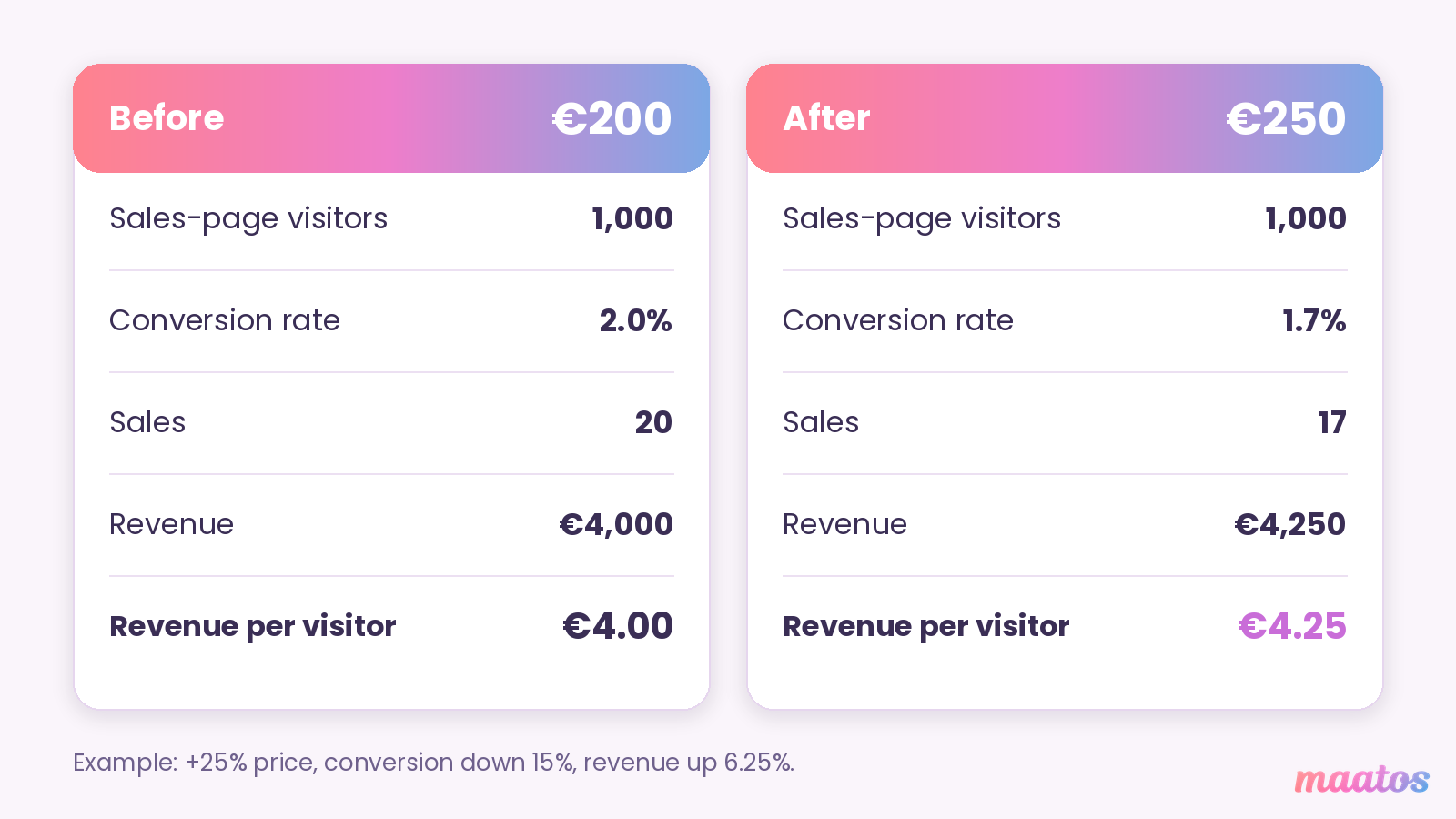
Say your sales page gets 1,000 visitors a month. At €200, 2% of them buy: 20 sales, €4,000, or €4 per visitor. You raise the price to €250. Conversion dips to 1.7%: 17 sales, €4,250, or €4.25 per visitor. Fewer students, more money, and three fewer inboxes to support.
Now the warning, because this is where people fool themselves. Twenty sales versus seventeen is well within the range of random luck. At small volumes, one good podcast mention or one sick week swings the result more than your price does. So compare equal windows (four to eight weeks before and after, avoiding holidays and launches), look at revenue per visitor rather than sales count, and don’t panic at week one. Our guide to course website analytics covers how to track this without drowning in dashboards.
If you only sell a handful of courses a month, lean on the break-even maths above and on what buyers tell you, not on the conversion rate. With tiny numbers, the maths is more reliable than the chart.
What happens to students who already bought?
Students who already paid in full usually aren’t affected at all. They bought the course at the old price, the deal is done, and a price rise for new buyers doesn’t change their access. The trickier cases are payment plans and subscriptions, so it helps to sort your buyers into four groups.
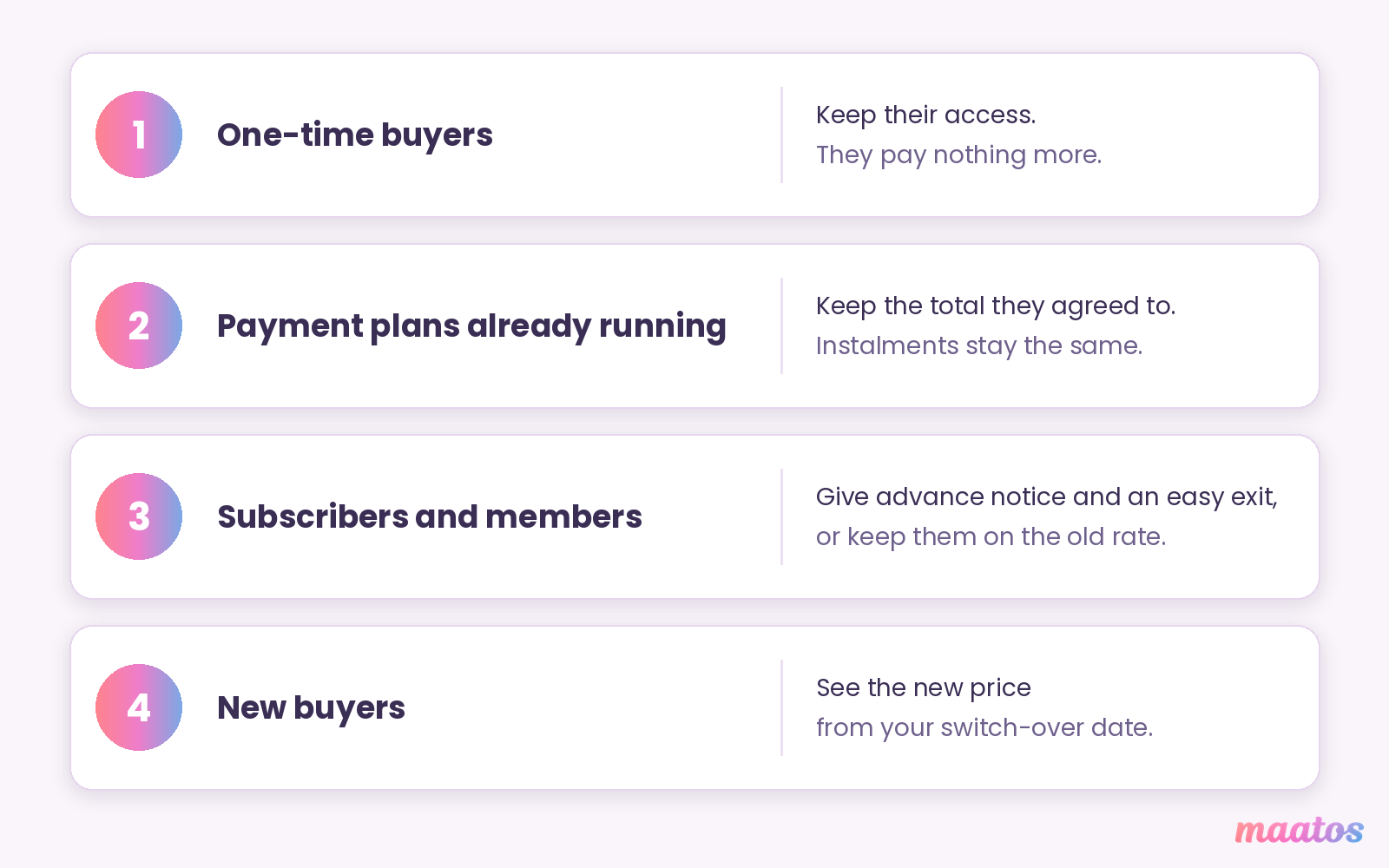
One-time buyers keep exactly what they bought. If you promised “lifetime access”, that promise stands. You can’t charge them the difference, and they don’t need to do anything.
Payment plans that are already running keep the total they agreed to. If someone signed up for six instalments of €40, they pay six instalments of €40, even after the plan for new buyers goes up. Changing an agreed instalment amount mid-plan is exactly the kind of thing that turns a happy student into a chargeback. (Our piece on payment plans for online courses goes deeper into setting the plan total in the first place.)
Subscribers and members are where the rules actually bite, so they get their own section below.
New buyers simply see the new price from your switch-over date.
Can you raise the price for existing subscribers?
Yes, you can raise the price of an ongoing subscription or membership, but only with fair notice and a genuine, easy way out. In both the EU and the UK, a contract term that lets you raise the price without giving the customer the right to cancel is on the official list of terms that may be unfair to consumers.
In the EU that’s point 1(l) of the Annex to the Unfair Contract Terms Directive (93/13/EEC). The same annex has a separate exception for changing other terms of an open-ended contract with reasonable notice, but it doesn’t switch off the price rule: point 1(l) still expects your customer to be able to walk away if the new price is too high. In the UK, the equivalent is paragraph 15 of Schedule 2 to the Consumer Rights Act 2015. In practice, all of this points the same way: check that your terms allow price changes, tell members well in advance, and make cancelling easy.
We’d give at least 30 days’ notice for a monthly membership, and more for an annual one. That’s our recommendation, not a legal number, and it’s also just good manners. If you sell to UK consumers, keep an eye on the new subscription rules in the Digital Markets, Competition and Consumers Act 2024. The UK government announced in August 2026 that they’ll come into force in January 2027. They add clearer up-front information, reminder notices, easy cancellation and a 14-day cooling-off period after a trial ends or a subscription renews. This is general information, not legal advice. If memberships are a big part of your income, a short check with a consumer lawyer is money well spent.
There’s also a mechanical detail that saves a lot of confusion. If your payments run through Stripe, a price’s amount can’t be edited once it’s created: you create a new price and switch to it. Existing subscriptions stay on the old price until each one is moved to the new price. So if you manage prices directly in Stripe, “grandfathering” (letting current members keep their old rate) is what happens by default. Moving people to the new rate is a deliberate step you take after the notice period, and it’s kindest to switch them at their next renewal so nobody gets a surprise part-month charge.
Should you grandfather members at all? Often, yes. Loyal members paying the old rate are your best advertisement, and churn from a surprise price rise can easily cost more than the extra income. A good middle path: keep existing members on their rate for a fixed period, say six or twelve months, and tell them that in the same email.
Is “the price goes up on Friday” a legal deadline?
A deadline is fine as long as it’s true. If you announce that the price goes up on a specific date, it has to actually go up on that date. Falsely claiming that something will only be available for a very limited time, or only on particular terms for a very limited time, to push people into an immediate decision is on the EU’s list of commercial practices that are always unfair (point 7 of Annex I to the Unfair Commercial Practices Directive). The UK’s version in paragraph 7 of Schedule 20 to the DMCC Act is the same minus the word “very”, which makes it slightly wider.
That rules out the “doors closing, price rising!” email that comes back every quarter with the same old price. It also means you shouldn’t extend the deadline “because so many of you asked”. Pick a date you’ll honour, and honour it.
The flip side is good news: a real price rise is one of the most honest pieces of urgency you’ll ever get to use. You’re not inventing scarcity. You’re telling people the truth, early.
One more thing to keep straight: don’t raise the price and then quickly run a “sale” back down to the old number. The EU’s formal 30-day “lowest prior price” rule is written for physical goods rather than courses, but the Unfair Commercial Practices Directive still bans misleading reference prices. Raise from €200 to €250, run a “sale” at €200 two weeks later, and advertising it as a discount from €250 is exactly the kind of claim it catches: for most of the past month, €200 was your price. Our article on course discounts and what they really cost explains why the 30-day test is still the safe habit to use.
How do you announce a price increase to your audience?
Announce a course price increase with one plain, friendly email that gives the new price, the date it takes effect, and a short reason, followed by one reminder and a last-day note. You don’t need to apologise, and you don’t need a 900-word justification.
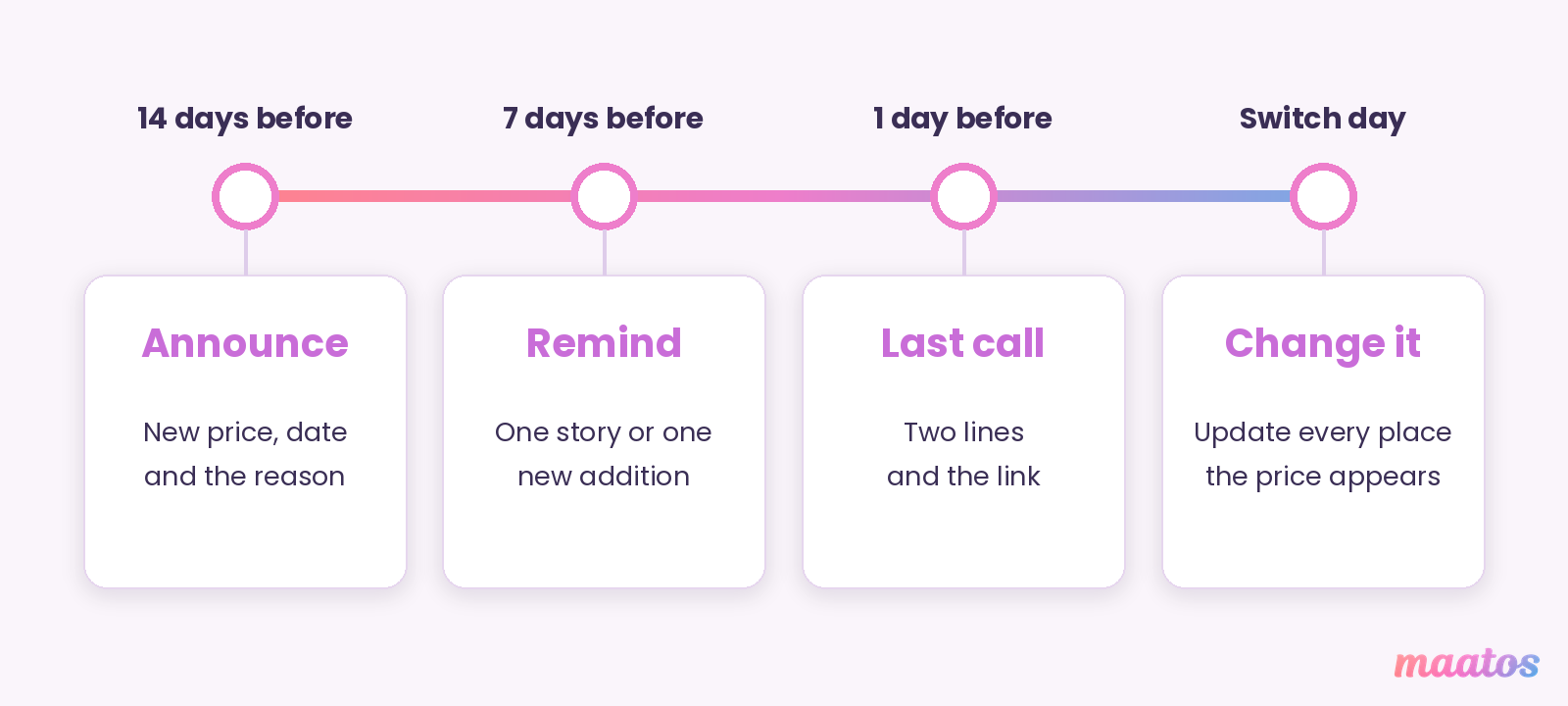
Here’s a simple rhythm that works for most creators:
- Two weeks before, send the main announcement. Say what’s changing, when, and why. Invite anyone who’s been on the fence to join at the current price before the date.
- One week before, send a short reminder, ideally with one student story or one thing that’s been added to the course since launch.
- The day before, send a two-line last call: “Tomorrow the price goes from €200 to €250. If you want in at the current price, here’s the link.”
- On switch day, change the price everywhere (see the next section) and don’t send anything apologetic.
For the reason, keep it concrete. “I’ve added four new modules and live Q&A sessions since launch, and the price now reflects that” lands far better than “due to rising costs”. People accept a price that follows value.
Something like this works as a template:
Hi Sam, a quick heads-up. On 1 November, the price of [Course name] goes from €200 to €250. Since launch I’ve added four new modules, rebuilt the workbook and started monthly live Q&As, and the price now reflects what’s inside. If you’ve been meaning to join, you can still enrol at €200 until 31 October. Everyone who’s already enrolled keeps full access, nothing changes for you.
Short, warm, true, with a date and a reason. If you’re stuck on the wording, the ChatGPT prompts for course marketing can help you draft variations. Just read the output aloud and make it sound like you before it goes out.
Where does your old price hide on your website?
Your old price usually lives in more places than just the sales page, and one forgotten spot is enough to confuse a buyer or undercut your new price. Before switch day, list every place a price appears and update them all in one go.
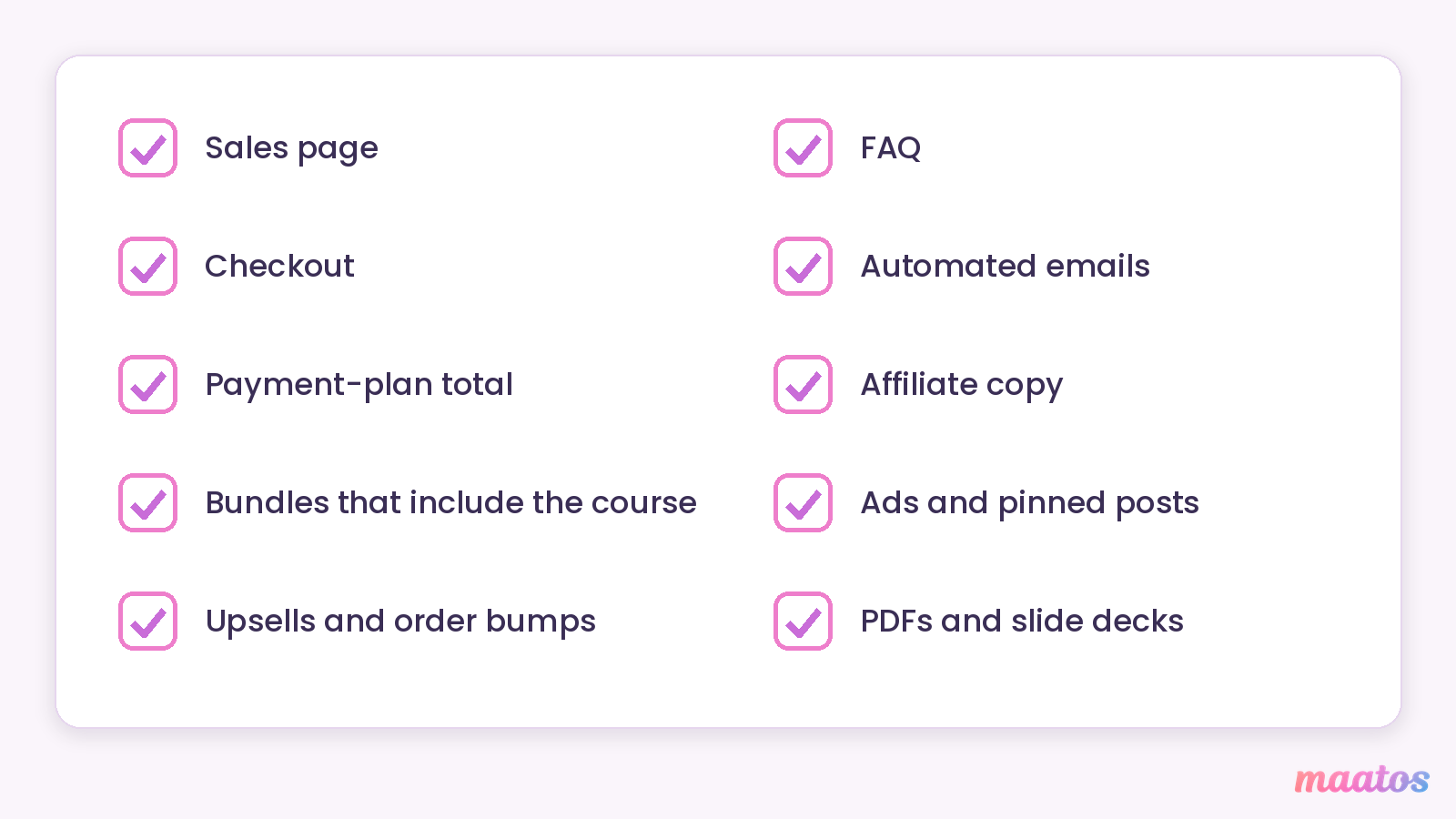
The obvious ones are the sales page and the checkout. The less obvious ones: the payment-plan total, any bundle that includes the course, upsells and order bumps pointing to it, your FAQ, automated email sequences that mention the price, affiliate swipe copy (your affiliates will quote whatever you gave them, so tell them early; our guide to course affiliate programmes covers how to set one up), ads and pinned social posts, and PDF brochures or slide decks you share on calls.
If you sell to consumers in the EU, remember that the price you show them has to be the final price including VAT. That comes from the Consumer Rights Directive (2011/83/EU), which says consumers must be told the total price including taxes before they buy. So pick the new VAT-inclusive number deliberately (€249 or €250, not the €248.05 you get by adding 21% VAT to a round €205) rather than adding VAT to a round net price. Our EU VAT guide for online courses explains how the rate varies by your buyer’s country.
What if raising the price isn’t the right move?
Sometimes the better move is to add a higher option instead of raising the one you have. If you’re nervous, or your audience is genuinely price-sensitive, keep the current course where it is and add a premium version above it: the same course plus live calls, feedback on assignments, or a small-group cohort.
This does two useful things. It tells you, with real purchases, whether people will pay more. And it makes your existing price look more reasonable, because it’s no longer the most expensive thing on the page. We go into how that anchoring works in course pricing psychology, and into building a full range of offers in the course product ladder. If you’re still deciding between one-off, subscription and tiered pricing altogether, start with course pricing models. The rest of our articles on selling courses pick up from there.
And if you do add a premium version, resist discounting it in its first month; you’d lose the one thing it’s there to measure.
How does this work if your course runs on Maatos?
On Maatos, your prices live on your own course website and payments go straight into your own Stripe or Mollie account, so a price change is entirely your call. There’s no marketplace setting your price for you and no platform commission on top, and the features page shows how payments, automatic VAT calculation and invoicing work. Our pricing page lists what each plan includes: one-time sales on every plan, with subscriptions and instalment payments from the Premium plan upwards. The Complete plan adds upsells, order bumps, optimised checkout pages and A/B testing, which is handy for testing a higher-priced version of your course.
If you run subscriptions on Maatos and want to raise the rate for existing members (not just new ones), get in touch with us first so we can walk through how it works for your set-up. And if the whole thing (new tier, updated pages, checkout) feels like a lot, our done-for-you service can build it with you.
Frequently asked questions
How much should I raise my course price?
For most creators, a step of 15 to 30% is a good size: large enough to change your income and to show how buyers react, small enough that most won’t balk. If you believe the course is worth double, go in three steps of about 25%, a few months apart, rather than one jump.
How often can I raise my prices?
There’s no fixed rule, but once or twice a year is plenty for most courses. Tie each rise to something real, such as new content, better results or a full cohort, so it’s easy to explain and doesn’t feel random to your audience.
Do I need to tell existing students about a price increase?
If they paid once and own the course, you don’t have to, though many creators mention it as good news: they got in at the lower price. If they’re on a subscription or membership that will be affected, yes. Give clear advance notice and an easy way to cancel.
What if a grandfathered member cancels and comes back?
Decide that before you send the announcement, and say it in the email. Most creators treat a returning member as a new one, at the current price. If your payments run through Stripe, that’s also what happens mechanically: a cancelled subscription can’t be restarted, so rejoining creates a new one at whatever price your checkout uses.
What if sales drop more than the break-even allows?
Give it the full four to eight weeks first. If revenue per visitor is still lower, you can move the price back, but announce it as a price change, not as a sale. A “was €250” claim for a price that only lasted a few weeks is the kind of reference price consumer law treats as misleading.
Can I say “price goes up soon” to create urgency?
Only if it’s true and specific. In the EU and UK, falsely claiming that an offer is available for a limited time is a banned practice. Announce a real date, then actually change the price on that date.
Is it better to raise the price or add a premium version?
If you’re unsure how your audience will react, add a premium version first. It gives you real data on willingness to pay without touching your core price. If the premium tier sells well, that’s strong evidence your base price has room too.
Your price is a decision, not a verdict
Raising your price isn’t a judgement on your worth. It’s a business decision you can make with a calculator, a calendar and one honest email. Run the break-even maths, sort out what happens for existing students, pick a real date, and update every place the old price hides.
And if you’d like a course website where the price, the checkout and the payment account are all yours to change whenever you decide, start your free 30-day Maatos trial and set up your new price the way you want it. You’ve got this.