
You can talk about your subject for an hour with no notes. Then someone says “you just need to write the sales page” and suddenly the cursor is blinking at you like it’s owed money.
Marketing is the part most course creators dread, and ChatGPT genuinely helps here — it will draft your launch emails and your whole sales page in minutes. The catch is that “write me a sales email for my course” hands back the same hype any beginner could have generated: unlock your potential, take your skills to the next level, the works. The prompts below are different. They brief ChatGPT on your real offer, your real student and your real proof first, so the copy actually sounds like your course — and then they show you how to edit out the robot afterwards. This is the selling-side companion to our broader set of ChatGPT prompts to build your course; that one helps you make the thing, this one helps you sell it.
Why does “write me a sales email” give you copy that doesn’t sell?
A bare prompt gives you bland copy because ChatGPT fills every gap you leave with the most average answer it has seen — and the average course sales email is generic hype. It doesn’t know the worry that keeps your student up at 2am, the specific before-and-after your course delivers, or the one objection that actually stops people clicking buy. Left to its defaults it reaches for stock phrases and an even, listy rhythm that readers now recognise on sight as “a machine wrote this”. That’s the opposite of persuasive.
The fix is to stop asking ChatGPT to invent your marketing and start asking it to organise what you already know about your offer. Once it has your specifics, it stops sounding like everyone else’s launch.
What should you gather before you open ChatGPT?
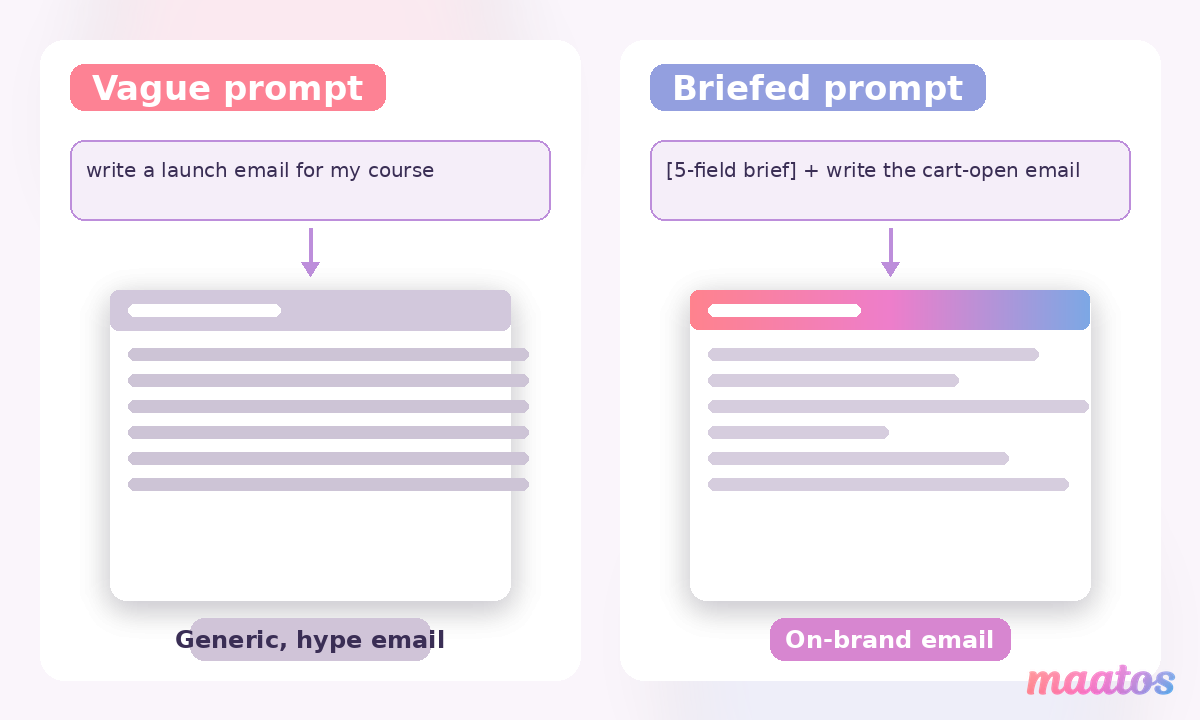
Write five things down once, and paste them at the top of every marketing prompt you run. Think of it as a reusable brief that turns ChatGPT from a guesser into a copywriter who has actually read your offer.
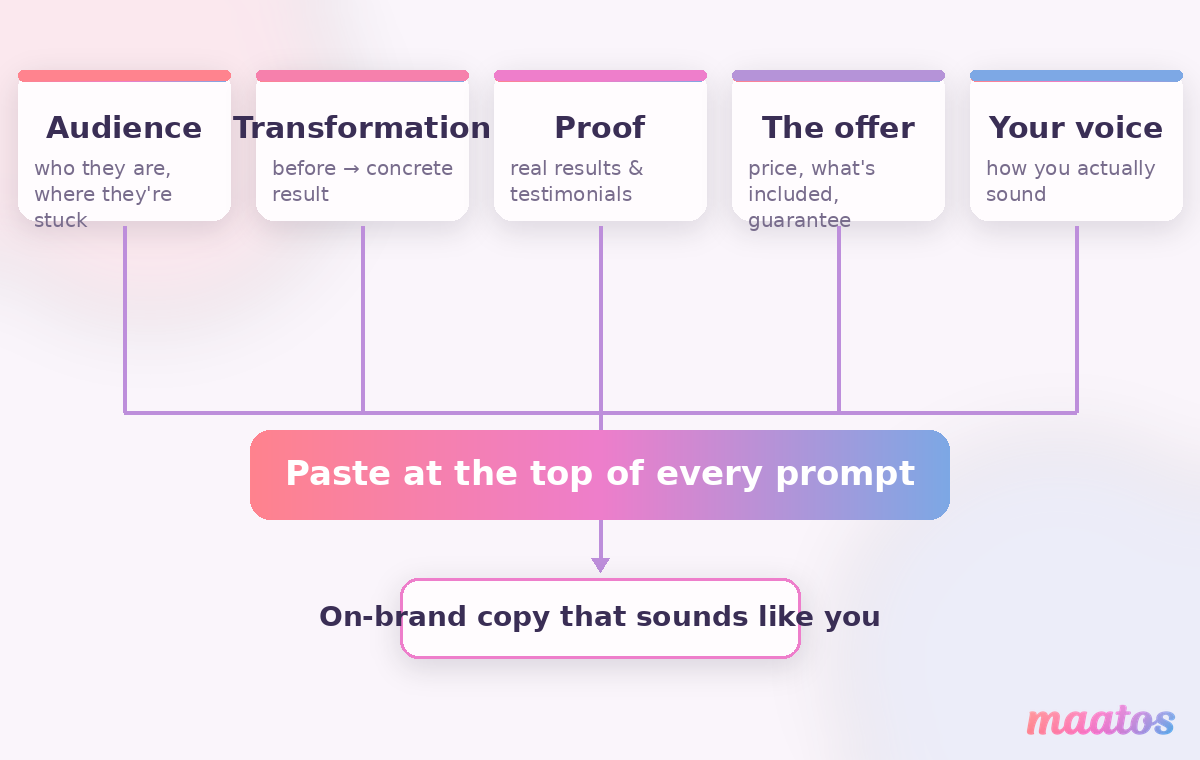
The five fields are your audience (who they are and exactly where they’re stuck), the transformation (where they start and the concrete result they walk away with), your proof (real outcomes, genuine testimonials, your own credentials — nothing invented), the offer (price, what’s included, any bonus or guarantee) and your voice (two or three lines describing how you sound — warm and plain, say, not corporate). That last one matters more than people expect: tell ChatGPT “write the way I’d explain this to a friend, short sentences, no buzzwords” and the draft arrives half-edited already.
If the transformation still feels fuzzy when you try to write it down, that’s a useful signal — it usually means the promise of the course itself needs sharpening before you market it. Our guide to planning a course curriculum with ChatGPT is the place to fix that first; a clear promise is what makes the marketing easy.
Which ChatGPT prompts write your course sales page?
Write a sales page section by section, never as one “write my whole sales page” request. A sales page is a sequence — a headline, the problem, your promise, what’s inside, proof, objections, the offer and the call to action — and ChatGPT writes each part far better when you ask for it on its own with your brief attached. If you’re not sure what those sections are or what order they belong in, our walkthrough of the sales-page sections that actually convert maps the whole page; these prompts fill it in.
Ten headlines to test
Your headline does most of the work, so generate a lot and pick one — don’t accept the first.
[Paste your brief.] Write 10 headline-and-subhead options for the sales page of this course. Each should lead with the transformation, not the course features. Vary the angle: some outcome-led, some curiosity-led, some that name the reader’s frustration directly. Keep them under 12 words. No exclamation marks.
Why it works: asking for ten forces variety, and banning exclamation marks alone kills most of the hype. Make it human: read each one aloud and keep the one that sounds like something you’d actually say — then cut a word or two more.
Turn your modules into outcomes
Students don’t buy “Module 3: Advanced Techniques”; they buy what Module 3 lets them do.
Here is my course outline: [paste your modules and lessons]. For each module, write one short line that describes the concrete outcome a student gets from it — what they can do afterwards that they couldn’t before. Plain language, no jargon, no “you’ll learn about…”.
Why it works: it forces a benefit out of every feature, which is the single most common gap on a weak sales page. Make it human: check each line against reality. If ChatGPT promises an outcome your course doesn’t actually deliver, cut it — overpromising is the fastest way to refunds.
Handle the objection that stops the sale
[Paste your brief.] List the top 6 reasons someone in my audience would hesitate to buy this course — price, time, “can I really do this”, “is this for my level”, and so on. For each, write a two-sentence, honest reassurance I could use in an FAQ. Don’t be salesy; acknowledge the concern first.
Why it works: objection-handling copy closes more sales than any clever headline, and naming the worry out loud builds trust. Make it human: answer as you would to a nervous student — warm, specific, and never dismissive of a real concern.
Which prompts write your launch email sequence?
A course launch usually runs as a short sequence rather than one big email — commonly five to seven messages across a week or two, each with a single job: announce, teach, tell a story, handle objections, then close. Map the arc first, then write each email.
[Paste your brief.] I’m launching this course with a cart open for [X] days. Plan a launch email sequence of [5–7] emails. For each one, give me the goal, the angle, roughly when to send it, and a subject line. Make the sequence build — don’t just repeat “buy now” five times.
Why it works: planning the arc before the words keeps every email pulling in one direction. Make it human: sense-check the timing against your own calendar and audience; a sequence that feels relentless does more harm than a quieter one.
Then draft the emails one at a time, each carrying your brief. For the open-cart announcement:
Write the cart-open email from the plan above. Lead with the transformation, keep it under 200 words, one clear link to the sales page, and write it in my voice: [paste your voice notes]. No “I hope this email finds you well”, no fake urgency.
Why it works: a tight word limit and a single call to action stop the email sprawling. Make it human: add one real detail only you have — a student’s result (with permission), a mistake you made early on, the reason you built the course. That sentence is what makes it yours.
Before anyone is on your launch list, of course, they have to be on your list at all — which is where a good lead magnet for course creators earns its keep, and ChatGPT is genuinely useful for brainstorming those: “Give me 10 lead-magnet ideas for [audience] that solve one small problem my course’s transformation depends on.” Pick the one you’d happily make this week.
How do you make AI copy sound like you, not like a robot?
Always run a second pass by hand where you cut the AI tells and put yourself back in — this is the step that separates copy that converts from copy people scroll past. Read the draft aloud. Any sentence you wouldn’t actually say to a student over coffee gets rewritten or deleted.
A handful of tells give AI copy away almost every time, so hunt them down: words like unlock, elevate, leverage, dive into, supercharge and take it to the next level; openers like “In today’s fast-paced digital world…”; tidy tricolons (“faster, smarter, and more effective”); and that smooth, evenly-weighted rhythm where every sentence is the same length. Replace them with plain words, vary your sentence lengths, and put a single concrete, true detail where the generic claim used to be. We hold every Maatos article to exactly this bar, which is why our whole approach to course marketing leans on real voice over templated copy — your sales page deserves the same.
This isn’t only about taste. Readers can smell generic copy and bounce, and Google increasingly rewards content that’s genuinely useful over content that just fills the page — regardless of whether a human or an AI typed the first draft. The draft can come from ChatGPT; the judgement, the proof and the voice have to come from you.
Where will ChatGPT let you down?
ChatGPT can’t supply what it doesn’t have — your real results, your real price, your actual testimonials — so it will cheerfully make them up if you let it. Treat it as a fast junior copywriter who’s never met your students: brilliant at first drafts, completely unreliable on facts about your business.
Three rules keep you safe. Never let it invent proof: if a draft says “join 2,000+ happy students” and you have forty, that’s a claim that will cost you trust the moment someone checks, and inflated numbers or fabricated testimonials can land you in real legal trouble. Never publish a price or guarantee it guessed — tell it the true terms or leave them out. And remember it defaults to hype, so you’re the one who supplies the substance and the restraint. Used that way, it saves you hours; used as an oracle, it writes you into a corner.
FAQ
What ChatGPT prompts write course marketing emails?
The most reliable approach is a brief plus a plan, then one email at a time. Paste a five-field brief (audience, transformation, proof, offer, voice), ask ChatGPT to plan a five-to-seven email launch sequence with a goal and subject line for each, then draft each email individually with a word limit and a single call to action. Editing the result in your own voice is part of the job, not optional.
Can ChatGPT write a course sales page?
Yes, if you write it section by section rather than asking for the whole page at once. Prompt it separately for headlines, the problem, module-to-outcome lines, proof and objection-handling, each time pasting your brief. Then assemble and edit. It drafts the structure quickly; you supply the real proof, the true price and the final voice.
How do I stop my AI copy sounding like AI?
Run a make-it-human pass: read it aloud, cut filler words like “unlock” and “elevate”, vary your sentence lengths, and replace every generic claim with one specific, true detail. If a sentence isn’t something you’d say to a student in person, rewrite it. That single edit does more for conversions than any clever prompt.
Will Google penalise an AI-written sales page?
There’s no automatic penalty for using AI — Google judges whether a page is genuinely useful, not who or what typed it. The real risk is that unedited AI copy tends to be thin and generic, which underperforms regardless of its source. Edited, accurate, genuinely helpful copy is fine; lazy copy isn’t, AI or not.
How many emails should a course launch have?
A common launch sequence runs five to seven emails over one to two weeks, each with a distinct job — announce, add value, tell a story, handle objections, and close. Fewer can work for a small, warm list; more only helps if every email earns its place. Quality and a clear arc beat volume.
Put the words to work
Drafting the copy is only half the job — those launch emails and that sales page need somewhere to actually live and sell from, ideally your own platform rather than a stack of disconnected tools. With Maatos you get your own branded sales pages, checkout and student emails in one place, with VAT and invoicing handled automatically, so the copy you just wrote turns straight into sales (you can see what’s included here). Start free on Maatos and give your course a home worth marketing.