


“Forty per cent off, three days only.” It is the easiest email you will ever write, and for a lot of course creators it is also the most expensive one.
A 40% discount is not a 40% problem. It is a 40% cut on every sale that was already coming your way, and it needs 67% more sales just to bring in the same money. Not 40% more. Sixty-seven. That single piece of arithmetic is the honest answer to “should I run a Black Friday sale?”, and it is why the answer is sometimes yes and more often no.
So this is a guide to working out which one you are in: what a discount actually costs when your product has no cost per unit, when a sale genuinely earns its keep, what you are allowed to claim about a “was” price if you sell to buyers in the EU or the UK, and what to put on the table instead when the numbers do not work.
What does a course discount actually cost you?
A discount costs you the slice you took off every sale you would have made anyway, which on a €497 course at 40% off is €199 a time, and because a course costs you almost nothing per extra student there is no margin cushion to absorb it.
The break-even is simple enough to do in your head. To keep the same revenue after a discount you need 1 ÷ (1 − discount) times the sales. Ten per cent off needs 11% more sales. A quarter off needs a third more. Half off needs double.
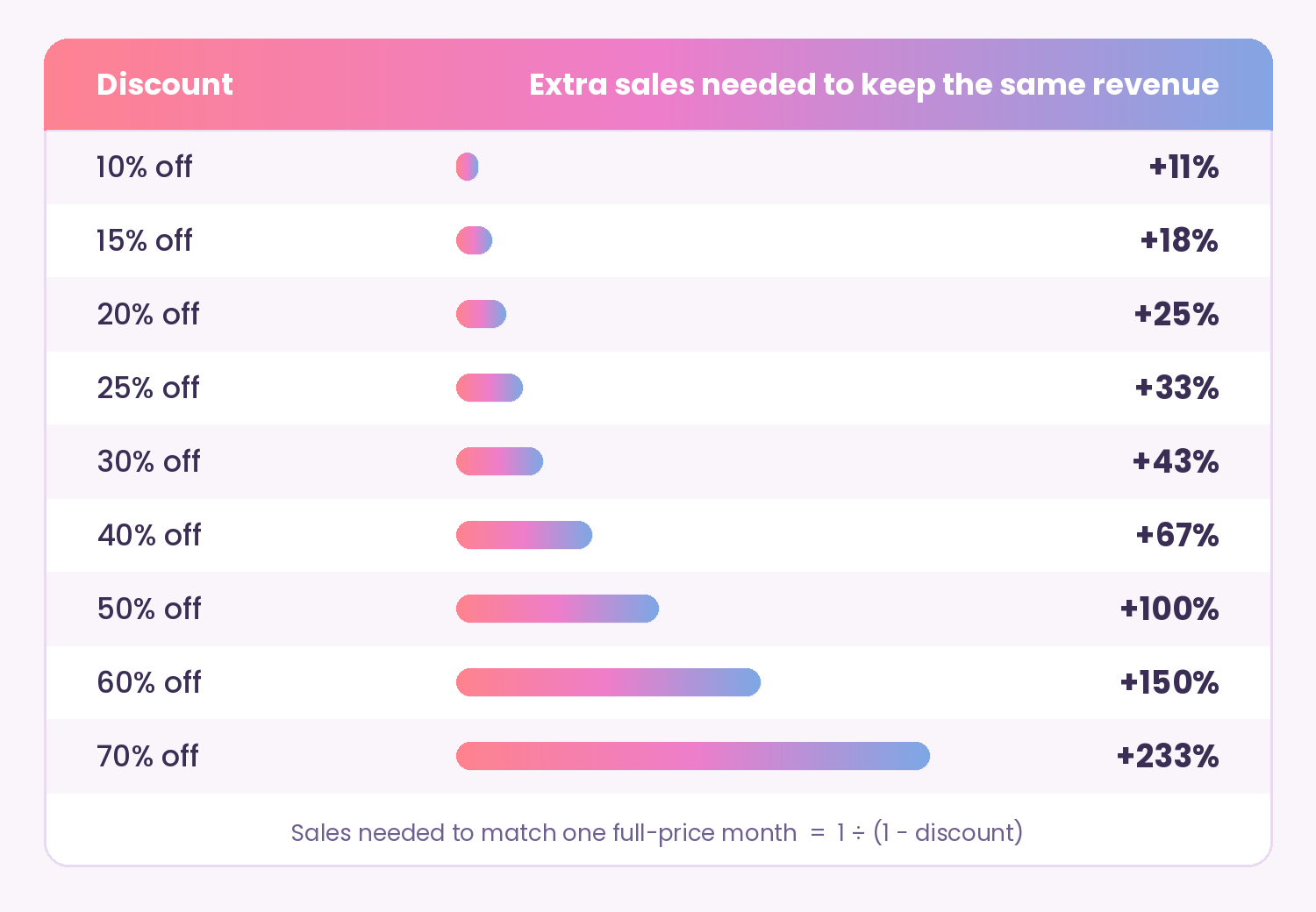
That table is worth pinning somewhere, because the shape of it is not intuitive. The jump from 30% to 40% off looks like ten points. In sales you need to find, it is the difference between 43% more and 67% more.
Now the bit that makes course discounts different from retail discounts. A shop cutting 40% off a jacket is cutting into a margin that was maybe half the price to begin with, so the discount can wipe the profit out entirely. Your course has no wholesale cost. Your margin is very nearly the whole price, minus payment processing of roughly 1.5% plus about 25 cents on European cards, or closer to 2.9% plus 30 cents on American ones. That sounds like the good news. It is not. It means there is no cost saving hiding behind the discount, and no dead stock you needed to shift. What you are giving away is not margin, it is cash from people who were going to buy from you regardless.
Take a course at €497 that sells around ten copies in an ordinary month, so €4,970. Run it at 40% off and the price is €298. To match that ordinary month you now need seventeen sales in the sale window. Get eighteen and the units look spectacular, up 80%, while the money is up 8%. You have served nearly twice as many students, carried nearly twice the support load and nearly twice the refund exposure, and handed about €199 back to every person who would have paid full price this month anyway. Those are round invented numbers, but put yours in and the shape does not change.
The interesting question, then, is never “how much should I take off?” It is “what is this discount buying me that a normal month would not?”
So when is a course discount actually worth running?
A discount earns its keep when it changes who buys or when they buy, and never when it is being used to fix a course that people do not believe in yet.
There are a handful of situations where it clearly works. A founding price on something that does not exist yet is the cleanest of them. If you are pre-selling a course before you build it, the lower price is not really a discount; it is what early buyers are paid for taking a risk on you and giving you feedback while the thing is still soft. Everyone understands that trade, and nobody feels cheated when the price goes up later.
A genuine closing date works too. Doors shut on Friday, the cohort starts Monday, and after that the price is what it is. Here the deadline does almost all the work and the discount is only a reason to decide now rather than in March. The catch is that this only functions if the date is real, which, as it turns out, is a legal point as much as a marketing one.
Then there is the case of a group that was never going to pay your full price: a partner’s audience, a returning student, someone in a country where €497 is most of a month’s rent. That is not a sale, it is a separate offer to a separate group, and it works precisely because it is not public.
And some discounts are simply housekeeping. Clearing an older course you are retiring, or pricing a small entry product low on purpose because it feeds the expensive one, are design decisions rather than concessions. If you have mapped out a product ladder, the bottom rung being cheap is the point of it.
The case where a discount never helps is the most common one of all. If nobody is buying at €497, the reason is usually that they do not believe the course will work for them, not that they cannot find €497. Cutting the price on a page with thin proof just buys you cheaper silence. The fix is on the sales page itself — evidence, specifics, a clear promise about who it is for — and no percentage sign will substitute for it.
What happens when the sale never really ends?
A permanent discount stops being a discount and becomes your price, except now your real price is a number nobody believes.
Anyone who has shopped for courses on a big marketplace knows the pattern: a list price nobody has ever paid sitting above a “sale” price that is simply the price. It works on strangers who arrive once through search. It does not work on an audience that watches you, because your list learns the pattern within two cycles. Buyers who would have bought in September start waiting for November, and you have converted a full-price customer into a discounted one at your own expense.
Marketplaces can run that way because the discounting decision is theirs, not yours, which is one of the underrated costs of renting someone else’s storefront alongside the commission they take on every sale. It is one of the reasons we built Maatos the way we did: on your own site that decision comes back to you, and so does the discipline that goes with it. Charge your full price most of the time, so that it still means something the two or three times a year you do not.
If your full price is the thing that feels wrong, that is a different project. Work on the price itself and how it is presented, or on which pricing model fits what you are selling, rather than papering over it with a permanent 40% banner.
Is “was €400, now €200” legal if you never sold at €400?
No. A reference price you never actually charged is a misleading claim in both the EU and the UK, and this is the part of discounting where most course advice gets the detail wrong.
The rule people quote is the EU’s 30-day rule: when you announce a price reduction you must show the lowest price you applied in the previous 30 days. That comes from Article 6a of the Price Indication Directive (98/6/EC), added by the Omnibus Directive (EU) 2019/2161 and applicable since 28 May 2022. It is real, and it is why every European webshop now shows a small “lowest price in the last 30 days” line during Black Friday.
Now the nuance. The Price Indication Directive applies to “products” in the sense of movable goods, not to services and not to digital content. The European Commission says so in its own guidance on Article 6a. An online course is digital content or a service depending on how you deliver it, so the 30-day arithmetic does not bind you the way it binds a shop selling trainers.
What does apply to you is the Unfair Commercial Practices Directive (2005/29/EC), which covers services and digital content, and which is stricter in spirit even though it contains no fixed number. A “was” price you never charged is a misleading action under Article 6, and staying quiet about how you arrived at it can be a misleading omission under Article 7. Annex I, point 7 — the blacklist of practices that are unfair in all circumstances — covers falsely stating that a product will only be available on particular terms for a very limited time in order to push an immediate decision. Blacklisted means there is no balancing test and no defence about context: a countdown timer that resets when the page reloads is simply not allowed.
In the UK the same conduct is caught by the unfair commercial practices regime in the Digital Markets, Competition and Consumers Act 2024, which came into force on 6 April 2025 and replaced the 2008 regulations. Its list of banned practices carries the limited-time ban across and drops the word “very” from it, which makes it wider rather than narrower, and it adds fake reviews outright. Drip pricing is handled slightly differently, through the rules on what an invitation to purchase has to show up front.
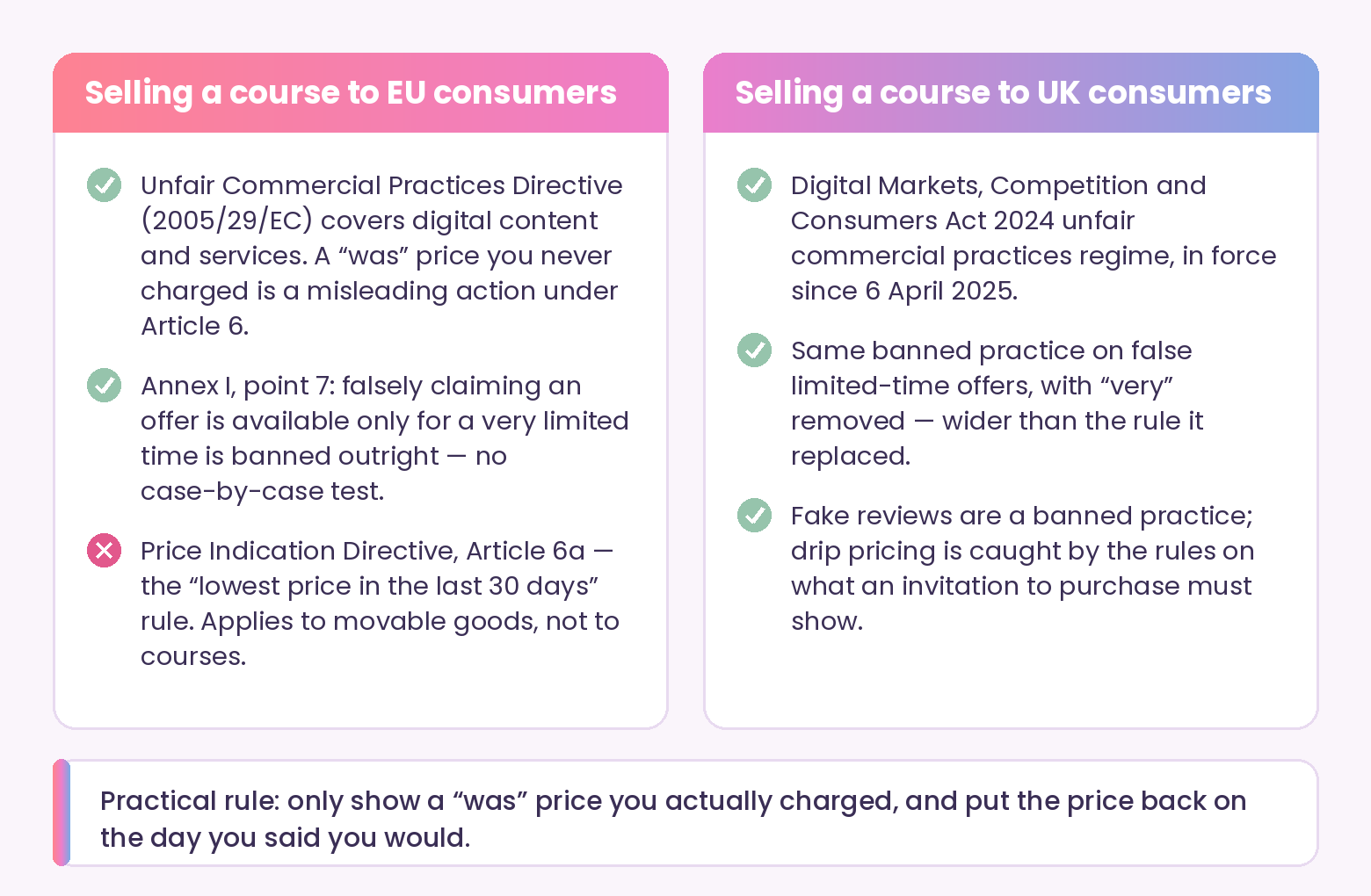
The practical rule is easier than the law: use the 30-day test even though it does not legally bind you. If your course genuinely sold at €497 for the past month, “was €497” is a true statement and you are on solid ground. If it did not, do not write it. And if you announce that the price goes back up on Sunday night, put it back up on Sunday night.
We are not lawyers, and this is general information rather than legal advice. If you are running a large promotion, or you are unsure how your own country implemented these rules, check with someone qualified in your market.
Does a discount change your VAT and your refunds?
Yes on both counts, and the second one is the one that quietly eats the result of a good sale week.
VAT is charged on what the customer actually pays, so a €497 course sold at €298 is taxed on €298. That is straightforward, but it does mean a discount on a VAT-inclusive consumer price cuts your net take and your tax bill together. It rarely changes your registration position or which country’s rate applies, though a large enough drop in turnover can move you across a threshold, and the rules for VAT on digital courses otherwise work exactly as they did before the sale. If your platform calculates VAT and issues the invoices for you this is a non-event, which is how we set Maatos up; you can see it on the features page.
Refunds are the less obvious half. Consumers in the EU have a 14-day right of withdrawal on distance contracts. For digital content you only lose that right if the buyer gives prior express consent to immediate access, acknowledges that they are giving up the right of withdrawal, and you confirm the contract. That is the exception in Article 16(m) of the Consumer Rights Directive, and courts read it strictly. The UK has its own near-identical cancellation rules. None of that is a problem in normal trading. It becomes one during a discount, because a price cut converts deliberators into impulse buyers, and impulse buyers have less invested in the decision. Whether that shows up as more refunds in your business is worth measuring rather than assuming, which leads to the single most useful habit here: judge a sale on net revenue thirty days later, after refunds have landed, against a normal month, not on gross takings on the Friday.
Should a course creator bother with Black Friday?
Only if your audience is big enough that a short, extremely crowded window beats a quiet week you pick yourself. Black Friday 2026 falls on 27 November, with Cyber Monday on 30 November.
Black Friday is the one exception to a rule that runs through the rest of this piece, which is that “it’s November” is not a reason a buyer accepts. In the last week of November it very nearly is, because everyone is already in that frame of mind and nobody needs the promotion explained to them. That is exactly what makes the window valuable and exactly what makes it brutal.
Be honest about what it is: an attention auction. On the morning of 27 November your email competes with every retailer on earth for the same inbox, and your subject line is one of four hundred. A creator with a 300-person list does not have a Black Friday problem, they have an audience problem, and 40% off will not solve it. It will sell the same handful of people a cheaper version of what they were going to buy in January.
If your list is large enough for the crowd to be worth fighting, two adjustments help. Go early or late, because the week before and the first quiet week of December have far less competition than the day itself. And make the offer something other than a bare percentage, because everyone is running a bare percentage that week and yours will not be the biggest one.
If your list is not that large, pick your own date and attach a reason to it: a cohort start, a new module going live, the anniversary of the course. A dated offer with an explanation converts better than a dated offer without one, and it does not train your audience to associate you with the last Friday in November for the rest of your career.
What can you offer instead of cutting the price?
Adding something is usually cheaper than taking money off, because a bonus costs you once while a discount costs you on every single sale.
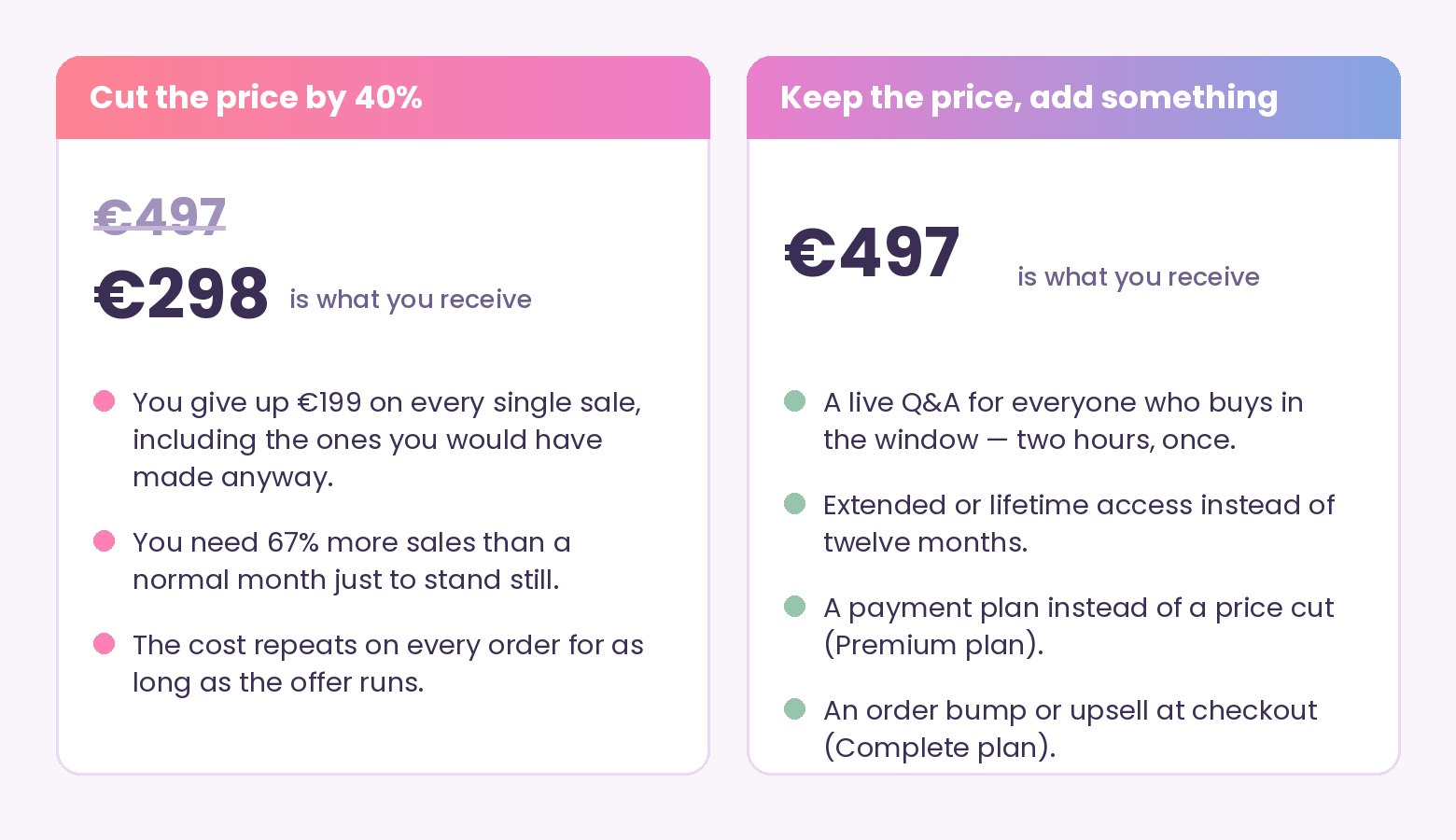
A live question-and-answer session for everyone who buys in the window costs you two hours and is worth considerably more than €200 to the right person. Extended or lifetime access instead of twelve months costs you nothing at all if your hosting is a flat monthly fee. A payment plan rather than a discount keeps the total the same while lowering the barrier that was actually stopping people; on Maatos that sits in the Premium plan, which is €99 per month excluding VAT, or €82.50 per month when billed annually. Bundling two courses that genuinely belong together raises the order value instead of cutting it, which is worth weighing against the alternatives in bundles versus subscriptions. An order bump or an upsell at checkout adds to the sale rather than shaving it, and lives in our Complete plan at €199 per month excluding VAT. The current numbers are all on the pricing page.
And if what you actually want is more sales rather than a lower price, an affiliate or partner push does something a discount cannot: you only pay for the sales that happen, and you reach someone else’s audience instead of discounting to your own.
How do you run a discount without wrecking your pricing?
Decide the reason, the depth and the end date before you write a single line of the email, and put the return to full price in your calendar in the same sitting.
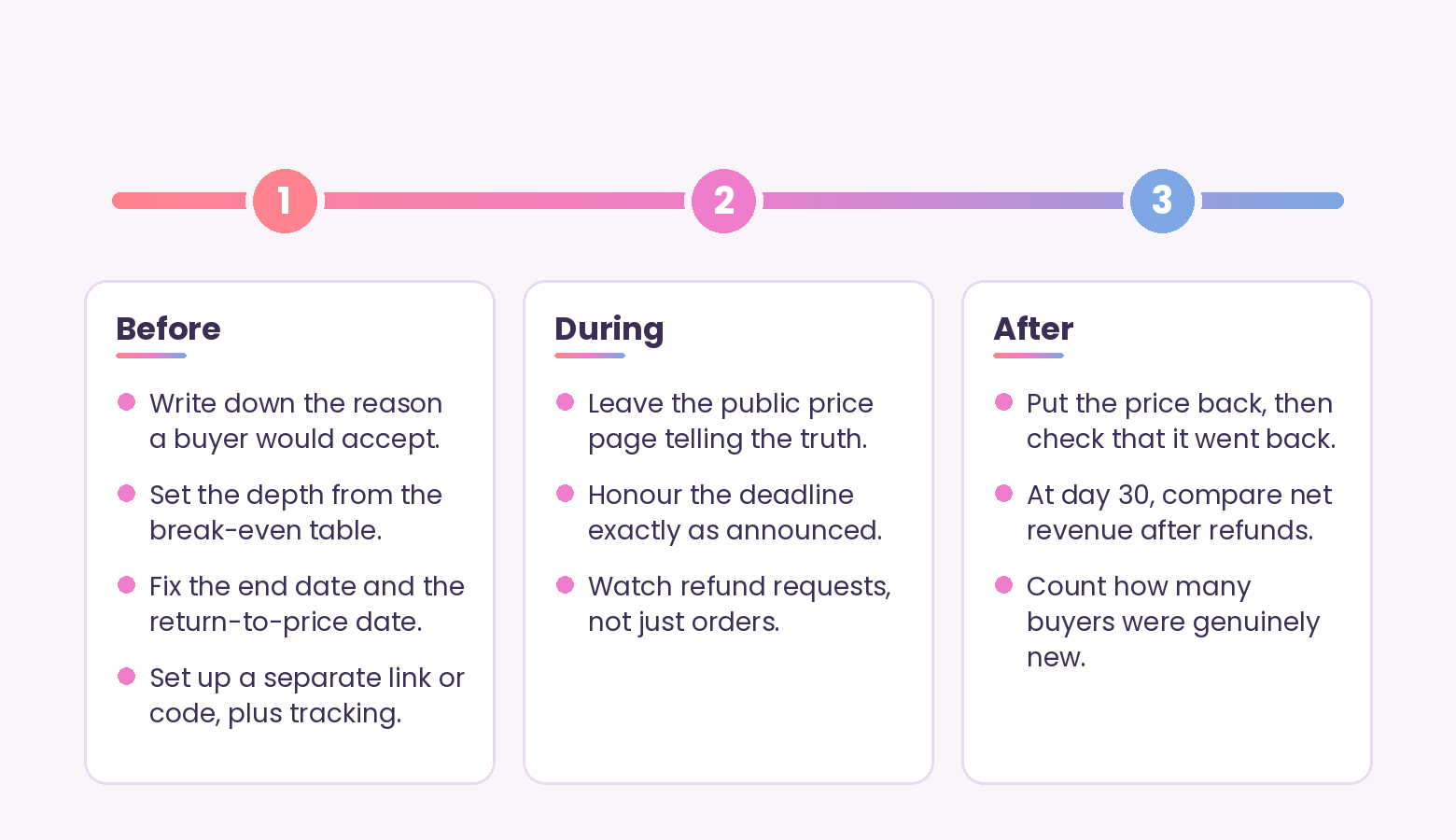
Start with the reason, written down in a sentence a buyer would accept without rolling their eyes. A cohort filling up, a module launching, a course being retired, the last week of November when everyone expects it anyway. “Because sales are slow” is not on that list, and readers can tell.
Set the depth from the break-even table rather than from what feels generous. If the goal is to nudge people who were already close to buying, a smaller cut usually does it, and a smaller cut is the only kind you can repeat without teaching your audience to wait.
Run it on a separate checkout link or code wherever your setup allows. That keeps the offer contained, and it means your public page still shows the price you genuinely charge the rest of the year rather than being rewritten every time you promote something.
Tag the buyers who come through the discount so that in three months you can compare their refund rate and their completion rate against your full-price students. Simple UTM tracking is enough. Most creators never look, which is why “the sale went well” is usually a feeling rather than a finding.
Then put the price back and check that it actually went back. Expired offers that quietly stay live are how a one-week promotion becomes a permanent price cut nobody decided on.
Thirty days later, do the comparison honestly, and be specific about what counts as a win: more money than a normal month, or the same money from genuinely new people who go on to buy the next thing. Same money from the same people is not a win, it is a discount you gave to your existing customers. If that is what the numbers say, you have your answer for next November. There is more on the mechanics of all this across the selling courses hub.
Frequently asked questions
How much should I discount an online course?
Pick the depth from what it costs you rather than from what looks generous. As a working ceiling, be careful past about 30%, because beyond that the extra sales you need — 43% more at 30% off, 67% more at 40% — simply do not exist on a small list, no matter how good the email is. The deeper the cut, the more it depends on reaching people who have never heard of you.
Is it legal to show a “was” price I never charged?
No. In the EU a fabricated reference price is a misleading action under the Unfair Commercial Practices Directive, which covers digital content and services, and in the UK the same conduct falls under the Digital Markets, Competition and Consumers Act 2024 regime that has applied since 6 April 2025. Both regulators and buyers can act on it: since 28 May 2022, EU consumers harmed by an unfair commercial practice have had individual remedies such as compensation or a price reduction, and the DMCC Act gives UK consumers a comparable right of redress.
Do the EU’s 30-day price rules apply to online courses?
Not directly. Article 6a of the Price Indication Directive covers products in the sense of movable goods, so at EU level a course sits outside it and you are not obliged to display a “lowest price in the last 30 days” line. National implementations vary, though, so check how your own country wrote the rule before assuming you are exempt from it locally.
When is Black Friday 2026?
Friday 27 November 2026, with Cyber Monday on 30 November. If you are planning a promotion around it, the emails, the sales page and the checkout link need to be finished a couple of weeks earlier, because the last week of November is not the week to be writing copy.
What happens to the VAT if a discounted sale gets refunded?
You refund the VAT along with the price and correct it in the period you issue the credit note, so a refunded sale should not leave you paying tax on money you no longer have. The trap is a VAT-inclusive consumer price: a 40% discount takes 40% off your net revenue and 40% off the VAT, so both sides of the invoice shrink and your accounting has to follow the discounted figure, not the list price.
Will discounting damage my brand?
One dated, explained discount rarely does anything of the sort. The damage comes from repetition, and it lands hardest on creators who sell to the same audience again and again, because a list watches your pricing over time in a way that cold search traffic never does.
Can I offer a lower price to one person without running a public sale?
Yes, and it is usually the better version. Use a separate checkout link or a code that is never shown on your pricing page, so the public price stays intact and true. The invoice still has to reflect what was actually paid, with VAT calculated on the lower amount, so keep the record straight even when the offer was informal.
What if the sale does not work?
Look at the traffic before you look at the price. If plenty of people reached the sales page and did not buy at 40% off, price was never the objection and the page is where the work is. If almost nobody arrived, the discount was fine and the audience was the constraint, which is a much slower problem to fix and one no promotion will solve in a week.
Before you decide anything about November
Do the smaller piece of work first. Open your own numbers, look at what a full-price month actually leaves you, and see whether a discount would buy you anything a normal month would not. Most of the time it will not, and knowing that is worth more than any promotional calendar.
That calculation is only really yours to make if the price is yours to set. On a marketplace, someone else decides when your course goes on sale and takes a share of what is left. On your own Maatos site you set the price, you change it on the day you choose, and what the student pays comes to you minus your payment provider’s fee. You can build the whole thing during the 30-day free trial and have a pricing page you actually believe in well before 27 November — start free and see what your numbers look like when nobody else is discounting on your behalf.