


You’ve built a course you’re proud of, and you know it would help far more people than have found it so far. The problem is reach: you can’t be on every podcast, in every newsletter, or in front of every audience that would benefit. An affiliate program is how you borrow other people’s reach — you let trusted partners recommend your course, and you only pay them when their recommendation actually turns into a sale.
That “only pay on a sale” part is what makes it so friendly to a small course business. There’s no ad budget to gamble, no retainer, no upfront risk. A partner shares their link, a student buys, and a slice of that sale goes to the person who sent them. The whole thing comes down to three decisions you control: the rules (when a commission is earned), the rate (how much it is), and the setup (the tooling that tracks referrals and pays affiliates without you doing it by hand). Get those three right and an affiliate program quietly compounds your sales while you focus on teaching.
If you’d rather hand the technical side to someone else, that’s exactly what Maatos’s services are for — and you can always get in touch if you want to talk it through first. Below, let’s take each of the three decisions in turn.
How affiliate commissions for courses actually work
A commission rule is just a plain-language answer to one question: *when does a partner earn money?* Spell that out clearly and you avoid the two things that wreck affiliate programs — affiliates who feel cheated, and payouts you didn’t mean to make. Vague rules are where disputes come from, so it’s worth a few minutes to get them explicit before anyone signs up.
It’s also worth thinking about tax early, because commissions are paid out of money you’ve collected — and that money may have VAT sitting inside it. If you sell into the EU, our guide to VAT and online courses in the European Union is a good companion read, because whether you base commissions on the gross or net price changes what your affiliates actually take home.
In practice, a handful of levers shape almost every commission rule:
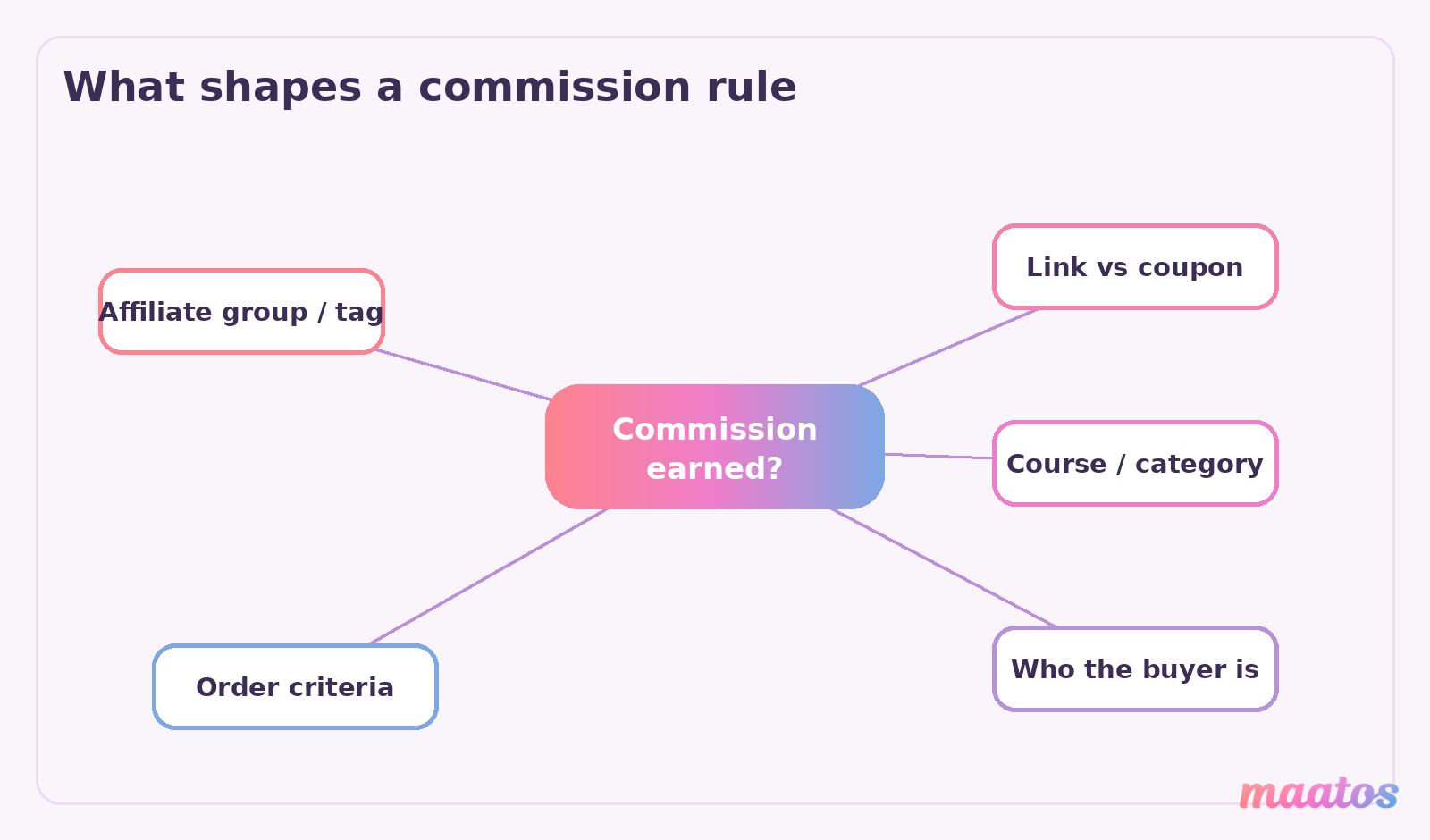
Affiliate groups and tags. You can sort affiliates into groups — your handful of star promoters, niche specialists, casual sharers — and pay each group differently. A top performer who sends real volume might earn a higher rate than someone who shares a link once. Grouping is what lets you reward your best partners without overpaying everyone.
Links versus coupons. Most tools can tell whether a sale came from a tracked link or a coupon code, and let you treat them differently. Links are clean and silent; coupons double as a discount the affiliate can offer their audience. Some creators pay a little less on coupon sales because the discount already costs them margin.
Course and category conditions. You don’t have to offer the same rate on everything. A premium certification can carry a higher commission than a €19 mini-course, simply because there’s more room in the price. Restricting bigger commissions to your premium catalog protects your margin on the cheap stuff while still motivating partners to push the high-value courses.
Who the buyer is. You can make commissions depend on the customer, not just the product — for instance, only paying out when the buyer is genuinely new, rather than an existing student upgrading a plan they’d have bought anyway.
Order criteria. Finally, you can attach conditions to the order itself: a minimum subtotal (say, no commission under €25), or excluding certain payment methods. These are the guardrails that stop tiny or awkward orders from eating into your numbers.
Single-tier versus multi-tier programs
Most course creators start with a single tier: an affiliate refers a sale, they earn a commission, done. A multi-tier (or sub-affiliate) program adds a second layer — affiliates can also earn a smaller cut of sales made by people *they* recruited into the program. The pitch is network growth: your best affiliates have an incentive to bring in more affiliates, not just more sales, which can snowball your reach and keep top partners engaged for the long haul.
It’s a powerful structure, but don’t reach for it on day one. Multi-tier programs add complexity to your payouts and can drift toward looking like a referral pyramid if the second tier is too generous. Get a clean single-tier program working first, then add tiers only if you genuinely have promoters worth recruiting recruiters.
Which rule wins when they overlap
Once you have more than one rule, two of them will eventually apply to the same sale — a category rate and a group rate, say. Good affiliate tools resolve this top-down: they check your rules in order and apply the first one that matches, so exactly one commission is paid and there’s no double-counting. The practical takeaway is to order your rules deliberately, most specific first, and to test that the right one fires before you go live.
None of this works without accurate tracking underneath it. The whole system rests on correctly tying each sale back to the affiliate who earned it — across devices, cookie windows and the gap between a click and a purchase that might come days later. If tracking is shaky, even perfect rules pay the wrong people, so it’s the first thing to verify when you test.
What’s a fair commission rate for a course affiliate?
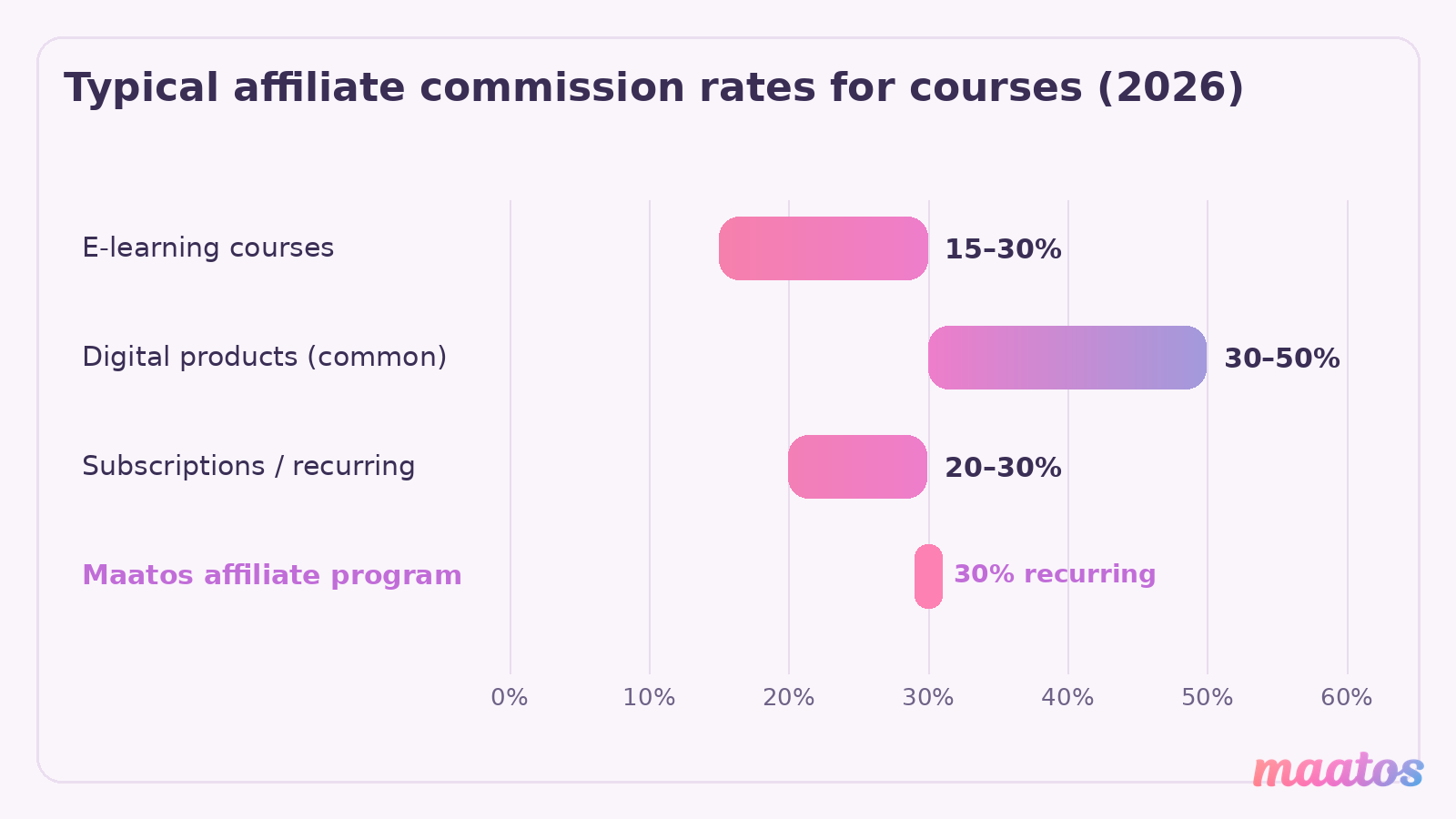
Here’s the number everyone actually wants. For online courses and digital products, affiliate commissions typically land somewhere between 20% and 50% of the sale, and for digital products specifically a competitive rate is often 30–50%. Narrow it to the e-learning niche and a solid, sustainable range is more like 15–30%. Recurring commissions on subscriptions usually sit a notch lower, around 20–30%, because they keep paying out month after month.
Why can courses afford to be this generous when a physical-product store might pay 5–10%? Because the marginal cost of one more sale is almost nothing. Handing an affiliate 40% of a €97 course still leaves you with around €58 — on a product that cost you the same to deliver to the 5th student as the 500th. The commission isn’t really an expense; it’s a sale you wouldn’t otherwise have made. That’s also why education is one of the most attractive niches for affiliates to promote in the first place, which makes a healthy rate a genuine recruiting tool.
For a real-world anchor, look at our own numbers: the Maatos affiliate program pays 30% recurring on every subscription a partner refers, with a 30-day cookie window — a deliberately strong rate because recurring software, like a good course business, has the margin to support it.
A few things shift your number up or down:
A high-value course — a professional certification or a cohort program with a long sales cycle — can justify a richer commission, because affiliates have to work harder to close it and the ticket size rewards them properly. An entry-level or mini-course usually carries a lower percentage, but you can make up for it with volume-based bonuses or seasonal promotions. And different subject categories simply behave differently; a sought-after tech or marketing course can sustain a rate that a niche hobby course can’t.
Subscriptions need two numbers, not one. Decide what you’ll pay on the first sale (the “parent” subscription) and what you’ll pay on renewals. Many creators pay a full rate up front and a reduced rate on renewals — enough to reward affiliates for sending customers who *stay*, without giving away the recurring revenue that makes a subscription worthwhile. Some pay renewals for a fixed window (the first 12 months, for example) and then stop.
Finally, you can vary the rate by who’s promoting. An influencer with a large, aligned audience might command an elevated rate; a tight group of proven top performers might get their own tier. The point is to reward the partners who actually move the needle, and to set the whole thing at a level you can pay happily, every month, without resenting it. If you can’t sustain 40% once volume picks up, start lower — cutting a rate later is far more painful than raising it.
Setting up your affiliate program, step by step
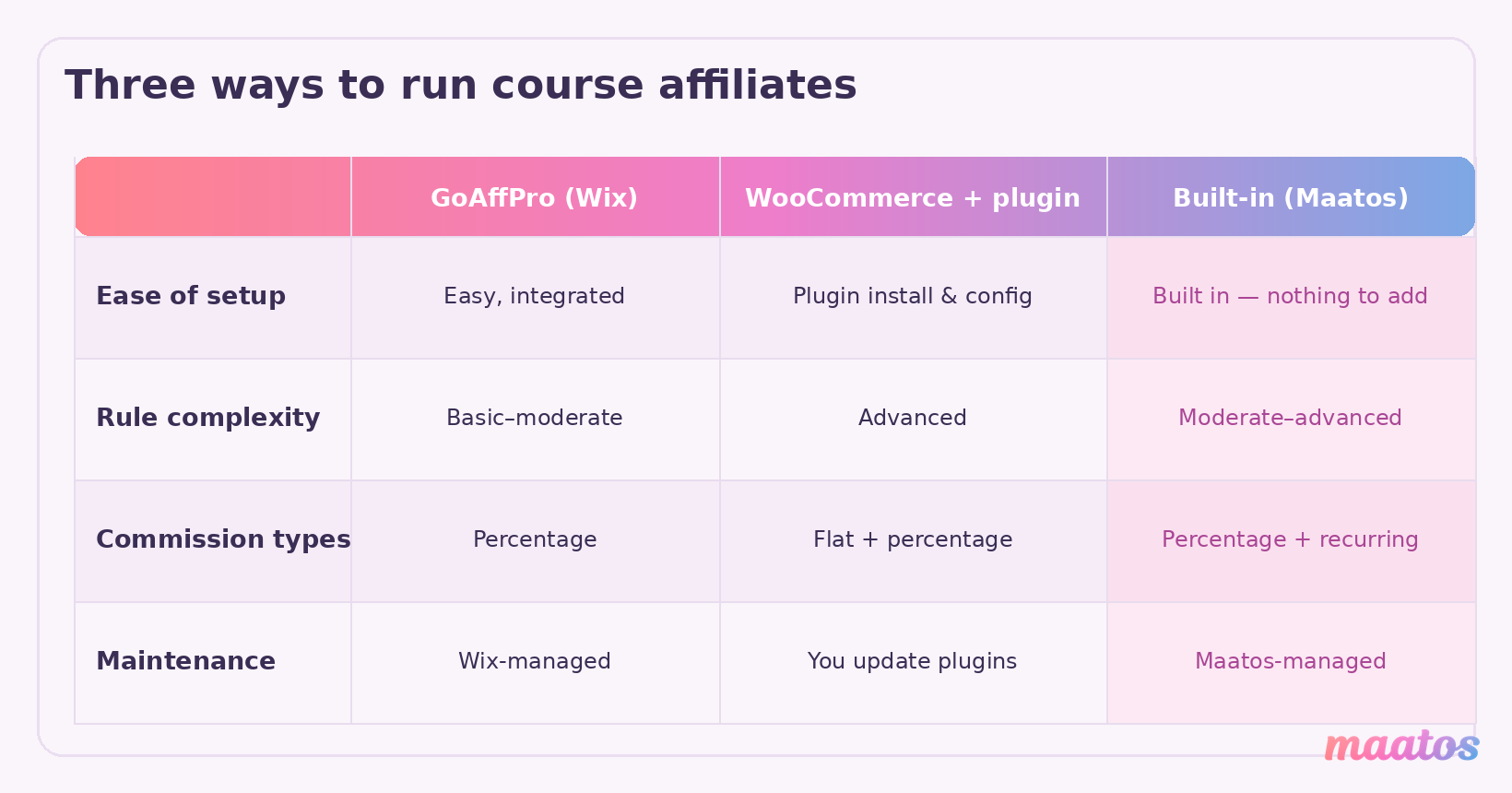
You have two honest routes to a working program. You can bolt an affiliate plugin onto a general-purpose platform you already use, or you can use a course platform that has affiliate management built in. Both work; the right one depends on where your course already lives and how much complexity you want to manage yourself.
Option A: Wix with GoAffPro
GoAffPro plugs into Wix and is a popular pick for creators who want affiliate management without leaving the Wix environment. The flow looks like this: in the GoAffPro dashboard you create commission plans (set the percentage, tied to your Wix pricing plans or individual courses — a good moment to revisit your course pricing models so commissions and prices fit together), define the rules that decide when a commission is earned (linking it to specific plans, or setting different rates for coupons versus links), apply each plan to the right pricing tier or course, organize affiliates into groups like influencers, resellers and regular promoters with their own rates, and then lean on the reporting to see which partners actually sell so you can tune the plans over time. It’s friendly and quick to stand up, with rules that stay basic-to-moderate.
Option B: WooCommerce with AffiliateWP or YITH
If your courses sell through WordPress and WooCommerce, plugins like AffiliateWP or YITH WooCommerce Affiliates give you far more granular control. You create named commission plans in the admin dashboard (“Course Launch Promo”, “VIP Affiliates”), set the rules governing them — product categories like “Online Courses”, user roles, referral method, order criteria such as a minimum subtotal — and assign plans to specific products or subscription levels, including different rates for an initial subscription versus its renewals. You can build affiliate groups with their own rates, and configure exactly how discounts, taxes, shipping and coupons affect the commission base, so you only ever pay on real revenue. It’s the most flexible route, at the cost of plugins to install, configure and keep updated.
Option C: a course platform with affiliates built in
The third route skips the bolt-on entirely: use a platform where affiliate management is already part of the product. On Maatos, the Affiliate marketing system is built into the Complete plan, alongside sales funnels, optimized checkout pages and upsells — so you set commission rules and rates in the same place you manage your courses and payments, with nothing extra to install or keep in sync. For a lot of course creators this is the calmest option: one login, one system, one less plugin that can break on an update. We’ll come back to what running it on Maatos looks like in a moment.
Set-up habits that save you headaches later
Whichever route you pick, three habits prevent most of the pain. Write your rules in plain language as you create each plan — ambiguity is what causes tracking errors and payout arguments down the line. Test before you launch by running a real purchase through both an affiliate link and a coupon, and confirming the commission lands on the right partner at the right rate. And revisit your groups and rates on a schedule, using the dashboard numbers to promote the affiliates who deliver and quietly retire rates that aren’t working. Affiliate programs reward a little ongoing gardening; they’re not set-and-forget.
Running affiliates on Maatos without losing margin
If you do run your program on Maatos, the same principle applies — precise rules are the backbone of accurate tracking and fair payouts — so define explicit triggers (which actions earn a commission: a completed enrollment, a subscription renewal), set product-specific conditions so a cheap course doesn’t pay like a premium one, add order-level filters like a minimum subtotal, and reach for multi-tier payouts only once you have promoters worth recruiting recruiters.
What makes Maatos comfortable for this is what sits underneath the affiliate system. You connect your own Stripe or Mollie account, so payments land directly with you and you stay in control of your cash flow. Crucially, Maatos takes a 0% platform fee — you pay only Stripe or Mollie’s own standard transaction fees, with no extra middleman cut skimming your commissions. And because VAT is calculated automatically and invoices go out to your customers without you lifting a finger, you always know your true net revenue before you work out what an affiliate is owed.
That last point connects to an idea we care about a lot: it makes no sense to recruit affiliates to grow your sales and then hand a chunk of every sale to a platform that charges commission on top. That’s the whole argument for keeping your platform fees at zero — the money you save on platform fees is money you can pay your affiliates instead, where it actually buys you more sales. You can see the full toolset on the features page and the exact plan that includes the affiliate system on pricing.
Frequently asked questions
What’s a good affiliate commission rate for an online course?
For most online courses, somewhere between 20% and 50% is normal, with 30–50% common for digital products and around 15–30% sustainable in the e-learning niche. Recurring subscription commissions usually sit near 20–30%. Pick a rate you can pay comfortably at volume — courses can afford to be generous because each extra sale costs almost nothing to deliver.
Should I pay commission on recurring subscription renewals?
You can, and it’s a good way to reward affiliates for sending customers who stay rather than churn. Many creators pay a full rate on the first payment and a reduced rate on renewals, or pay renewals only for a fixed window such as the first 12 months. The goal is to keep affiliates invested in retention without giving away the recurring revenue that makes subscriptions worthwhile.
Affiliate links or coupon codes — which should I use?
Use both. Tracked links are clean and invisible, ideal for blog posts, emails and link-in-bio spots. Coupon codes double as a discount your affiliate can offer their audience, which lifts conversions but costs you a little margin — so some creators pay a slightly lower commission on coupon sales to balance it out.
Do I need a separate plugin, or can my course platform handle affiliates?
It depends on your platform. General tools like Wix or WooCommerce need an affiliate plugin (GoAffPro, AffiliateWP, YITH). A platform with affiliate management built in — such as Maatos on the Complete plan — lets you run the program natively, with no extra plugin to install or keep updated.
How do I avoid paying commission on refunds or chargebacks?
Good affiliate tools let you tie commissions to settled, non-refunded orders, so a refunded sale claws back or never approves the commission. Set a clearing period (the length of your refund window) before commissions become payable, and exclude refunded and charged-back orders from the commission base.
Is the commission calculated before or after VAT?
Best practice is to base commissions on the net price — the amount you actually keep — not the VAT-inclusive total, since the VAT isn’t your revenue. On Maatos, VAT is calculated automatically and shown separately on invoices, which makes it straightforward to pay affiliates on the right number. For cross-border specifics, check the VAT and online courses in the EU guide.
Affiliate marketing rewards clear thinking more than clever tactics: decide when a commission is earned, set a rate you can pay happily for years, and put it on tooling that tracks every referral correctly. Do that and you’ve built a sales channel that grows while you teach. If you’d like that channel running on your own branded platform — affiliate system, payments and VAT handled in one place — you can start free with Maatos and have it set up in an afternoon, browse everything on the features page, or let our team build it for you with the done-for-you service. More on selling smarter is over in the Selling Courses hub.