


You built the course. You put it online. You told your list, you posted about it, you waited — and almost nobody bought.
The instinct at that point is to blame the content. It’s almost never the content. Course sales usually die somewhere much less interesting: in a decision you made months earlier about who the course was for, or in a checkout page that asks for a credit card in the wrong currency, or on a platform that keeps 63% of every sale and won’t tell you who your students are.
So here’s the honest answer to “why isn’t my course selling?” — the mistake that costs creators the most is building the course before anyone told you they wanted it. That’s number one below, and it’s the one worth reading twice. But it isn’t the only one, and several of the others are baked into the platform you’re selling on rather than the lessons you recorded. We’ve walked a lot of creators through this, and the same nine things come up again and again. Each one below comes with the fix.
Mistake 1: building before anyone asked for it
Failing to work out exactly who your course is for — and whether they’d actually pay for it — is the most expensive error in course creation, because every later decision inherits it. Without that foundation, choosing your topic is guesswork rather than a strategic decision grounded in real demand, and no amount of production polish rescues a course nobody asked for.
How to tell you skipped the research
Three symptoms show up early, usually before launch:
- Vague topics that try to appeal to everyone and end up attracting no one.
- Content with no through-line, so learners can’t see the value or the progression.
- Marketing that lands flat, because the message isn’t connected to any specific pain or goal.
If you’ve ever tried to write a sales page and found yourself stuck on the first paragraph, that’s usually not writer’s block. It’s that you don’t yet know who is on the other end of the sentence.
Validation is the step that catches this. It tests whether your idea actually solves a problem for a defined group of people. Skip it and even excellent content can fall flat, because it misses on relevance rather than quality.
What it actually costs you
Ignoring validation leads to courses that struggle to attract buyers because the positioning is unclear, campaigns that read as generic and never engage anyone, and — the painful one — months of work poured into a topic with no proven interest behind it.
Understanding exactly who your course serves lets you tailor both the curriculum and the marketing. You stop diluting the message and start making something precise, and precision is what people buy.
If you’d rather not do that groundwork alone, our done-for-you service covers the research-and-setup end of it, and the pricing page shows what that costs before you commit to anything.
Why a narrow audience outsells a broad one
A precise picture of your ideal student — their situation, their obstacle, what they’re actually trying to achieve — works as a roadmap for every decision that follows. Once you know who you’re building for, you can design lessons around specific problems, use language and examples that land emotionally, pick formats that suit how these particular people learn, and write marketing that speaks to a real person rather than a demographic.
Narrowing your focus feels like shrinking the market. It does the opposite. Instead of “anyone interested in fitness”, you’re speaking to “busy professionals who want a workout they can finish before the kids wake up” — and that person, unlike the abstract fitness enthusiast, recognises themselves and reaches for a card.
Courses built around a broad or unclear audience tend to end up with generic content that lacks depth, a mixed message that engages no one, nothing that distinguishes them from a dozen alternatives, and conversion rates that reflect all three.
Two quick examples make the difference obvious:
- “Introduction to Digital Marketing”, aimed at beginners everywhere, struggles because it covers a great deal superficially without addressing any particular learner’s situation.
- A course built for local small business owners who want affordable social media that they can actually keep up with offers a targeted, actionable solution — and can charge more for it.
Getting this right first saves time and money later, because every element of the course is aligned with demand that you’ve confirmed exists rather than demand you hope exists.
Mistake 2: launching without testing the idea first
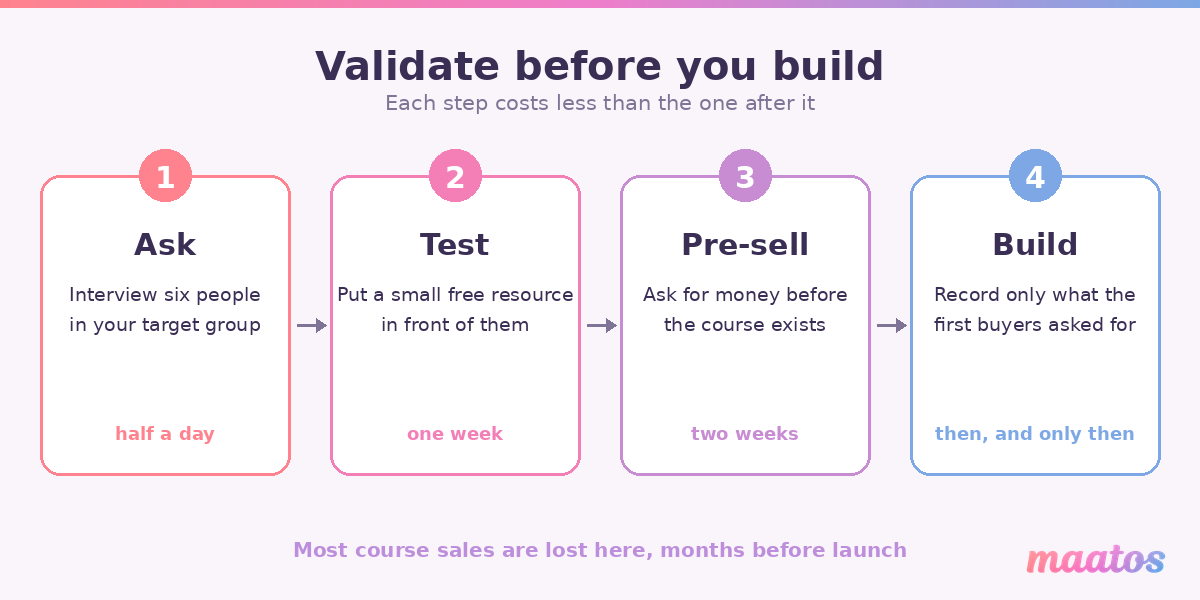
Validation isn’t a phase, it’s a handful of cheap experiments you run before you commit weeks to recording. Three work well, and you can do all three in a fortnight.
Ask people directly — properly
Surveys give you the quantitative side: interest levels, format preferences, what people expect to pay. Google Forms or Typeform will do fine; you don’t need anything fancier.
Interviews give you the part surveys can’t. Half an hour on a call with six people in your target group will teach you more than 200 survey responses, because you hear the hesitation and the wording.
Ask open questions and then stay quiet:
- What’s the hardest part of (your topic) for you right now?
- What have you already tried, and what happened?
- What would a course have to do for it to be worth paying for?
Listen for the words they use. Those words belong in your sales page more or less verbatim — you’ll never phrase the problem better than the person living it.
Put something small in front of them
A mini-course, a webinar, a checklist, a short email series — a lead magnet takes a fraction of the effort of a full course and tells you whether the interest is real. If people sign up eagerly, work through it and come back with questions, that’s a strong signal. If it takes three days to get eleven downloads from a list of 900, that’s a signal too, and a much cheaper one to receive now than after you’ve recorded fourteen modules.
Distribute through your email list, the social platforms your people actually use, or the niche forums and communities where they already gather. Use the responses to learn which sub-topics they want covered in depth.
The strongest version of this test is a pre-sell: ask for money before the course exists. Nothing validates like a card being entered. We’ve written up how to do that honestly, with and without an existing audience, in pre-selling a course without an audience and pre-selling before you build. If you’d rather build the smallest possible real version first, the lean course MVP approach covers that route.
Keep listening after you’ve decided
Validation isn’t only about confirming that interest exists — it’s about understanding why people need this. Watch for the themes that keep recurring in comments, replies and DMs. Note the language people use for their own struggle and mirror it back in your materials. And let what you hear reshape the curriculum, rather than defending the outline you drew in week one.
Mistake 3: launching to an empty room
Launching without an audience is the fastest route to a disappointing first week. With no one who already trusts you, a launch is shouting into a void: few signups, no word of mouth, and a revenue figure that doesn’t cover the microphone.
Audience building isn’t about follower counts. It’s about a group of people who are glad to hear from you and interested in the thing you teach. That takes time, which is exactly why it starts long before the course goes live.
Growing a group of people who care about your topic
Publishing useful things consistently — blog posts, videos, a podcast, whatever suits how you communicate — is what earns you a reputation as someone worth listening to. It’s slow and it compounds.
Being present where your people already are matters more than being everywhere. Pick the one or two platforms your future students actually use, and turn up as a participant: answer questions, share what you’ve learned, join the conversation rather than broadcasting into it. A creator with 800 engaged followers in one place outsells one with 8,000 scattered across five.
Free resources — a checklist, a guide, a short mini-course that solves one specific problem — turn passive readers into an email list of people who’ve raised their hand. And live formats, a webinar or an open Q&A, build more trust in an hour than a month of posts, because people get to see you think.
Turning a list into people who buy
An email list is only an asset if you use it. Send something regularly and make it genuinely useful, not just promotional. Share the build in progress — what you’re recording this week, what you got wrong — because anticipation is easier to create than attention. Ask questions and respond to the answers, so it stays a conversation rather than a broadcast.
Consistent contact is what makes you the obvious choice when the offer finally arrives. It turns cold contacts into people who already feel like they know how you think. If you want a practical structure for that, our email marketing ideas for course creators and the onboarding sequence for new students both give you sequences you can adapt.
Mistake 4: renting your audience on a marketplace
Here’s where we get to the platform mistakes proper — and this is the big one. Selling exclusively through a course marketplace means you never own the customer relationship, and you keep a minority of the revenue.
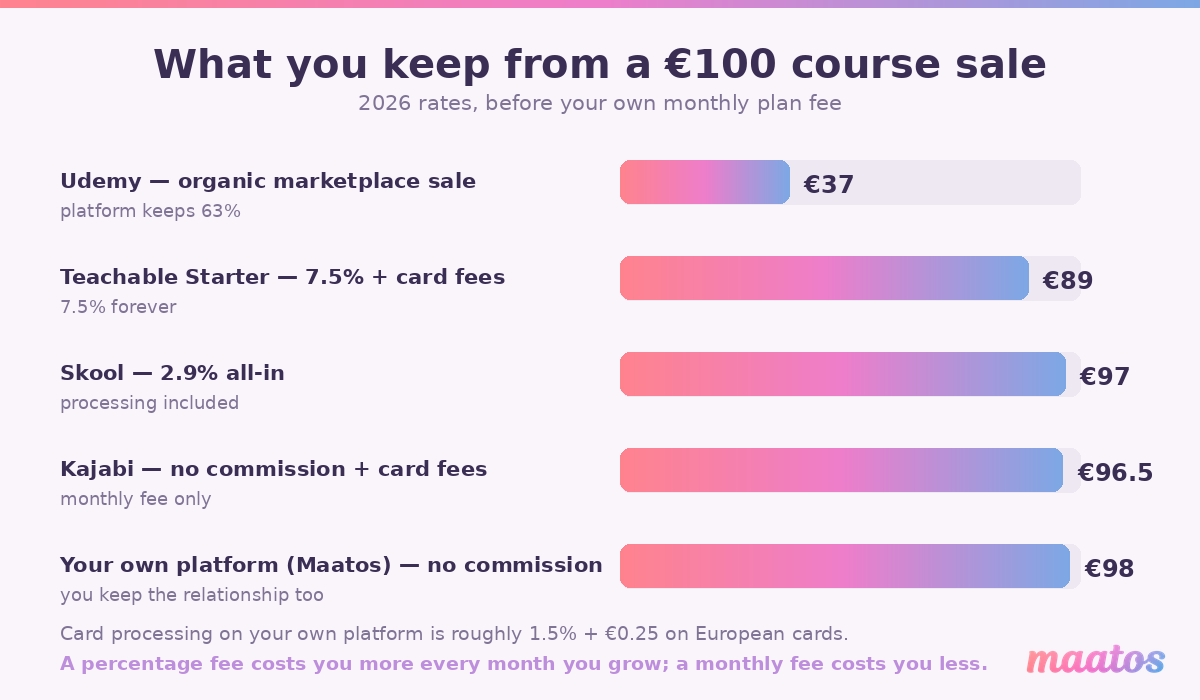
The trade is straightforward when you see it written down. A marketplace brings you students you’d never have reached; in exchange it keeps most of the money and all of the contact details. On Udemy in 2026, an organic marketplace sale pays the instructor 37% — the platform keeps 63%. Bring the buyer yourself with your own coupon link and you keep 97%, which tells you precisely what the 63% is buying: discovery, not delivery. Subscription revenue through Udemy Business pays from a pooled fund, where your share depends on how much of the total watch time your course captured.
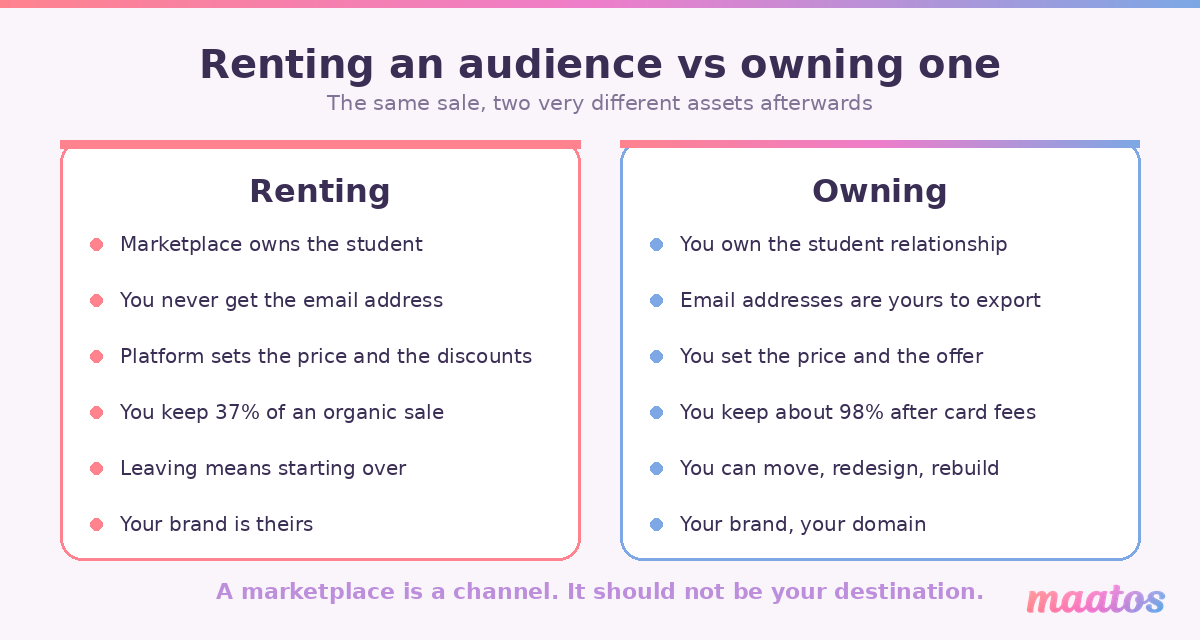
None of that makes marketplaces wrong. If you have no audience and want exposure, they put you in front of millions of learners, and that’s real. The mistake is treating a marketplace as your destination rather than a channel — because after two years on one you have revenue but no list, no pricing control, no brand, and no way to contact the 1,400 people who bought from you.
The version that works in 2026 is a sequence rather than a choice: use a marketplace for discovery if you need it, and move your main offer onto a platform you control, where the margin and the relationship are yours. We’ve laid out the full fee maths in how to stop paying platform fees, and the case for ownership over the long run in the long-term benefits of owning your course website.
Mistake 5: choosing a platform you can’t leave
Before you commit, check whether you can export your students and your content — and find out before you need to. Plenty of platforms make it difficult or impossible to take student email addresses with you. That isn’t an oversight; a creator who can’t take the relationship elsewhere is a creator who can’t leave.
Ask three questions of any platform you’re considering, and get the answers in writing rather than from a marketing page:
Can I export my student list, with email addresses, whenever I want? Can I download my own video and course files in a usable format? And if I stop paying, what happens to my content and my students’ access?
Migrating later is genuinely expensive. Creators lose months rebuilding content, re-enrolling students and losing sales through the transition. Picking on exportability up front costs nothing; discovering it in year three costs a season. If you’re weighing the underlying architecture rather than a specific brand, open-source versus SaaS course platforms walks through what each model does to your freedom to move.
With Maatos, the site is yours: your own domain, your content, your student data, exportable — and payments run through your own Stripe or Mollie account rather than ours, so the money never sits in a middleman’s balance.
Mistake 6: paying a percentage of every sale, forever
A transaction fee is a tax on growth: it costs nothing at zero sales and more every month you succeed. This is the fee structure people underestimate most, because the headline monthly price is the number they compare.
Here’s what a single €100 course sale looks like across the common setups, using 2026 rates:
| Where you sell | What the platform takes | Payment processing | You keep (per €100) |
|---|---|---|---|
| Udemy, organic marketplace sale | 63% | included | ~€37 |
| Udemy, your own coupon link | 3% | included | ~€97 |
| Teachable Starter (~$29/mo) | 7.5% | ~2.9% + €0.25 | ~€89 |
| Skool | 2.9% all-in | included | ~€97 |
| Kajabi (from ~$71/mo) | 0% | ~2.9% + €0.25 | ~€96.50 |
| Your own platform (Maatos, from €49/mo) | 0% | ~1.5% + €0.25 European cards | ~€98 |
Two things stand out. The first is that the monthly fee and the percentage fee behave completely differently as you grow: a fixed €49 is 4.9% of one €1,000 month and 0.5% of a €10,000 one, while 7.5% stays 7.5% forever. The second is that at low volume the percentage platforms are genuinely cheaper — if you sell three courses a month, a fee-based plan wins, and we’d rather tell you that than pretend otherwise. The crossover usually arrives somewhere around €700–€1,000 a month in sales. Work out where yours is before you sign up for either.
Maatos charges no commission on your sales at any plan level: Basic is €49/month excluding VAT (€40.83 if you pay annually) for up to three courses, Premium €99 for up to fifteen with subscriptions and instalments, and Complete €199 for unlimited courses plus the funnel and affiliate tooling. Every plan starts with 30 days free, and if you’re still building, the Builders plan is €10/month until you have students. The pricing page has the current detail, and our comparison with Skool, with Teachable and with Kajabi put the numbers side by side.
Mistake 7: a checkout that quietly leaks buyers
Most abandoned course purchases are lost at the payment step, not at the decision step. Someone read the sales page, decided yes, clicked buy — and then met a form that asked for a company name, offered only credit cards, showed a price in a currency they don’t use, or bounced them to a page that didn’t look like your site any more. Each of those is a small betrayal of trust at the exact moment trust matters most.
The fixes are unglamorous and they work. Offer the payment methods your buyers actually use, which varies enormously by country: iDEAL in the Netherlands, Bancontact in Belgium, SEPA direct debit and Klarna across much of Europe, Apple Pay and Google Pay nearly everywhere. Ask for the minimum information you need. Keep the checkout on your own domain and in your own branding. Show the total, including tax, before the final click. And offer instalments for anything above roughly €300 — it converts better than a discount, and you keep the full price.
We’ve collected the specific changes that move the number most in checkout optimisation quick wins, and the technical side of connecting payments properly in setting up Stripe for courses without the pitfalls. Maatos connects to your own Stripe or Mollie account, which is what gives you the local payment methods and the direct payouts; the optimised checkout pages, order bumps, upsells and A/B testing sit on the Complete plan.
Mistake 8: forgetting tax until the first foreign sale
If you sell a course to a consumer in another EU country, VAT is generally due at the rate where the buyer lives, not where you live. Digital courses are treated as electronically supplied services, and the moment your cross-border sales pass the €10,000 annual threshold, the country-of-the-buyer rule applies and you’ll want the One Stop Shop registration to file it all in one return.
This catches people out because it arrives as a surprise rather than a decision. You launch, a sale comes in from Ireland, and three months later you’re working out whether you owed 23% on it. The fix is to have the platform handle it from day one: calculate the right rate at checkout, capture the evidence of where the buyer is, and issue a proper invoice automatically. Maatos does that calculation and sends the invoices without you touching anything, which is the difference between a tidy quarterly filing and an evening with a spreadsheet.
For the general rules, handling VAT and sales tax on digital courses is the place to start, and the country-by-country VAT guides cover the specifics. None of that is tax advice — rates and thresholds change, so check the current position with your accountant before you rely on it.
Mistake 9: a course site that falls apart on a phone
More than half of the people who read your sales page will do it on a phone, and a meaningful share will try to buy on one too. If the page reflows badly, the video player fights the screen, or the checkout form needs pinch-zooming to complete, those sales are gone and you’ll never see them in any report.
Test it yourself, on an actual phone, on mobile data rather than your own wifi: read the sales page, start a lesson, complete a purchase. Most creators have never done this on their own site, and most who do it find at least one thing broken. Mobile-friendly design for course websites covers what to check.
Mistake 10: flying blind
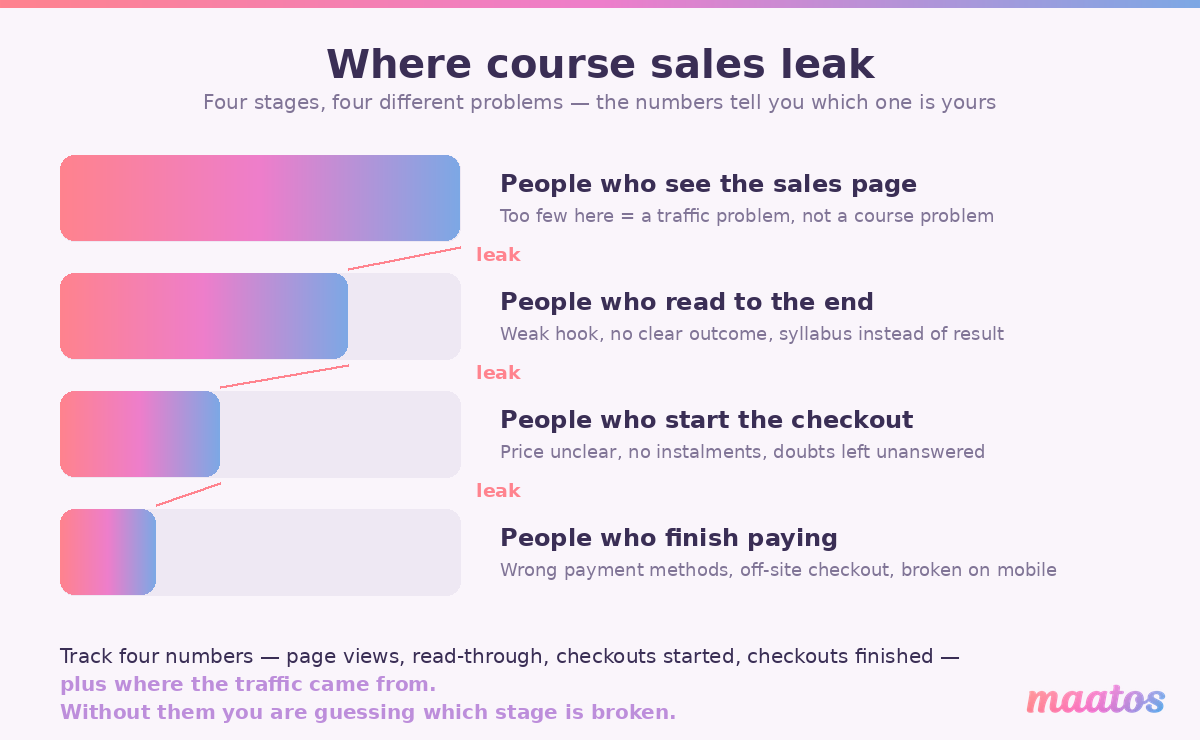
Without analytics you can’t tell the difference between a traffic problem, a page problem and a checkout problem — and each one has a completely different fix. A creator with no numbers rewrites their sales page when the real issue was that only 40 people saw it.
You need very little: how many people reached the sales page, how many started a checkout, how many finished, and where the traffic came from. Four numbers, and they turn “it isn’t selling” into a specific, solvable question. Analytics for a course website sets that up, and the analytics dashboard for course creators covers what to watch once the data is flowing. Maatos connects to Google Analytics and Search Console, and shows you student progress inside the platform, so you can also see where people stall in the course itself.
Does the course itself cost you sales?
Sometimes, yes — usually through structure rather than content. A well-designed curriculum guides learners step by step, with milestones that act as checkpoints and show visible progress. When students can see what they’ve completed and what’s next, they keep going, and students who finish are the ones who recommend you.
Long and complex kills engagement fast. Courses that sprawl overwhelm people, and overwhelmed people refund or quietly disappear. Narrow the scope and go deep on the core rather than covering everything shallowly — a course that does one thing thoroughly is easier to sell and easier to finish than one that promises everything.
Break it into pieces people can actually complete. Shorter lessons with a single clear objective are easier to absorb, easier to return to, and much easier to fit into the twenty minutes your student actually has.
Vary the format, because a two-hour wall of talking-head video is a hard sell no matter how good the content:
- Video for demonstrations and anything where watching beats reading
- PDFs for worksheets, templates and reference material people will come back to
- Text summaries so someone can revise a lesson in ninety seconds
- Screencasts for software walkthroughs
Clear structure also makes the marketing easier to write, which is the part people miss. When the curriculum has a shape, you can say exactly what someone will be able to do at the end — and that sentence sells the course. A high refund rate is often a structure problem in disguise; why refund rates run high and how to fix it goes into the patterns.
How do you name a course so it sells?
A course name should promise a result, not describe a syllabus. It’s the first thing anyone sees, and a weak one loses the reader before they reach your carefully written description.
A name that works does three things: it makes the topic instantly recognisable, it connects to something the reader actually wants, and it puts the benefit in front rather than the content list. Names that do none of those contribute directly to the problem this whole article is about — courses that never get the chance to be considered.
Five things help:
- Lead with the outcome, not the topic. Instead of “Introduction to Photoshop”, try “Master photo editing in 30 days” — the shift is from what the course contains to what the student walks away with.
- Be specific. “Marketing basics” disappears into the crowd; “Social media marketing for local businesses” doesn’t.
- Promise something concrete rather than something dramatic. A time frame, a number, a defined capability. Skip the unlock, ultimate and transform vocabulary — it’s the wallpaper of every course landing page and readers have long since stopped seeing it.
- Keep it short. Under seven words if you can. Long titles read as uncertain.
- Name the audience when it sharpens things. “A freelancer’s guide to winning clients” tells the right person this is theirs.
Three that do the job:
- “Zero to fluent: speak Spanish confidently in 12 weeks”
- “Stress-free project management for busy entrepreneurs”
- “The Instagram growth playbook for creatives”
Each makes a clear promise, names a specific person, and could not be mistaken for a syllabus. The description underneath has to do the same work — how to write a proper course description covers that, and sales page sections that convert plus high-converting course landing pages handle the page it lives on. If pricing is the piece you’re unsure about, course pricing models that convert and pricing psychology tweaks are the two to read.
Where the platform helps — and where it genuinely doesn’t
Let’s be straight about this, because the section this replaced was a sales pitch wearing a lab coat.
No platform will validate your idea for you. Mistakes one through three are yours: the audience, the testing, the list. Software cannot tell you whether people want the thing. If you skip that work, the best platform in the world will host a course nobody buys, very reliably, for €49 a month.
What a platform does decide is everything from mistake four onwards — and that’s most of the mechanical ways sales leak. Whether you own the student relationship. Whether you can leave. What percentage of each sale survives. Whether the checkout works in your buyer’s country. Whether VAT is handled or discovered. Whether the thing works on a phone. Whether you can see what’s happening.
Maatos is built around that second list. You get your own branded course website with the LMS built in, on your own domain, with hosting and the technical side handled — you’re not maintaining a server. The drag-and-drop builder means you don’t need a developer to change your sales page on a Tuesday afternoon. Lessons take video, audio, PDFs, quizzes and certificates, and there’s a forum and student progress tracking so you can see where people stall.
Payments run through your own Stripe or Mollie account, so you’re paid directly and you keep the full price minus normal processing — no commission to us at any plan level. VAT is calculated automatically and invoices go out on their own. It connects to Klaviyo, Mailchimp and ActiveCampaign so your student data stays in sync with your email tool, which is how you integrate email marketing without breaking deliverability rather than exporting CSVs every month. Yoast is built in for the SEO side. And there’s a webshop if you want to sell digital downloads alongside your courses.
The funnel-building, optimised checkout pages, order bumps, upsells, A/B testing and the affiliate system are on the Complete plan (€199/month) — worth knowing before you plan a launch around them. If you’d rather not assemble any of it yourself, our done-for-you service builds it for you, and our services page explains what that includes. If you’re still deciding whether to build it yourself at all, building your own course website and the weekend launch checklist are the practical next reads — and the rest of our guides on building a course website sit in one place.
Frequently asked questions
Why is my online course not selling?
In most cases the course was built before the demand was confirmed, or the sales are leaking somewhere mechanical — a checkout that doesn’t accept the buyer’s payment method, a page that breaks on mobile, or a marketplace keeping most of the revenue. Check your numbers first: if fewer than a few hundred people have seen the sales page, you have a traffic problem, not a course problem.
What is the biggest mistake course creators make?
Building the entire course before testing whether anyone wants it. It’s the most expensive mistake because every later decision — the structure, the price, the marketing — inherits the wrong assumption, and you only find out after the work is done.
Should I sell my course on Udemy or my own website?
Use a marketplace for discovery if you have no audience, and your own platform for the offer you actually depend on. Udemy’s organic sales pay instructors 37% and don’t give you the buyer’s email address; your own platform keeps roughly 98% after payment processing and gives you the relationship. Many creators run both, using the marketplace as a top-of-funnel channel.
How do I validate a course idea before building it?
Interview six people in your target group, put a small free resource in front of your audience to see if interest is real, and then pre-sell: ask for money before the course exists. If nobody buys at pre-sale, you’ve saved yourself two months of recording. Sales are the only validation that isn’t polite.
How much do course platforms take per sale?
It varies more than most creators expect. In 2026, Udemy keeps 63% of an organic marketplace sale, Teachable’s Starter plan takes 7.5% plus payment processing, Skool takes 2.9% all-in, and platforms like Kajabi and Maatos take no commission — you pay a monthly fee and normal card processing of roughly 1.5–2.9%. Percentage fees cost you more the better you do.
Do I need an audience before I launch a course?
You need some audience, but far less than you’d think. A few hundred engaged people who trust you will outperform several thousand passive followers. What matters is that they’re the right people and that they hear from you regularly before the offer arrives, rather than for the first time on launch day.
Do I have to charge VAT on an online course?
If you sell to consumers in the EU, VAT is generally due at the rate of the buyer’s country once your cross-border sales exceed €10,000 a year, with the One Stop Shop letting you file it all in one place. Rules differ elsewhere and change over time, so confirm the current position with your accountant — and pick a platform that calculates it and issues the invoices automatically.
How long should an online course be?
Long enough to deliver the outcome you promised and no longer. Focused courses of a few hours, split into lessons of five to fifteen minutes, consistently see better completion than sprawling twenty-hour programmes — and completion is what produces the testimonials that sell the next round.
Where to start
If you recognised your own course in more than a couple of these, don’t rebuild everything at once. Start with the cheapest fix that could plausibly be the problem: look at your four numbers, buy your own course on your own phone, and see what happens. That half-hour tells you which of these nine you’re actually dealing with.
And if the answer turns out to be the platform — the commission, the checkout, the student list you can’t get at — you can try Maatos free for 30 days and build the whole thing on your own domain before you pay anything. If you’re still building and don’t have students yet, the Builders plan keeps it at €10 a month for as long as you need. Good luck with the launch.