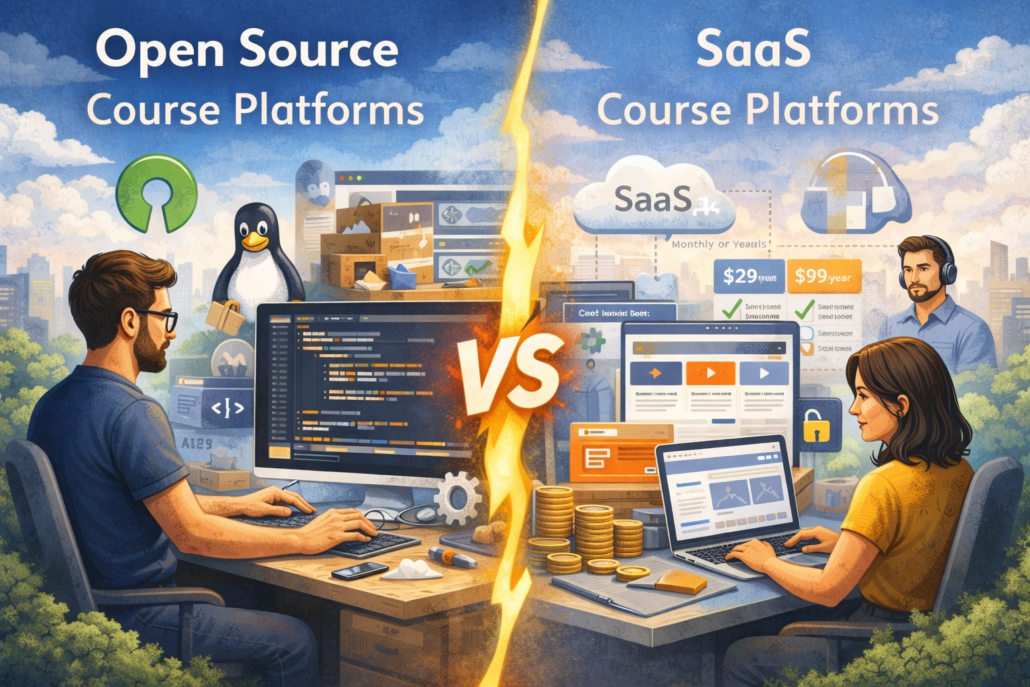
At some point, almost every course creator hits the same fork in the road. You’ve outgrown the idea of posting on a marketplace, you want your own platform — and then someone mentions “open source” and the comparison rabbit hole opens up. Open source LMS or SaaS? Free software or a monthly subscription? Full control or fast launch?
The honest answer is that neither is objectively better. They make completely different demands on your time, budget, and team — and the one that’s right for you depends on where you actually stand, not where you’d like to stand in theory. This guide walks through those trade-offs in plain terms so you can make the call with your eyes open.
If you’re still at the stage of figuring out what an LMS actually is and does, this overview of learning management systems is a good starting point before diving into the comparison.
What we’re actually comparing
Before getting into pros and cons, it helps to be precise about what each model is.
A SaaS course platform is software you access through your browser and pay for on a subscription basis. The company that built it also runs it — servers, security patches, backups, updates. You sign up, configure your settings, upload your content, and start building. Think of it like using Gmail: you don’t own the infrastructure, but it works reliably and you can reach it from anywhere.
An open source LMS is a platform where the underlying code is publicly available. You can download it, install it on your own server, and modify it however you like. Moodle and Canvas are the most widely known examples. The software licence is free, but you are responsible for hosting it, keeping it updated, applying security patches, and managing everything that keeps it running. If something breaks at 2am, that is your problem to solve — not a vendor’s support team’s.
Both approaches exist on a spectrum. There are SaaS platforms that offer more or less flexibility, and there are managed open source deployments where someone else handles the infrastructure on your behalf. But the core distinction — who bears the technical responsibility — stays the same throughout.
At a glance: how they compare
Here is a quick reference across the main dimensions before we go through each one properly.
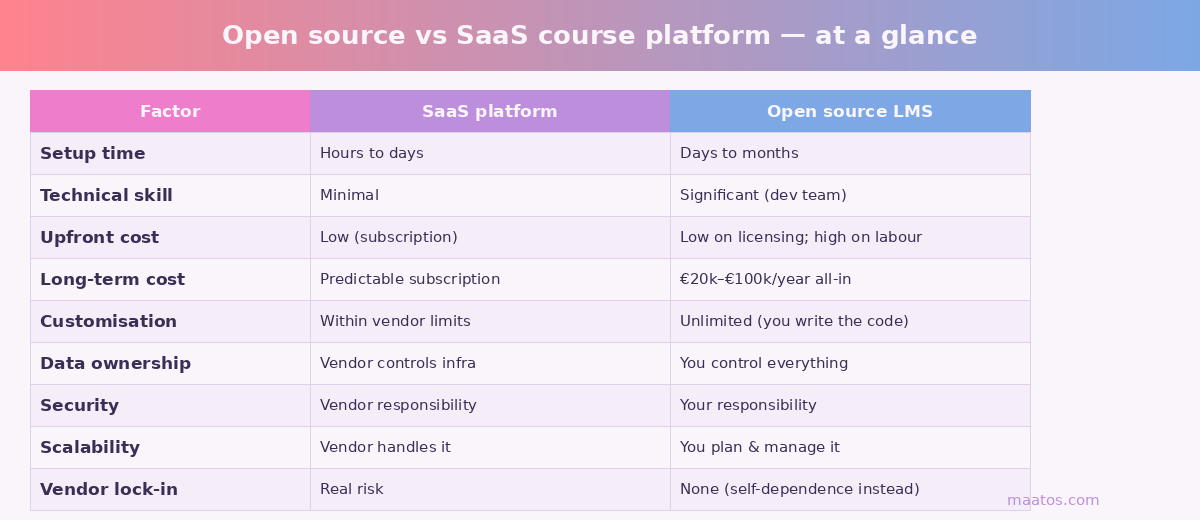
Now let’s work through each of those dimensions properly, because the one-line version rarely tells you enough to make a real decision.
How quickly can you actually launch?
With a SaaS platform, the infrastructure is already there. You create an account, upload your content, configure your branding, and start selling. Depending on how polished you want things to look on day one, you could be live in a day or a week. The technical setup has already been done by someone else — that is partly what the subscription fee is paying for.
With an open source LMS, the setup process is a different kind of project entirely. You need to provision a server (cloud or physical), install an operating system, configure a web server, set up a database, install and configure the LMS itself, and then work through whatever doesn’t connect cleanly the first time. For Moodle, the installation process alone can take several days for someone experienced — and weeks for someone learning as they go. Then you add customisation, testing, and launch preparation on top. It is not unusual for the timeline to stretch to two or three months for anything beyond the most basic deployment.
If time-to-launch matters to you — and for most course creators it does, because delayed launches mean delayed revenue and delayed feedback — SaaS wins this category clearly.
What does it actually cost?
Open source software is free to download. That part is true. But free to download is not the same as free to run, and this is where people often get surprised.
With an open source LMS, the costs are real — they are just spread out and sometimes hard to see until you are already committed:
- Server hosting, which scales in cost as your users and traffic grow
- A developer to set the platform up — and to maintain it, update it, and fix things when they break
- Security patching on the platform itself, the server operating system, and any plugins or extensions you have installed
- Your own time managing all of the above, or the cost of someone else doing it
- The opportunity cost of technical overhead that could otherwise go towards course creation and student engagement
When you count all of this honestly, a mid-sized open source deployment — a few hundred active learners, some integrations, an in-house or contracted developer — typically runs somewhere between €20,000 and €100,000 a year in total. That number surprises people who went in expecting the software to be “free.”
With a SaaS platform, you pay a monthly or annual subscription that typically includes hosting, maintenance, support, and software updates. The number goes in your budget and stays approximately there. At smaller scale, this is almost always cheaper than managing your own infrastructure. At very large scale — tens of thousands of users with consistent load — a well-run self-hosted setup can eventually become cost-competitive. But that crossover point is a long way off for most course creators, and getting there requires sustained technical investment along the way.
Customisation: how much do you actually need?
This is the question where people most often deceive themselves. The idea of “unlimited customisation” sounds compelling until you work out what you’re actually going to use it for.
Open source genuinely offers unlimited customisation. If you have developers, you can modify the underlying code, build features from scratch, and integrate with anything. A training programme for medical professionals that needs to track response time on quiz answers — because recall speed matters clinically — is something a SaaS platform almost certainly can’t do. A developer working on an open source LMS can build it. Full brand control down to every pixel, proprietary workflows, unusual data structures, specific compliance integrations: all achievable with the right resources.
SaaS platforms restrict you to what the vendor has built and chosen to expose. Most allow you to customise branding — logos, colours, sometimes layout adjustments. But you can’t change how the underlying system works. If you want the gradebook to calculate results differently and the platform doesn’t support that method, you’re stuck. If you need an integration with a tool that isn’t on their approved list, you may be stuck there too, though many platforms offer developer APIs that can bridge some of these gaps.
The useful question isn’t “which model offers more customisation in theory” — it’s “do I actually need the extra customisation that open source provides, and do I have the resources to build and maintain it?” Most course creators launching their first or second platform don’t need Moodle-level flexibility. The overhead of managing it isn’t worth the capability they’d use ten percent of.
Who owns your data — and why it matters
Data ownership is one of the more genuinely consequential trade-offs in this comparison, especially if you’re building a course business you intend to run and grow for years.
On a self-hosted open source LMS, you control everything. Learner engagement data, purchase history, progress records, personal profiles — all of it lives on infrastructure you manage. You can integrate it with your CRM, your email marketing platform, your analytics setup, entirely on your own terms. You decide what to collect, how it’s stored, who has access, and how long you keep it. This also means full responsibility for GDPR compliance and data security.
On a SaaS platform, the vendor controls the infrastructure. Data export options vary significantly — some platforms are generous and straightforward about it, others have meaningful limitations on what you can export and in what format. If the vendor changes its pricing significantly, discontinues a feature you rely on, or (in the worst case) shuts down the service, your ability to take your data and move is limited by what they’ve built into the export tools. This is a real risk, not a theoretical one: several well-known course platforms have made major pricing or policy changes over the years that left creators in difficult positions.
If data sovereignty matters for your business — because of compliance requirements, because you’re building something that depends on deep learner analytics, or simply because you want a direct relationship with your students’ data — the open source model, or a managed platform where your data lives in your own environment, has a genuine advantage here.
Vendor lock-in vs maintenance burden: the honest trade-off
These two risks are the flip sides of the same coin, and understanding both is important before committing to either path.
With SaaS, vendor lock-in is real. Your content, learner records, workflow automations, and custom configurations are all built around one vendor’s system. If that vendor raises prices significantly, you’re negotiating from a position of weakness because switching is genuinely painful. If they sunset a feature you depend on, you adapt or rebuild. Migration from one SaaS platform to another is slow, often incomplete, and sometimes means losing data or functionality you’d relied on.
The way to mitigate this is to check data export documentation before you commit, understand what the terms say about data portability, and where possible keep your most critical learner data in systems you control independently — your own email platform, your own CRM.
With open source, the vendor lock-in risk disappears entirely — but the maintenance burden lands squarely on you. Every security vulnerability discovered in the platform needs a patch you apply promptly. Every major version update needs to be tested against your custom configurations before you push it live. Every compatibility issue between a plugin you depend on and a new version of the core software is yours to debug. If your team misses a critical security patch, the exposure is on you.
None of this is a reason to rule out open source. But it is a reason to go in with realistic staffing plans and maintenance budgets, not optimistic assumptions that it will mostly run itself.
Scalability: what happens when you grow?
With a SaaS platform, scaling is largely an administrative task. You move to a higher plan tier, and the infrastructure adjusts. If student numbers jump unexpectedly after a successful launch, the platform handles the load. You don’t think about servers, database performance, or traffic spikes. That is what the vendor has built for.
With an open source LMS, growth requires planning ahead. More concurrent learners means more server capacity, database optimisation, and potentially load balancing across multiple servers. None of this is impossible for a team with the right skills. But it requires someone who knows what they’re doing, and time to do it before the growth happens rather than scrambling after. If student numbers grow faster than expected and the infrastructure isn’t ready, you risk the platform becoming slow or unreliable at exactly the moment it matters most.
The difference in practice is this: with SaaS, scalability is a feature included in your subscription. With open source, scalability is a responsibility you own and need to plan for continuously.
Platform ownership: why it matters beyond the technical comparison
The open source vs SaaS framing is often treated as a purely technical question, but there is a broader business question underneath it worth naming directly: who is actually in control of your course business?
If you sell on a marketplace like Udemy or Skillshare, you don’t own the platform or the student relationship. The marketplace sets pricing rules, commission rates, discount policies, and discoverability algorithms. Students find your courses through the marketplace’s search, not through your own brand. Owning any kind of platform — open source or SaaS — is a fundamentally different proposition: at minimum, your pricing and your student data are yours.
With a self-hosted or owned platform, you set prices independently, build direct communication channels with your students, and accumulate data that helps you improve and grow without a third party between you and that information. You can stop paying platform fees on course sales and keep the revenue in your business. Keeping an extra 20–30% on each sale doesn’t just feel better — it compounds meaningfully over time.
The comparison between SaaS and open source is a question of how you own your platform. The more important prior question is often whether you own one at all. For a longer read on why this matters, why you should build your own course website covers it well.
A third path: managed WordPress for course creators
A growing number of course creators don’t want the maintenance overhead of a raw open source LMS, but also don’t want to be fully dependent on a SaaS vendor’s product roadmap, pricing decisions, or data export limitations. For them, a managed WordPress-based platform occupies useful middle ground.
This is where Maatos sits. Built on WordPress, it gives you genuine ownership of your data and your platform without requiring you to build and maintain server infrastructure from scratch. You get your own domain and brand — no vendor logo in the corner, no co-branding constraints — full data ownership in your own environment, no transaction fees on course sales (just standard payment processor charges), and the flexibility to run cohort courses, evergreen content, memberships, or certifications alongside each other, whatever your business model needs.
Stripe and Mollie payment integrations, email marketing connections, and your own analytics setup are all built in. Support is handled, hosting is managed, and security is taken care of — but the platform and the data are yours. It suits course creators who want the independence of the open source model without the technical overhead of managing everything themselves.
If you want to see what is actually included, the features page covers it without the usual marketing gloss. Pricing is transparent and straightforward. And if you are specifically comparing this kind of owned platform against a community-platform alternative, the Maatos vs Skool comparison is worth reading too.
Who should choose what: specific profiles
“It depends on your needs” is the least useful answer a comparison guide can give. Here is an attempt at something more specific.
Open source LMS is the right choice when you have all of the following:
- An in-house development team, or a reliable contracted developer who will own, maintain, and update the installation on an ongoing basis
- Specific technical requirements that no managed platform meets — unusual integrations, proprietary workflows, compliance environments with particular data handling constraints
- Scale at which the long-term hosting and infrastructure costs become cheaper than a SaaS subscription (this typically means very large user numbers or very specific hosting requirements)
- A genuine organisational requirement for full data sovereignty, not just a preference for it
If you are missing any of those — especially the first one — open source will cost you more in time, stress, and money than the alternatives, not less.
SaaS is the right choice when:
- You are a solo instructor, coach, or small team without dedicated technical staff
- You need to launch and start generating revenue quickly, without a multi-month setup phase
- Your course delivery needs are standard — video, quizzes, certificates, payments, progress tracking — without unusual technical requirements
- Predictable monthly costs are important for how you plan and manage your budget
A managed platform like Maatos makes sense when:
- You want genuine ownership and control without managing server infrastructure yourself
- You are building a real course business with long-term ambitions, not just testing an idea on a marketplace
- Brand independence matters: your own URL, your own design, your own student relationship — no co-branding
- You want to avoid both the maintenance burden of open source and the lock-in risk of a pure SaaS platform
If you want to see what a complete build looks like step by step, building an online course platform from scratch walks through it practically. More posts in this area live in the Build Course Website hub.
Frequently asked questions
What is the real difference between an open source LMS and a SaaS LMS?
An open source LMS gives you access to the source code, which you install and run on your own server — giving you full control over customisation and data, but making you fully responsible for maintenance, security, and hosting costs. A SaaS LMS is hosted and maintained by the vendor; you pay a subscription and work within the features and limits they provide. The core trade-off is control and flexibility on one side versus speed, simplicity, and predictable costs on the other.
Is an open source LMS really free?
The software licence is free to use, but running an open source LMS is not free. You pay for server hosting, and you pay for the developer time needed to set it up, maintain it, apply security patches, and fix issues when they arise. Mid-size deployments realistically cost €20,000–€100,000 per year when all costs are counted. “Free” refers to the licence only — not to the total cost of ownership.
Which is better for a solo course creator: open source or SaaS?
For most solo course creators, a SaaS platform or a managed platform like Maatos is the more practical choice. Self-hosting an open source LMS assumes you have technical staff or a meaningful budget for contracted developers — resources most solo creators don’t have or don’t want to spend on infrastructure management. Speed of launch, predictable costs, and the ability to focus on course creation and students rather than server administration tend to matter more at this stage.
What are the vendor lock-in risks with SaaS course platforms?
Vendor lock-in on a SaaS platform means your content, learner data, integrations, and platform workflows are all built around one vendor’s system. If that vendor changes pricing significantly, discontinues features you rely on, or shuts down, migrating is typically slow and often incomplete. Mitigating this means checking data export options before you commit and keeping critical learner data in systems you control independently — such as your email platform or CRM — where possible.
Can I own my data on a SaaS course platform?
You own the content you create, but the infrastructure and data storage is controlled by the vendor. Export options vary widely by platform — some let you export learner data fully and easily, others have real limitations on format or completeness. If complete data ownership is a hard requirement — for compliance, for analytics, or because you want no intermediary between you and your students’ data — a self-hosted open source LMS or a managed platform where your data lives in your own environment is the stronger choice.
What is the difference between an open source LMS and a marketplace like Udemy?
A marketplace like Udemy hosts your courses on their platform alongside thousands of other instructors, controls pricing and discounting, and owns the student relationship. An open source LMS is software you host yourself — you control pricing, branding, student relationships, and all your data. The two have almost nothing in common except that both deliver online courses. The ownership, control, and economics are completely different propositions.
What should I look for when choosing between open source and SaaS for my course business?
The four questions that matter most are: Do you have the technical capacity to manage a self-hosted platform? Do you have customisation requirements that no managed platform can meet? How important is complete data ownership for your specific business model? And what is your realistic total budget for platform infrastructure, including developer time? If the answer to the first two questions is no, a managed platform of some kind is almost always the more sensible choice. If both are yes, the overhead of open source is worth taking on.
How does Maatos fit into the open source vs SaaS comparison?
Maatos is a managed, WordPress-based platform that sits between the two models. You get genuine ownership of your data and your brand without the maintenance burden of running a raw open source LMS yourself. There are no transaction fees on course sales, no vendor co-branding on your pages, and no restrictions on how you structure your pricing or business model. It suits course creators who want the independence of the open source model without the technical overhead of managing server infrastructure themselves.
Making the call
Open source LMS and SaaS course platforms both help you deliver courses online — but they ask very different things of you in return. Pretending the choice is purely about features misses the point. It is about what your team can realistically sustain, what your budget can handle, and how much platform control you actually need versus how much sounds appealing in theory.
If you have the technical resources and specific requirements that justify it, open source is a serious option with real advantages: full ownership, unlimited customisation, no vendor dependency. If you want to launch quickly and focus on teaching rather than infrastructure management, SaaS removes a lot of friction. And if what you are really after is a platform you own and can grow without either the maintenance burden or the lock-in, a managed platform built on solid foundations is worth looking at.
The best way to get a sense of whether that fits what you’re building is simply to see it. You can explore everything Maatos includes and start for free — no commitment needed to find out whether it is the right fit for your course business.