

“How many hours does it need?” It is the first question almost every first-time course creator asks. And underneath it there is usually a quieter worry: if my course only takes three hours, can I really charge for it? Will it feel like a “proper” course?
Here is the short version. An online course should be exactly as long as the result it promises, and not one lesson longer. There is no magic number of hours. A 45-minute course that teaches one concrete skill can be excellent; so can a twelve-week programme.
In this article we walk you through how to size your own course: working backwards from the result, how many modules and lessons you will probably need, how long a single video lesson should be (with the research behind it), and why a compact course is often worth more than a long one.
How long should an online course be?
An online course should be as long as it takes your student to reach the result you promise, and no longer. There is no minimum number of hours that makes a course “serious”.
Think of two very different courses. One teaches a freelancer to set up their bookkeeping in a spreadsheet in a single afternoon. The other takes a complete beginner to taking on their first paid photography client over three months. One is short, one is long, and both can be great. What they share is that each one delivers exactly what it promises.
So “how long should it be?” is the wrong question to start with. The better question is: what must my student be able to do at the end, and what is the shortest route there? Answer that, and the length follows. Start the other way round, from a number of hours that feels impressive enough, and you will start adding filler, and students notice it.
Why isn’t a longer course a better course?
Because students buy a result, not footage. Someone who signs up for your course wants to be able to present with confidence, run their first ad campaign or finally understand their tax return. The faster they get there, the more value you have delivered. Many of your students will be busy adults with half an hour to spare on a weeknight. For them, “I got through it in a week and it worked” is a far better story than “it took forty hours”.
A bloated course also works against you commercially, because people do not finish it. The best-known numbers come from free courses, so read them with that in mind. Justin Reich and José Ruipérez-Valiente analysed all 565 courses MIT and Harvard ran on edX from 2012 to mid-2018, covering 5.63 million learners in 12.67 million course registrations. In 2017-18, 3.13 percent of all participants completed their course, according to Inside Higher Ed’s report of their paper in Science (January 2019). Among the learners who had paid for a verified certificate, 46 percent completed.
Those are free, open courses, not the paid course you are building, so do not treat 3 percent as your forecast. But look at the second number. Even among people who had paid, roughly half did not finish. People who pay finish far more often; even so, paying does not do the work for your student.
And an unfinished course costs you more than it seems. A student who drops out halfway never gets the result, so they never write the glowing review, never recommend you to a colleague and never buy your next course. A compact course that people finish is almost always a better business than a long one that sits half-watched.
How do you work out the right length? Work backwards
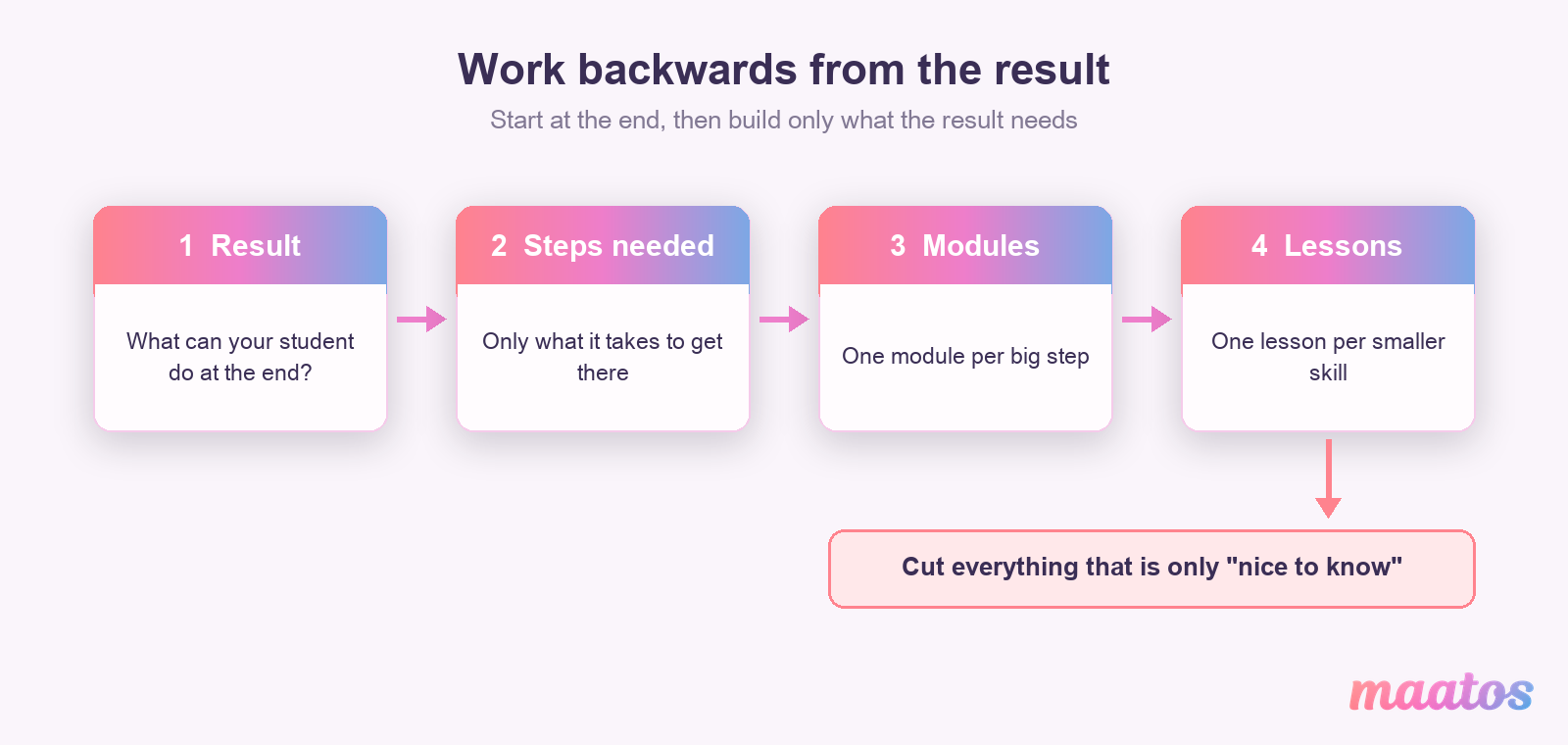
You work out the right length by starting at the end: write down the result, list the steps that are truly needed to get there, and turn those steps into modules and lessons. Then cut. This works for any topic.
In practice it looks like this.
- Write the promised result. As concretely as you can: what can your student do afterwards that they could not do before? “Understand video editing” is too vague. “Edit a 60-second product video on a phone and post it” is something you can build towards. If you need help sharpening it, we wrote a separate guide on defining clear learning outcomes for your course.
- List the steps that are really needed. Not everything you know about the topic. Only what your student must be able to do to reach that result.
- Turn steps into modules and lessons. Each big step becomes a module. Each smaller skill inside that step becomes a lesson.
- Cut everything that is “nice to know”. This is the hard part, because you are the expert. Researchers call it the curse of knowledge: once you know something well, it is hard to imagine not knowing it, so every side path feels essential. Your student does not need the history of the technique. They need to arrive.
What is left after step four is the length your course needs.
A worked example
Say you teach small business owners to make product videos. Here is how the method plays out. Treat it as an illustration of the method, not a benchmark for your topic.
The result you promise: a beginner can shoot, edit and post a 60-second product video using only their phone.
The steps that are truly needed fall into four groups, and those become four modules. Plan the shot (three lessons: what the video has to show, a five-shot list, using window light). Shoot it (four lessons: phone settings, keeping the phone steady without a tripod, getting clean sound, shooting all five shots in twenty minutes). Edit it (four lessons: trimming, order and pace, captions, music and export). Post it (three lessons: formats per platform, choosing a cover frame, a final check before you hit publish).
That is 14 lessons. At around six minutes of video each, you land at roughly an hour and a half of video (about 85 minutes), plus a short assignment at the end of each module where your student shoots and edits their own product.
What got cut? Colour grading, gimbals, a comparison of five editing apps, the story of how you got into video. All interesting. None of it needed to post a good 60-second video. Some of it could become a second, more advanced course later.
Notice that no target number of hours came into it. What decided the length was the result, and a firm hand with the cutting.
How many modules and lessons does a course need?
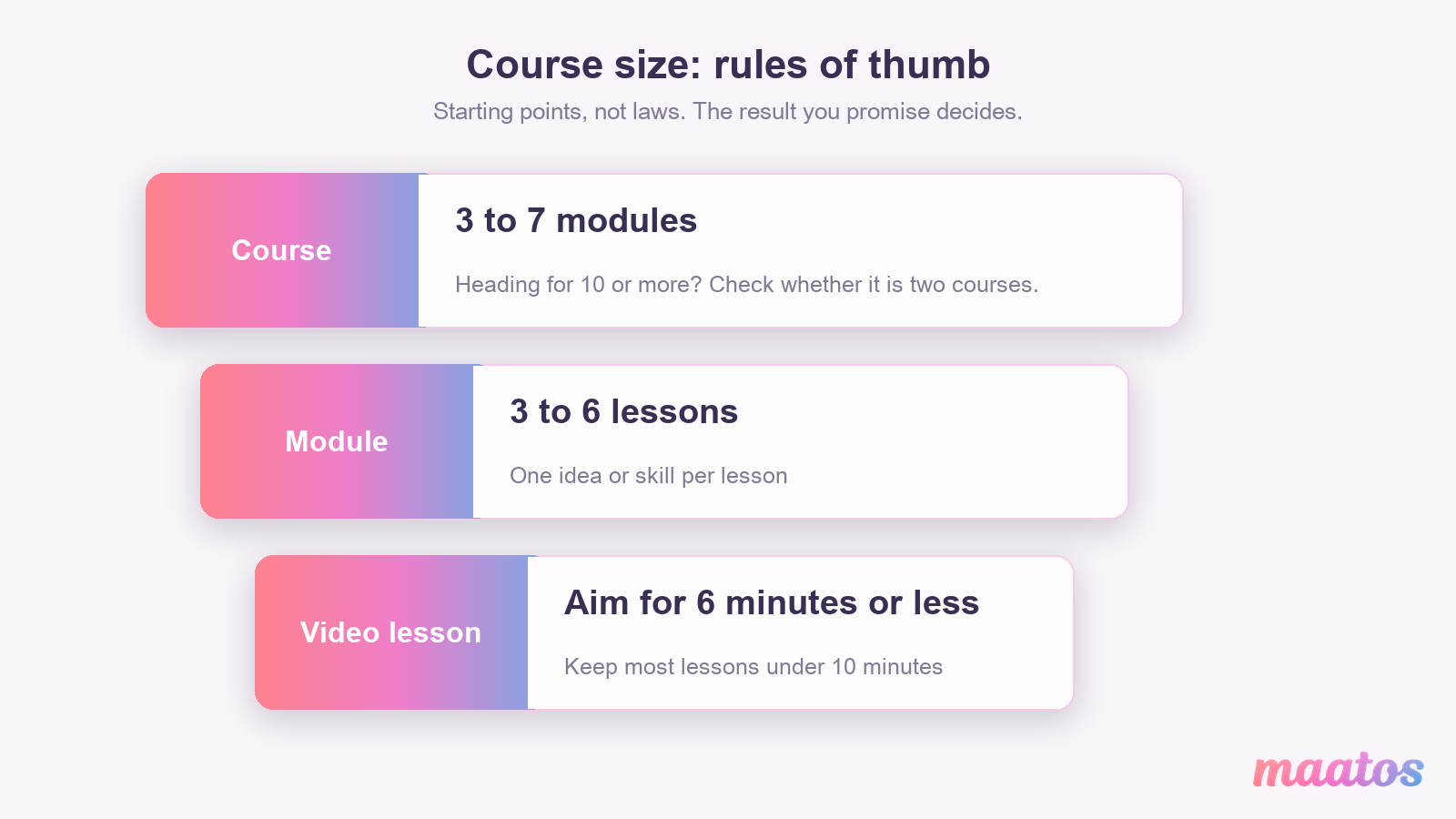
Most courses work well with three to seven modules of three to six lessons each, with one idea per lesson. That is a rule of thumb, not a law, but it holds up for a surprising range of topics.
A mini course can get by with one to three modules. A large programme can go well past seven. But once you are heading towards ten or twelve modules, stop and ask yourself whether you are building one course or two. Very often there is a beginner course and a follow-up course hiding inside one oversized plan, and splitting them makes both easier to sell and easier to finish.
Inside each module, aim for three to six lessons, and give every lesson exactly one job: one idea, one skill, one task. That rhythm is easy for students to move through, and it is kinder to you as well. A short lesson about one thing is quicker to record and much easier to update later.
The order of those modules matters as much as their number. How to sequence them so students get early wins and keep going is covered in our guide to writing a course outline students actually finish. Structure and length go together: a clean structure makes a course shorter, because nothing is repeated and nothing is there just in case.
How long should each video lesson be?
Keep most video lessons under about ten minutes, and aim for six or less. Here the rule of thumb has data behind it.
In 2014, Philip Guo, Juho Kim and Rob Rubin analysed 6.9 million video watching sessions across four edX courses from autumn 2012. They found that the median time people spent watching a video was at most six minutes, regardless of how long the video was. On videos longer than nine minutes, students often made it less than halfway through. Their recommendation to course teams was to plan lessons as chunks shorter than six minutes. The study looked at watch time in four science and engineering courses from 2012, so treat it as a strong hint, not a law.
Be careful how you read that. Six minutes is a ceiling on typical watching, not a moment where everyone switches off. A twenty-minute video does not get twenty minutes of watching; in a typical session it gets roughly the same few minutes as a shorter one. So a long video mostly adds minutes nobody watches.
There is a learning reason too. Our working memory can only hold a little new information at once, and John Sweller’s work on cognitive load (Cognitive Science, 1988) shows that overloading it gets in the way of learning. Pack five new ideas into one video and very little of it sticks. Our piece on how people learn and the four best-known learning theories puts this in the wider picture. The practical version is simple: one idea per video, and cut long material into a series of short lessons.
Whether your lessons should be short clips, longer videos or a mix of both is its own decision, and we compare the options in micro-lessons vs long videos. Once you know the length, getting the recording right is the next job: our guide to course video and audio quality helps there.
Short videos have one more benefit that has nothing to do with your students: they are much easier for you to maintain. When something in your field changes, you re-record one six-minute lesson instead of a 40-minute monster.
Which length fits which kind of course?
Roughly speaking, courses come in three sizes, and it helps to know which one you are making. These ranges are rules of thumb from practice, not research findings.
A mini course usually runs under about two hours and solves one narrow problem. It is a low-risk first purchase for a new student, and a good first product for a new creator.
A core course, sometimes called a signature course, is usually the main product, the one a creator’s business is built around. It typically holds somewhere around three to eight hours of lesson material over roughly five modules, and takes a student through a complete transformation in one area.
A programme goes further. It is longer, and the extra length usually comes from more than video: assignments with feedback, a community, live sessions or coaching calls. Much of a programme’s value is in that support, not in the hours of content.
How you deliver it affects how long it feels as well. The same eight hours can be a self-paced course people finish in a weekend or a six-week cohort with live calls. We compare those formats in drip, cohort or self-paced.
Does a longer course justify a higher price?
No. Hours say very little about price. A 90-minute course that solves an urgent, expensive problem can easily be worth more than a twenty-hour programme that is nice to have. You price the transformation, not the running time.
What does justify a higher price is the size of the problem you solve, how quickly you solve it, and what comes with the content: personal feedback, a community, live support, a certificate that means something in your field. If you are already selling and suspect you are too cheap, read our guide on when and how to raise your course prices.
So if you feel tempted to add two extra modules “so the price feels fair”, stop. You are making the course worse to make it look bigger, and your students will feel the padding long before they appreciate the volume.
The length mistakes creators make
The most common mistake is making a course too long, out of fear that compact will look cheap. Many first-time creators cram in too much. Some do it to justify the price, others simply because they know a lot and want to share all of it. The outcome is the same: a course that overwhelms your student and that you never quite manage to finish.
That leads straight to the second mistake: never launching. You keep adding lessons and polishing videos, and in the meantime the course helps nobody and earns nothing. The smarter route is to start lean. Build the compact version that just delivers the promise, launch it, and then grow it based on the questions your real students ask. Your first version does not have to be your last. We describe that approach step by step in building and launching a lean first course, and there is more on getting a first course right in our creating courses section.
A third, smaller mistake: guessing the length instead of checking it. Once a handful of students have gone through your course, look at where they stop and which lessons they replay. That tells you more about the right length than any rule of thumb, including the ones in this article.
Frequently asked questions
How long should an online course be?
There is no fixed length. Anything from under an hour to several weeks can be right, as long as every lesson moves your student towards the promised result.
How many modules does an online course need?
Most courses work well with three to seven modules, each with three to six lessons. A mini course can do with one to three modules. If you are heading towards ten or more, check whether you are really building two courses.
How long should each video lesson be?
Aim for six minutes or less and keep most lessons under ten. In a study of 6.9 million viewing sessions on edX, the median time people watched was at most six minutes, whatever the video’s length. Give each video one idea and split longer material into several lessons.
How long do students actually take to finish a course?
It depends on the course length, the format and how much time your students have each week, and there is no reliable average for paid courses. What the research does show is that many people never finish at all: in MIT and Harvard’s free edX courses, 3.13 percent of all participants completed in 2017-18, and 46 percent of those who paid for a certificate. Keeping your course compact is one of the few levers you control.
Is a short course worth less than a long one?
No. A course is worth what it achieves for the student, not how many hours it runs. A compact course that solves a real problem quickly is often worth more than a long programme that people leave half-finished.
Let the result set the length
Start from what your student wants to be able to do, keep your modules and lessons small, your videos short, and be ruthless with the “nice to know”. Then launch the compact version. You can always add a module when real students ask for it; you can never get back the months spent polishing lessons nobody needed.
Once your modules are lined up, they need a home. You can try Maatos free for 30 days and put your lessons on your own course website, in your own branding, ready for your first students.