


You’re brilliant at your subject. Nobody is arguing with that. But knowing something inside out and helping someone else learn it are two very different skills, and most of us were only ever trained in the first one. You picked up your expertise on the job, in the field, over years — not in a lecture hall on how memory works.
Here’s the reassuring part: you don’t need a teaching degree to build a course people actually finish. You just need a feel for how people learn. Educational researchers have spent a century studying exactly that, and most of their work boils down to four well-known learning theories: constructivism, behaviourism, cognitivism and humanism. Each one looks at learning from a different angle, and each one hands you a few practical moves you can drop straight into your next course. Let’s walk through all four — and, more importantly, what to do with them.
1. Constructivism: we learn by building understanding together
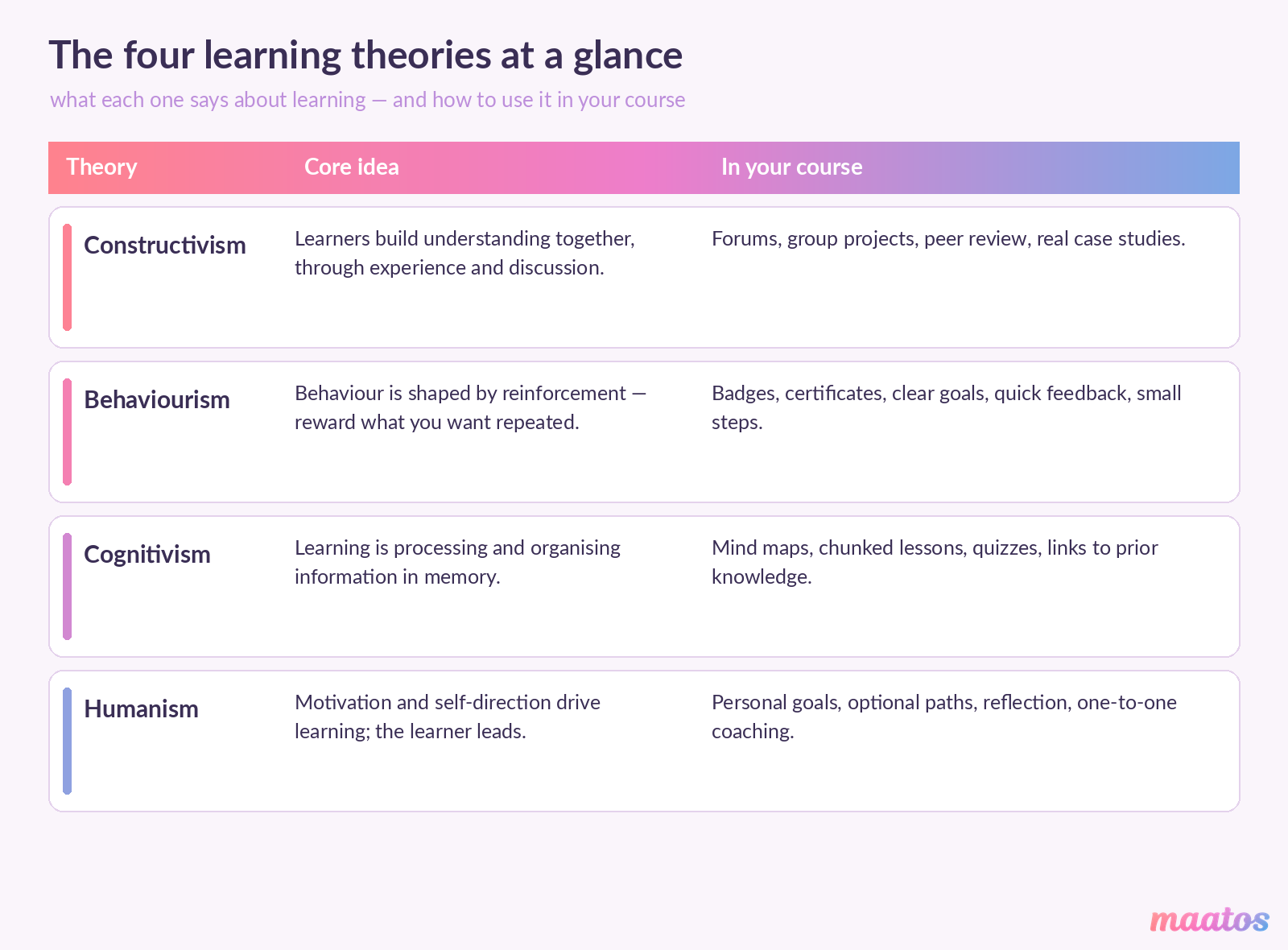
Constructivism says learning is an active, social thing. Learners don’t just pour information into their heads like water into a glass; they build understanding by doing, discussing and bumping their ideas against other people’s. Knowledge comes out of collaboration and reflection, not passive watching. The idea is usually traced back to Lev Vygotsky and John Dewey, who argued that we make sense of new material through experience and conversation rather than instruction alone.
For course design, that’s a nudge away from one-way content. A wall of videos with a quiz bolted on the end is the opposite of constructivist. The fix is to give learners something to do with the material, and someone to do it with. This is exactly why we’re such fans of building a community around a course rather than shipping lessons into a void.
A few ways to put constructivism to work:
- Open a space for discussion — a forum, a chat group, a comments thread under each lesson — where learners can swap ideas, ask the awkward questions and share what happened when they actually tried it.
- Set project-based assignments that ask learners to apply the material to something real, ideally alongside their peers.
- Use peer review, so learners read and respond to each other’s work. Half the learning happens when you have to explain why something does or doesn’t work.
- Bring in case studies — messy, real-world scenarios with no clean answer — and let the group reason through them.
If you’re weighing up whether to run your course as a live cohort or let people work alone at their own pace, this is the theory tugging you toward the group end of that spectrum — something we dig into in our guide to drip, cohort and self-paced models.
2. Behaviourism: we repeat what gets rewarded
Ever heard of Pavlov’s dogs? The behavioural psychologist Ivan Pavlov got dogs to drool at the sound of a bell — useful, in its way. Behaviourism grew out of that work (B.F. Skinner pushed it furthest) and it studies how behaviour is shaped by what follows it. In plain terms: reward the behaviour you want more of, and it tends to come back.
That sounds clinical, but it’s quietly at work in every course that keeps people moving. Desired behaviour — finishing a lesson, posting in the group, handing in an exercise — gets recognised. Progress gets visible. You’re not bribing anyone; you’re just closing the loop so effort feels like it counts. This matters most in structured paths, coaching programmes and skills training, where momentum is everything.
Behaviourism in practice looks like:
- Recognising progress with completion badges, certificates or a simple progress bar that fills as learners go. Small wins, made visible.
- Setting clear, specific goals so learners always know what “done” looks like — which starts with writing proper learning outcomes for your course.
- Giving feedback quickly and often, so people find out they’re on the right track while it still matters, not three weeks later.
- Breaking content into small, manageable steps, each with its own little moment of “nice, done that.”
3. Cognitivism: we learn by organising information in our heads
Cognitivism is often pitched as behaviourism’s opposite, though it’s a touch more subtle than that. Where behaviourism looks at the outside — what shapes behaviour — cognitivism looks inward, at how the mind takes in, stores and retrieves information. It grew from the work of psychologists like Jean Piaget and Jerome Bruner, and it treats memory, attention and existing knowledge as the real machinery of learning.
The practical upshot: learning sticks when new information has somewhere to land. A new idea that connects to something the learner already knows gets remembered; a free-floating fact gets lost by Tuesday. Your job is to structure material so it’s easy to slot in — which is also why a clear course skeleton matters so much. (We wrote a whole piece on building a course outline students actually finish.)
To lean on cognitivism in your course:
- Use visual structure — diagrams, flowcharts, mind maps — to show how the pieces fit together, not just what each piece is.
- Build in active repetition. Quizzes, short summaries and spaced recall beat re-watching a video every time.
- Add reflection prompts that ask learners to put an idea in their own words and connect it to what they already know.
- Keep lessons short and focused so working memory isn’t drowning — the case for micro-lessons over long videos is largely a cognitivist one.
4. Humanism: we learn when we’re motivated and given room to grow
Humanism puts the learner, not the curriculum, at the centre. Drawing on thinkers like Abraham Maslow and Carl Rogers, it holds that learning is driven by motivation, self-direction and a genuine desire to grow. People are individuals with their own goals and their own pace, not identical units to be marched through a fixed syllabus.
At first glance that feels impossible to pull off online, at scale, for strangers. But it’s more doable than it sounds. You don’t have to hand everyone a blank canvas — you just have to leave a little room for choice. Shorter modules people can pick and mix, optional deep-dives, the odd coaching session for individual steering: all of it gives learners a sense of ownership without you writing a bespoke course for each one.
Humanism in a course tends to mean:
- Letting learners set their own goals and judge their own progress against them, rather than only against your test.
- Offering choice — multiple modules, tracks or electives — so people can shape their own route through the material.
- Weaving in reflection on personal and professional growth, not just content mastery.
- Making space for one-to-one contact — a coaching call, personalised feedback — where it’s worth it, so learners feel seen.
Wait — aren’t there five learning theories?
You’ll sometimes see a fifth name on these lists: connectivism. It’s the newest of the bunch, proposed by George Siemens and Stephen Downes around 2005, and it’s the one practically built for the internet age. Connectivism argues that in a world of search engines, communities and AI, learning is as much about knowing where to find knowledge and how to navigate a network as it is about holding facts in your own head.
We’ve kept the focus on the classic four because they’re the foundations — the ones that shape how you actually structure lessons. But connectivism is worth a nod, especially online: every time you point learners toward a community, a resource library or a curated reading list instead of trying to cram everything into the course itself, you’re being a little bit connectivist. Think of it as the four theories, updated for a connected world.
How to combine learning theories into one good course
Here’s the thing worth underlining: no strong course runs on a single theory. Understanding them one at a time is useful, but the magic is in the mix. The best online courses borrow from all four, because real learners aren’t all the same — some thrive in a group, some want to be left alone with the material, some live for the badge, some just want the freedom to explore.
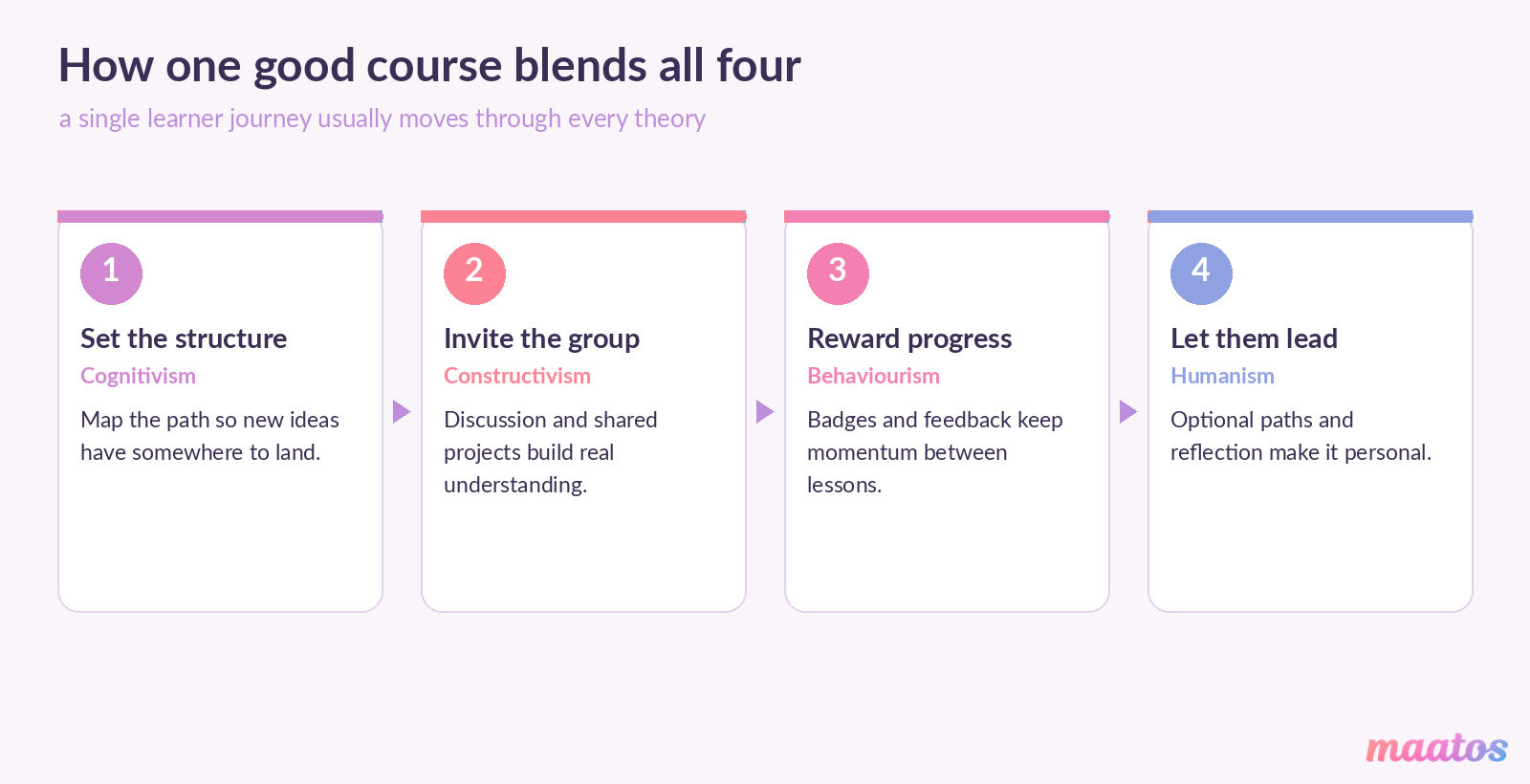
In practice, a single course usually moves through every theory in turn. You open with a clear structure and a mental map of where things are going (cognitivism). You leave room for people to set personal goals and wander down the paths that interest them (humanism). Along the way you get them talking, building and reviewing together (constructivism). And you keep the momentum up by recognising progress and giving quick feedback (behaviourism). Same course, four lenses.
That blend is what lets one course speak to a wider range of people. It’s a balancing act — structure against freedom, the individual against the group, guided instruction against self-discovery — and getting it roughly right is what turns a tidy content dump into a course people finish and recommend. The good news is you don’t need four separate tools to do it; a platform that handles lessons, community, quizzes, progress tracking and certificates in one place lets you weave all four together without the technical headache. (That’s a fair bit of what Maatos does, if you’d rather not stitch five plugins together yourself.)
Which learning theory fits your teaching style?
Reflecting on these four doesn’t just improve your course — it tells you something about yourself as a teacher. Most of us have a natural lean. If you love a lively discussion and learn best by arguing things out, you’re probably a constructivist at heart. If you’re all about clear goals and visible progress, behaviourism is your comfort zone. If you obsess over how ideas are structured and remembered, that’s the cognitivist in you. And if you instinctively want to meet each person where they are, hello, humanist.
None of those is the “right” one — but knowing your default helps you spot your blind spot. The discussion-lover often forgets to give the structure cognitivists crave; the structure-lover forgets to leave humanist room to breathe. Once you can name the four, you can deliberately borrow the moves that don’t come naturally to you, and your courses get rounder for it.
If the technical side of building all this — the lessons, the community, the quizzes, the certificates — is the part that makes you want to lie down, that’s exactly the worry we take off your plate. You can have us build the whole platform for you with our done-for-you service, lean on our design and strategy services when you need a hand, or just check what fits your budget on our pricing page. You bring the teaching; we’ll handle the tech.
Frequently asked questions
What are the four main learning theories?
The four most widely taught learning theories are constructivism (we learn socially, by building understanding through experience), behaviourism (behaviour is shaped by reinforcement and reward), cognitivism (learning is how we process and organise information in memory) and humanism (motivation and self-direction drive learning). A fifth, connectivism, is often added for the digital age.
Which learning theory is best for online courses?
There isn’t a single best one. The most effective online courses blend all four: clear structure (cognitivism), room for personal goals (humanism), discussion and collaboration (constructivism) and visible progress with quick feedback (behaviourism). Matching the mix to your topic and audience matters more than picking a winner.
Do I need to understand learning theory to create a good course?
No — you don’t need a teaching qualification to build a course people love. But a working feel for these four theories helps you make better calls about structure, interaction and motivation, which is the difference between a course people start and a course people finish.
What is connectivism, and why isn’t it one of the four?
Connectivism is a newer theory (from around 2005) arguing that, in a networked world, learning is partly about knowing where to find knowledge and how to navigate communities and tools, including AI. It’s increasingly relevant online, but the classic four remain the foundations most course design is built on, so we treat connectivism as a modern add-on rather than a replacement.
Ready to put this into practice?
You now have four lenses for the same question — how do I help this person actually learn? — and a handful of concrete moves for each. The next step is simply to build something and try it on real learners. Start your own course platform free with Maatos and put these theories to work on a course that’s unmistakably yours. For more guidance as you go, our creating courses hub is full of practical guides for new instructors. You’ve got the knowledge — this part’s yours to run with.