

Every December someone emails a course creator the same question: “Can I buy your course for my sister?” Most creators say yes, then improvise. A code gets typed into an email at 23:40 on the 23rd, nobody knows when it expires, and the VAT on that sale gets booked however the checkout happened to book it.
You can do better than that in an afternoon. Selling your online course as a gift comes down to three decisions: how the buyer pays and the recipient gets in (a gift voucher code, or you enrol the recipient yourself), what the buyer actually receives on the day (a voucher they can print or forward), and which rules sit on top (validity, refunds and the EU VAT rules for vouchers). This guide walks through all three, with the setup in Maatos where it applies and a checklist at the end.
Can someone buy your online course as a gift?
Yes, and you do not need a special gift checkout to make it work. A gift is just a purchase where the person who pays and the person who learns are different people. Your only job is to separate those two moments cleanly: the buyer pays now, the recipient gets access later, under their own name and email address.
That last part matters more than it looks. If the buyer simply checks out as normal, the course lands in the buyer’s account. Then they either share their login (awkward, and it breaks your progress tracking and certificates) or they email you asking to move it. Both are avoidable if you decide the route before the first gift order comes in.
As of October 2026, some course platforms have a gift button built in. Kajabi has gift offers, LearnWorlds has a buy as a gift option and Thinkific has gifting for creators who use its own payment processor. They come with conditions: Kajabi’s works on one-time purchase offers only, Thinkific’s excludes subscriptions, payment plans and free products, and LearnWorlds needs its shopping cart switched on and leaves out subscription and instalment products. Podia’s help centre says it has no gifting option and describes a coupon workaround. Maatos has no gift button either, so here is what we recommend instead. There are two routes that work on almost any course platform, including ours.
Route 1: a gift voucher code the recipient redeems
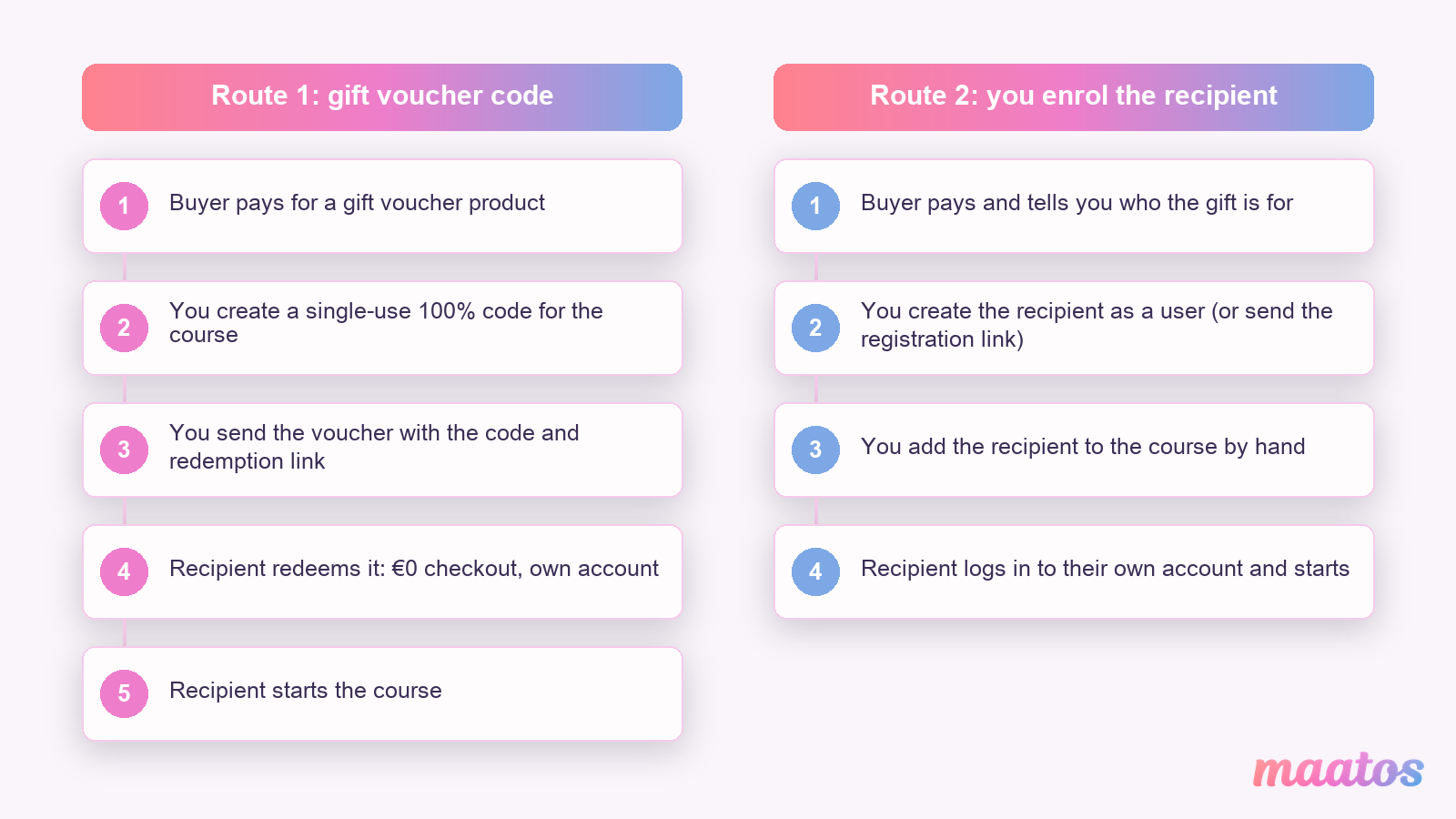
The buyer pays for a gift. You send them a single-use code that gives 100% off your course. They pass it on, and the recipient enters it at checkout, pays nothing, creates their own account and starts. This is the route to use when you expect more than a handful of gift orders, or when the buyer wants something to wrap.
In Maatos this runs on coupon codes. Our help article on coupons describes how you create one: you can give a percentage or a fixed amount off, limit the code to specific products (so a gift code for your beginner course cannot be used on your masterclass), mark it for individual use so it cannot be stacked, and set a usage limit. For a gift you want 100% off, one product and a usage limit of one. The same article recommends a usage limit on any 100% code, for example a single use, so the code cannot be shared online and used again and again.
Two practical details from our help centre are worth knowing before December. First, you create codes one at a time; a generator that makes many codes in one go is only available in a custom environment. That is fine for twenty gifts and tedious for two hundred. Second, you can build a link that opens your checkout with the course already in the basket and the code already applied, by adding the product ID and the code to your checkout address. Put that link (or a QR code of it) on the voucher and the recipient never has to type the code. They only fill in their own details to create their account.
How does the buyer pay for the gift in the first place? The cleanest way is a separate product, for example “Gift voucher: Sourdough at Home”, priced the same as the course. Maatos lets you sell products other than courses through the same platform, so the buyer goes through your normal checkout, VAT is calculated and they get an invoice, just like any other order. What Maatos does not do is send the code automatically when that product is bought. There is no dedicated gift checkout. You get the order, you create the code and you send the voucher, which is a two-minute job per order and the main reason to set a cut-off date (more on that below).
Route 2: you enrol the recipient yourself
The buyer pays, tells you who the gift is for, and you add the recipient to the course by hand. In Maatos you create the recipient as a user (or send them your registration link) and then add them to the course from its management screen. No code, nothing to lose, nothing to leak.
This route suits a small number of gifts, gifts where the buyer wants the course ready on a specific morning, and organisations buying for a team. For that last case our knowledge base describes the reverse of a shop order: you create the order, send the employer the invoice and give them a code with a usage limit that matches the number of seats (or one code per employee). It is the same mechanism as a gift voucher, used as a licence code.
The trade-off is that you handle a recipient’s personal details yourself and the timing depends on you. If the buyer pays on 22 December and you are offline until the 27th, Route 2 is the wrong choice.
What should the buyer actually receive?
The buyer is not buying a code. They are buying the moment their friend opens something on the 25th and smiles. A string of letters in an order confirmation does not deliver that, so send a voucher: a one-page PDF they can print, fold into a card or forward by email.
A good course voucher answers every question the recipient will have without needing the buyer:
- what the gift is, in plain words (the course name and one line on what they will be able to do afterwards)
- who it is from, with space for a personal message
- how to redeem it: the redemption link or QR code, and the code itself as a fallback
- until when the code can be redeemed, and how long access lasts once they start
- who to contact if something does not work
Here is what that looks like for an obviously made-up course:
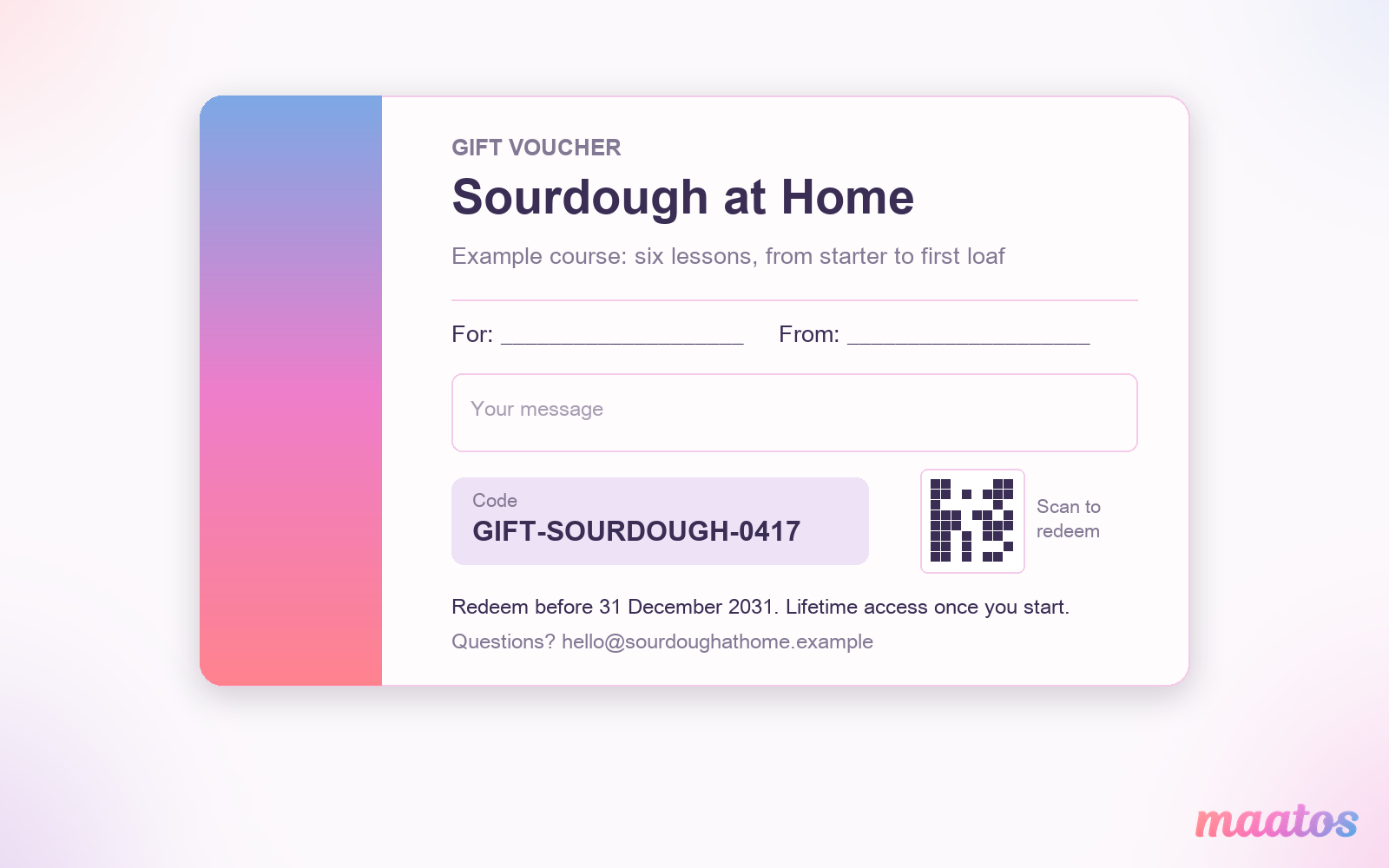
Two wordings you can borrow and adapt. A warm one for consumer gifts: “Someone thinks you’d love this. This voucher gives you full access to Sourdough at Home, six lessons from starter to first loaf. Redeem it before 31 December 2031 at the link below and the course is yours, at your own pace.” And a plain one for business buyers: “This code gives one person full access to Course name. Redeem it before 31 December 2031 at the link below. Access lasts 12 months from the day the course is started.”
Notice the difference between the two dates in that second wording. The redeem-by date is about the code. The access period is about the course. In Maatos you set the access period per course; it is lifetime by default and can be shortened to days, weeks, months or years, and our help centre says it counts from the moment the course is started. So a voucher that sits in a drawer until February does not quietly eat into the recipient’s access. Write both dates on the voucher anyway, because the recipient does not know how your platform counts.
How long should a course gift voucher stay valid?
Longer than you probably think, because a year can be too short. There is no single European rule; voucher expiry is national law, and the differences are big. In Ireland, the Consumer Protection (Gift Vouchers) Act 2019 says a gift voucher with an expiry date must be valid for at least five years from purchase, according to the Irish consumer authority. In the Netherlands, since 1 January 2022 a clause in consumer terms that limits a gift voucher’s validity to less than two years is void as unreasonably onerous (Staatsblad 2021, 506). Other countries have their own rules, and some have no specific rule for vouchers at all.
So check the rules of your own country (and, if you actively sell to customers in other countries, theirs too) before you print a date. If you sell across Europe and want one simple policy, the generous option is also the safe one: give vouchers a long validity, or none at all. For a digital course that costs you very little, since an unredeemed voucher takes no seat and no time.
Two habits keep you out of trouble wherever you are. Put the expiry date on the voucher and in the confirmation email, not only in your terms. And decide in advance what you will do when someone writes in two weeks after it expired. Many creators simply reactivate the code for a polite customer; it costs you nothing, because nobody has taken the seat.
What if the voucher is never redeemed?
Then you were paid for a course nobody took, and two questions follow: does the buyer get their money back, and what happens to the VAT?
On refunds, start with your own terms and your country’s consumer law. EU consumer law gives buyers of digital content and digital services a right of withdrawal in many online sales, and the details (when it starts, when it ends once the service has begun) depend on what exactly was sold and how. A gift voucher adds a twist because the buyer and the user are different people. The simplest fair policy is to put it in writing on the product page: whether the buyer can cancel within the withdrawal period, and what happens after that. If you would happily refund an unused voucher in January, say so. It is a selling point.
The VAT side has a specific EU answer for part of it, which brings us to the question most creator guides skip.
Do you charge VAT when the voucher is sold or when it is redeemed?
It depends on whether your voucher is a single-purpose or a multi-purpose voucher, and since 2019 EU law defines both. Council Directive (EU) 2016/1065 (read on 30 October 2026), adopted on 27 June 2016, added voucher rules to the EU VAT Directive for every voucher issued after 31 December 2018.
In the VAT sense, a voucher is something the seller has to accept as payment, or part payment, for goods or services, where the goods or services or the seller are named on the voucher or in its terms. A paid gift code for your course fits that description. A 25% discount code does not: the directive says instruments that only entitle the holder to a discount, without a right to the goods or services themselves, are not covered. So your Black Friday code is just a lower price; your gift voucher is something else.
A voucher is single-purpose when, on the day you sell it, you already know two things: the place of supply of the course it will be exchanged for, and the VAT due on it. For single-purpose vouchers, VAT is charged when the voucher is sold (and again on each resale by a business acting in its own name), and handing over the course later is not a separate transaction for VAT.
Every other voucher is multi-purpose. For these, nothing is taxed when the voucher is sold. VAT is due when the course is actually supplied, so at redemption, and it is calculated on what the buyer paid for the voucher.
So the real question is: when you sell the voucher, do you know which country’s VAT applies and at what rate?
For a course sold to private customers in other EU countries, that country is normally the customer’s country. The rules for where an online course is taxed differ for automated courses and live online teaching (our guide to VAT on online courses in the EU walks through both). With a gift, the customer who will use the course is the recipient, and you often do not know where they live when the buyer pays. That pushes a cross-border voucher towards multi-purpose. If, on the other hand, everything you sell is taxed in one country at one rate (for example because all your customers are in your own country, or because you sell automated courses, are established in the EU and stay under the EU-wide €10,000 threshold for cross-border digital sales, so your home rate applies everywhere; that threshold does not cover live teaching), your gift voucher can be single-purpose and you simply charge VAT at the sale.
The European Commission’s 2024 assessment of the voucher rules backs that reading. It summarises a judgment of the EU Court of Justice from 18 April 2024 (case C-68/23) as saying that single-purpose status depends on the place of supply to the end consumer being known when the voucher is issued, and an earlier case (DSAB Destination Stockholm, C-637/20, 28 April 2022) in which a city card whose VAT was not known at issue was classed as multi-purpose.
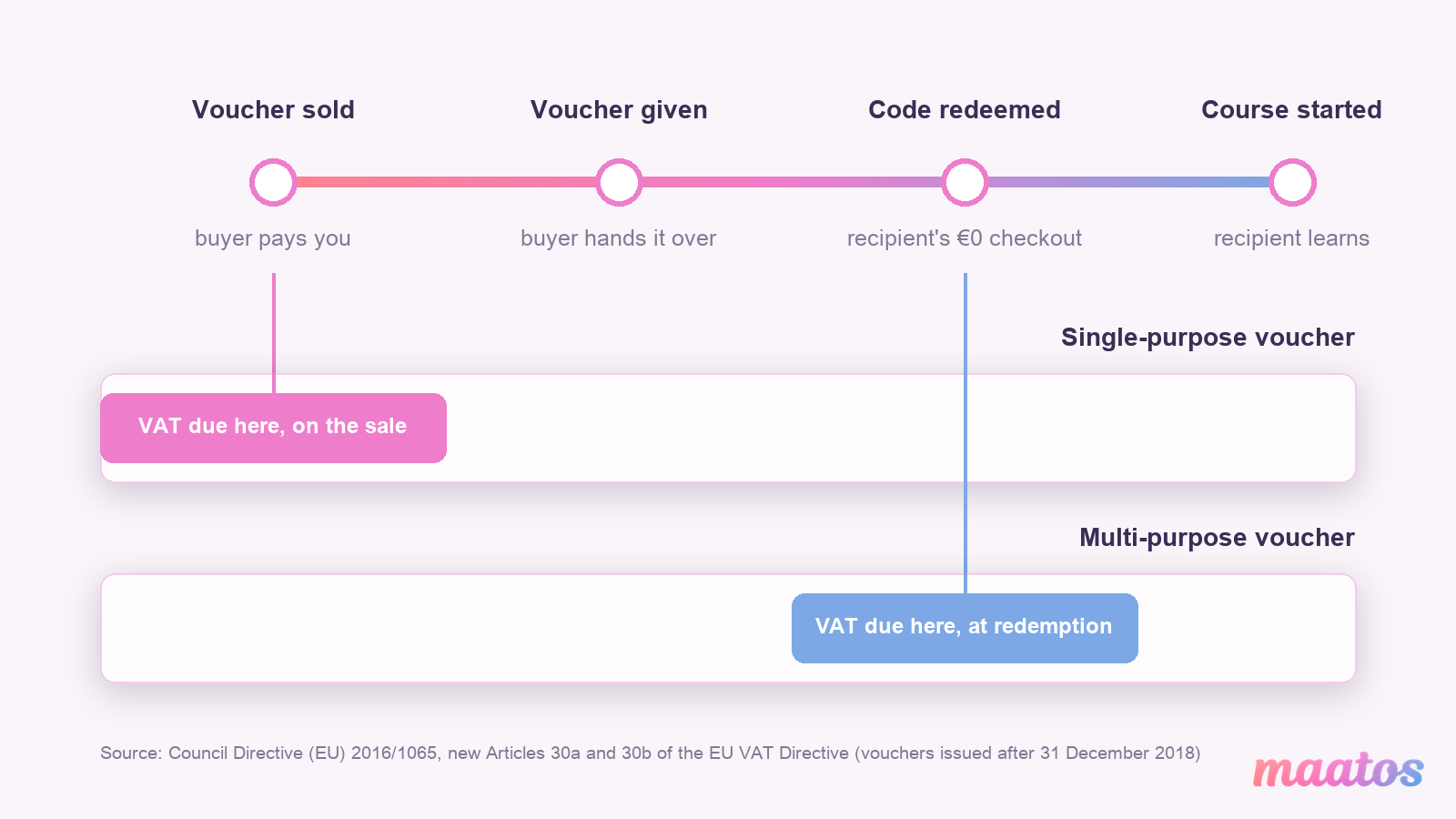
What this means in practice. Your checkout calculates VAT on the order that carries money, the buyer’s order for the voucher product, at the rate for the buyer’s location. The recipient’s redemption is a €0 order. So your checkout always behaves as if the voucher were single-purpose and taxed in the buyer’s country. That is right only when the buyer’s country is also where the course is taxed. If your vouchers are multi-purpose, or the recipient lives elsewhere, the VAT belongs to the moment and (usually) the country of redemption, and your bookkeeping has to correct it. Treat this as a question for your accountant before December rather than after it, and bring them the facts: which countries you sell into, whether you charge one rate or per-country rates, and how many gift vouchers you expect.
And the unredeemed voucher from the previous section? The directive explicitly does not cover a multi-purpose voucher that is never redeemed and whose payment the seller keeps. That is left to each country, so it is one more line for the accountant.
When should you start promoting course gifts before Christmas?
Earlier than feels natural, and with a firm last order date. Some gift buyers are done in November; others are still looking in the last week before Christmas. You want both, and the late ones only work out if your delivery is fast and your cut-off is clear.
Pick your last order date by working backwards from your own availability. If you send vouchers by hand (Route 1 with manual codes, or Route 2), the cut-off is the last day you are sure to be at your desk, not the 24th. Say it on the product page, in your emails and on the voucher product itself: “Order by 21 December and your voucher arrives the same day.” After that date you can keep selling with honest wording, such as “a voucher you can print or forward”.
Then give gift buying its own visible place. Add one line and a link to your course sales page (“Buying this for someone else? Get it as a gift voucher”), mention it in your November and December emails, and keep the gift product out of the way of normal buyers so nobody buys a voucher for themselves by mistake. If you are wondering what to put on that sales page, our post on sales page sections that convert covers the structure, and these checkout quick wins help the recipient’s €0 checkout go smoothly too.
Should you also discount the gift? That is a pricing decision, not a gifting one. A gift voucher sells because it solves a present problem, and it usually needs no extra reason. If you are thinking about a December promotion anyway, read when a course discount actually pays off first. More on pricing and launching sits in our posts on selling courses.
Your gift voucher kit: the checklist
Everything above fits on one page. Set it up once in October or November, test it, and December becomes a matter of answering orders.
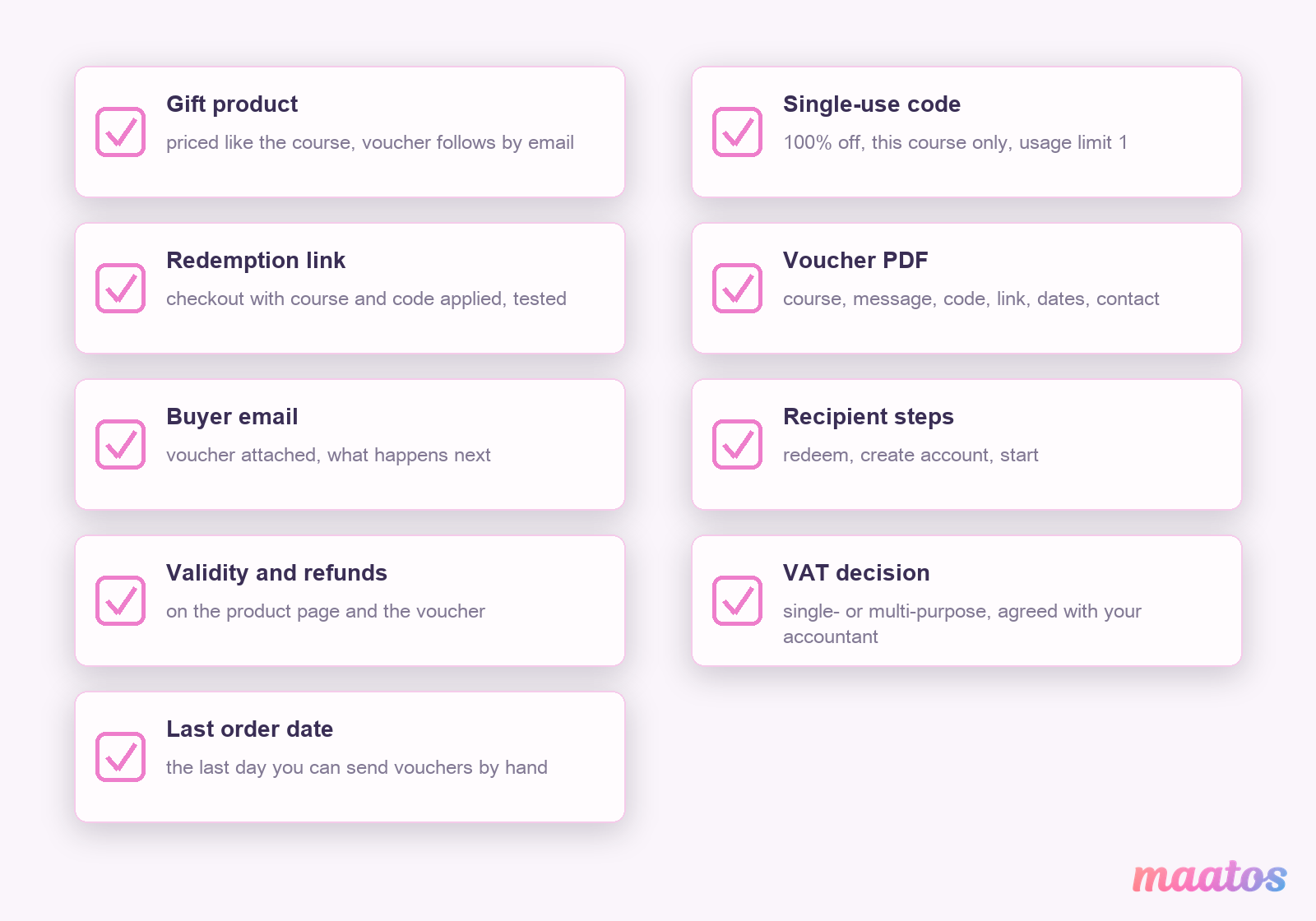
Start with the product the buyer pays for, at the course price, with a clear name and a line on the page saying a voucher follows by email. Create your first single-use 100% code limited to the course, then build the redemption link and test it in a private browser window until you land in a €0 checkout with the course in the basket. Make the voucher template once, with fields for the code, the message and the dates. Write the email that goes to the buyer with the voucher attached, and the short instructions the recipient will read. Put the validity and the refund policy on the product page and the voucher. Have the VAT conversation with your accountant. And set your last order date.
Then run the whole thing once as a customer: buy the voucher, redeem it with a second email address, and start the course. It takes ten minutes and it is the only way to see what your buyer and recipient will see.
Frequently asked questions
Can someone buy my online course as a gift for someone else?
Yes. Either sell a gift voucher that the recipient redeems with a single-use 100% code, or take the payment and enrol the recipient in the course yourself. Both keep the course in the recipient’s own account.
How do I sell a gift voucher for an online course?
Create a gift product at the course price, sell it through your normal checkout, and send the buyer a voucher with a single-use code that gives 100% off that one course. In Maatos you can add a redemption link that opens the checkout with the course in the basket and the code applied.
Do I charge VAT when the voucher is sold or when it is redeemed?
Under the EU voucher rules that apply since 2019, VAT on a single-purpose voucher is due when it is sold, and VAT on a multi-purpose voucher is due when it is redeemed. It is single-purpose only if you know the country of taxation and the VAT due on the day you sell it, which is often not the case for cross-border gifts.
How long should a course gift voucher stay valid?
It depends on the country: Ireland requires at least five years for gift vouchers with an expiry date, the Netherlands two years in consumer terms, and other countries have their own rules. Check yours, lean towards a long validity, and print the expiry date on the voucher itself.
What if the person never redeems it, can the buyer get a refund?
That depends on your terms and your country’s consumer law, including the withdrawal rules for digital content and services. Decide your policy in advance and state it on the product page; refunding an unused voucher on request is generous and easy to sell.
When should I start promoting course gifts before Christmas?
From November, with a last order date based on when you can still send vouchers by hand. Add a gift line to your sales page and your November and December emails, and say clearly when a voucher will arrive.
Set it up during your free trial
If you are building your course on Maatos, everything in the kit (the gift product, the single-use codes, the redemption link and the course access settings) is part of the platform you get in the 30-day trial, no credit card needed. Start your free trial, build the gift voucher in an afternoon, and buy one from yourself before the first real buyer does.