


Systeme.io’s free plan is one of the best deals in the course world, and we say that as the competitor. Two thousand contacts, unlimited emails, a course, three sales funnels and your own domain, for nothing, with no card. If you are testing whether anyone wants your course at all, it is hard to argue with.
So here is the short answer. Systeme.io is a marketing machine that also does courses: funnels, email, webinars and checkout first, priced in US dollars by how many contacts you have. Maatos is a course website first: your own branded site with a full learning environment behind it, priced in euros by how many courses you offer, with a designer who can build the site with you. Both are European companies, so this is not a “US platform versus EU platform” story. It is a funnel tool versus your own course platform, and the right answer depends on which of those your business actually is.
We are not neutral. Maatos is our product, and you should read everything below knowing that. What we can do is check our claims harder than theirs and give Systeme.io the credit it earns. Every Systeme.io figure here comes from Systeme.io’s own pricing page and help centre, and every Maatos figure from our pricing, features and Done-for-You pages, all read on 9 October 2026. Prices move, so check the date before you quote this back at anyone.
What does Systeme.io do better than Maatos?
Price, marketing tools and breadth. If your business runs on a list and a sequence of pages, Systeme.io gives you more of that machinery for a lower subscription than ours, and it is not close.
Every Systeme.io plan, free included, sends unlimited emails, has sales funnels, automation rules, an affiliate programme you run yourself, a booking calendar, coupons and 0% transaction fees. The paid plans add evergreen webinars (from the $47 Webinar plan), raise the limits on A/B tests, upsells and order bumps, and go up to unlimited websites, blogs and communities. You can take payments through Stripe, PayPal, Mollie and a long list of regional processors, and Systeme.io’s help centre documents iDEAL and Bancontact through Stripe for euro sales. It even offers a free migration of your existing business on the Unlimited monthly plan or any annual plan, done by hand, in 17 days on average according to its help centre (its migration page quotes 2 to 5 business days for simple moves).
Maatos does none of the email marketing itself. We connect to tools like Klaviyo, Mailchimp and ActiveCampaign and keep your student data in sync, but you bring and pay for the email tool. Sales funnels, order bumps, upsells and A/B testing exist on Maatos only on the Complete plan at €199 a month. If you read those two paragraphs and thought “the funnel stuff is the whole point”, Systeme.io is probably your answer, and you can stop reading here with our blessing.
Is Systeme.io really free?
Yes, with three limits worth knowing before you build on it: a $10,000 lifetime cap on sales, a badge you cannot remove, and contact-based limits that grow with your list rather than your revenue.
The cap is the one people find out about late. Systeme.io’s help centre says free accounts have “a lifetime sales revenue limit of $10,000 USD”: a warning banner appears at $8,000, and at $10,000 “your payment pages will stop accepting new sales” until you upgrade. That is lifetime, not per month. For a test, it is generous. For a course you plan to sell for years, it is a launch date for your first bill. Its terms add that sales in other currencies, euros included, are converted to dollars for this cap, so the exchange rate moves the line, and that you get three days to upgrade once you hit it.
The badge is the second. On the free plan, Systeme.io shows an affiliate badge on your pages that earns you a commission when someone signs up through it, and its help centre is plain about it: “users on the Free plan cannot remove the affiliate badge.” Removing it starts at the $17 Startup plan.
The third is the shape of the limits. The free plan covers 2,000 contacts, 3 sales funnels, 1 course, 1 blog and 1 custom domain, and its comparison table lists 500 students. Systeme.io describes its plans as “based primarily on contact limits”, and a contact is anyone on your list, buyer or not. A free lead magnet that does its job can move you up a plan before you have sold a single extra course.
None of that is a trick. It is a free plan built to graduate you onto a paid one, and it is clear about it if you read the help centre. Just read it before you build a business on top of it.
What do Systeme.io and Maatos cost in a year?
Systeme.io costs $0, $170, $470 or $970 a year on annual billing. Maatos costs €40.83, €82.50 or €165.83 a month billed annually, about €490, €990 or €1,990 a year, plus a €10 a month plan for building before you have students. Systeme.io quotes US dollars and Maatos quotes euros excluding VAT, so we give each one in its own currency and leave the conversion to you.
On Systeme.io, the paid plans are Startup at $17 a month, Webinar at $47 and Unlimited at $97. Pay annually and you get two months free: $170, $470 and $970 for the year. There is also a custom plan for teams with no public price. Its terms say subscriptions are not refundable, and if a paid account goes over its plan’s limits you get three days to reduce your usage before the subscription is upgraded automatically.
On Maatos, Basic is €49 a month (€40.83 a month billed annually) for up to 3 courses. Premium is €99 a month (€82.50 annually) for up to 15 courses, with subscriptions, instalments, an appointment calendar and your own domain set up for free. Complete is €199 a month (€165.83 annually) for unlimited courses and the selling tools: affiliate system, sales funnels, optimised checkout pages, order bumps, upsells and A/B testing. The Builders plan at €10 a month gives you every feature except students, for as long as you need to build. Every plan starts with 30 days free without a credit card, and every plan includes unlimited video storage, unlimited students and no limit on sales.
What you will not find on either side is a cut of your sales. Systeme.io lists 0% transaction fees on every plan, and our pricing FAQ says there are no costs beyond the subscription; on both, your payment provider (Stripe, Mollie, PayPal and so on) charges its own processing fee, which you pay anywhere. If you want to see how much a platform commission costs over a year on the platforms that do charge one, we did the sums in our piece on keeping more of every course sale.
Systeme.io’s paid plans start at $17 a month and ours at €49 excluding VAT. Convert at today’s rate and check whether VAT is added for your country, but for most people the Systeme.io subscription will be the smaller one. We are not going to argue with arithmetic. The more useful question is what makes each bill go up.
What makes your bill go up on each platform?
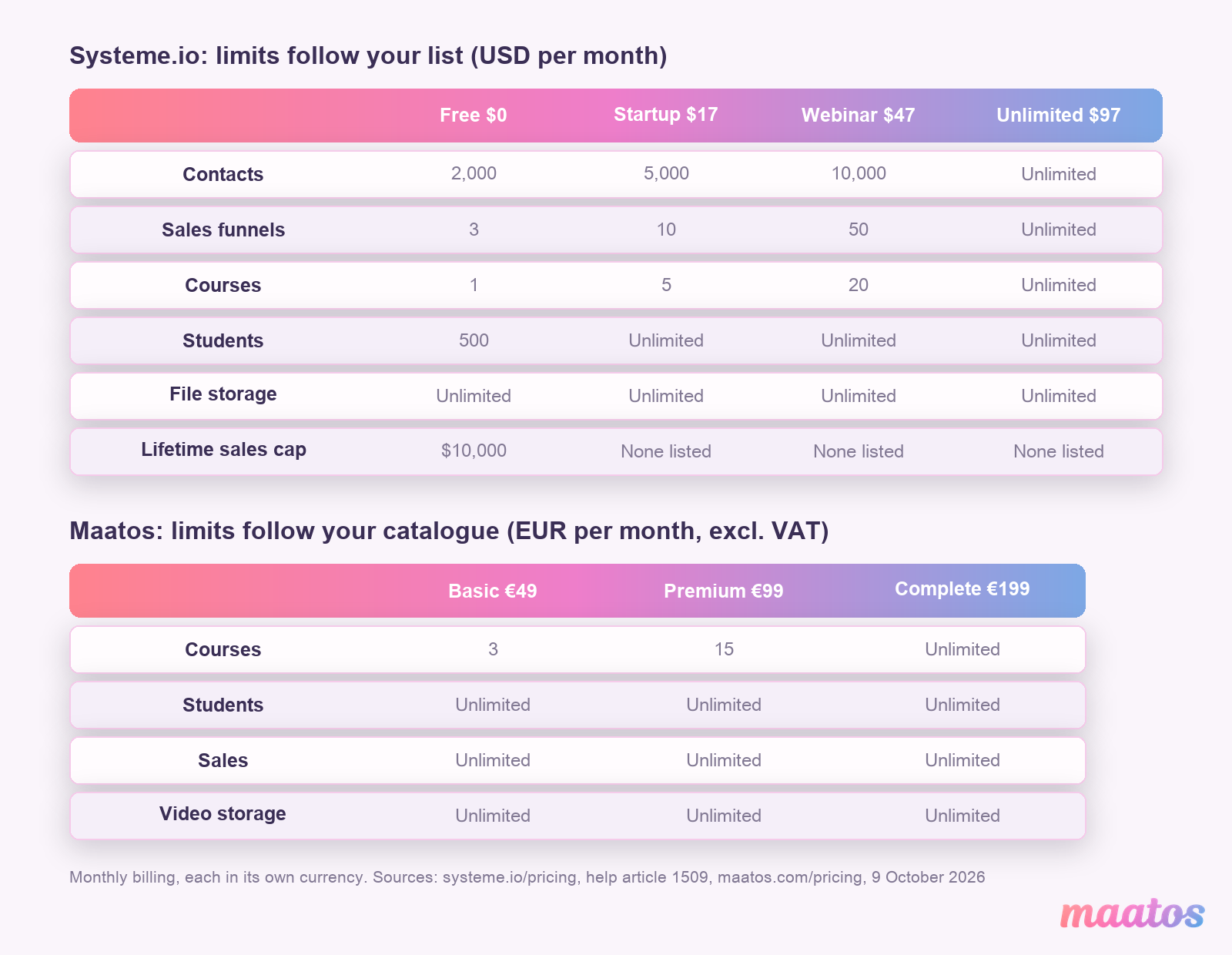
On Systeme.io, your bill follows your list: contacts, funnels, campaigns and courses each have a ceiling per plan. On Maatos, your bill follows your catalogue: the number of courses is the main limit, while students, sales and video storage stay unlimited.
That difference sounds technical, but it changes the economics of a growing course business. Say you run a free mini-course or a webinar that collects 6,000 email addresses, and 150 of them buy. On Systeme.io you are past the Startup plan’s 5,000 contacts because of the 5,850 people who did not buy, so you are on Webinar at $47 a month. On Maatos the list lives in your email tool, so the email tool’s own pricing applies there, and if you sell three courses you are on Basic whatever the size of your list.
The reverse is also true, and we should say it. If you sell lots of separate small products, Systeme.io’s Startup plan includes 5 courses where our Basic plan includes 3. Count your own catalogue and your own list before you look at either price page.
Our own ceilings are not invisible either. Our pricing FAQ applies a fair-use policy of around 200 lessons per course, including 200 or more videos; past that there is no hard cut-off, but a higher plan keeps the site fast. And if a site passes about 5,000 active monthly users, we get in touch to talk about options.
Can you sell online courses on Systeme.io?
Yes, and properly. Systeme.io’s help centre documents quizzes per module, completion certificates with your logo and signature, drip schedules, assignments, course bundles, student progress exports and communities you can sell as a product. Video can be uploaded directly (up to 2 GB per file) or embedded from elsewhere.
One caution: Systeme.io’s own pages do not always agree with each other. On 9 October 2026 its online-courses page said it “does not have native certificate generation”, while a help article updated in February 2026 explains how to issue certificates on completion. The pricing FAQ calls the Startup plan’s funnels “unlimited”, while the comparison table on the same page says 10. That is not a reason to avoid it. It is a reason to test the exact feature you need on the free plan before you rely on it.
Maatos covers the core of that list from a different angle. Our features page lists video, audio and PDFs, quizzes, certificates, a forum, drag and drop for both the course and the website, and student management that shows where people get stuck, and our pricing FAQ adds that video is hosted on a dedicated server protected against downloading. We have a forum rather than Systeme.io’s communities. Our features page does not list drip schedules, assignments or bundles, so if you need one of those, ask us before you choose.
Where does a course business outgrow a funnel tool?
Usually in three places: how the site feels to a returning student, how far you can take your own brand, and how much of the setup you are doing alone at eleven at night.
A funnel is built to move a stranger in one direction, towards a checkout. That is exactly right for a launch. A course business also has people who come back every week: students looking for lesson four, a past buyer checking whether there is a follow-up course, someone comparing your programme with another one. Those visitors want a website with a home page, a course catalogue and a login that feels like your school, not a sequence of steps. Systeme.io can build a full website with a blog and navigation, and its website builder page says so plainly. It also compares itself, on that same page, with Wix, which it says has “more design templates and a more polished visual editor”. We would rather you heard that from them than from us.
On Maatos, the website is the product. Your course site runs on your own domain with your own colours, logo, content and styling, built in a drag and drop editor, and the learning environment sits behind it as part of the same site. That is the difference we are betting on: when someone types your name into a browser, they land on your school, and it looks like you.
The third place is the one nobody prices in. Building a good course site takes evenings, and most course creators would rather spend those evenings on the course.
Who builds the site for you?
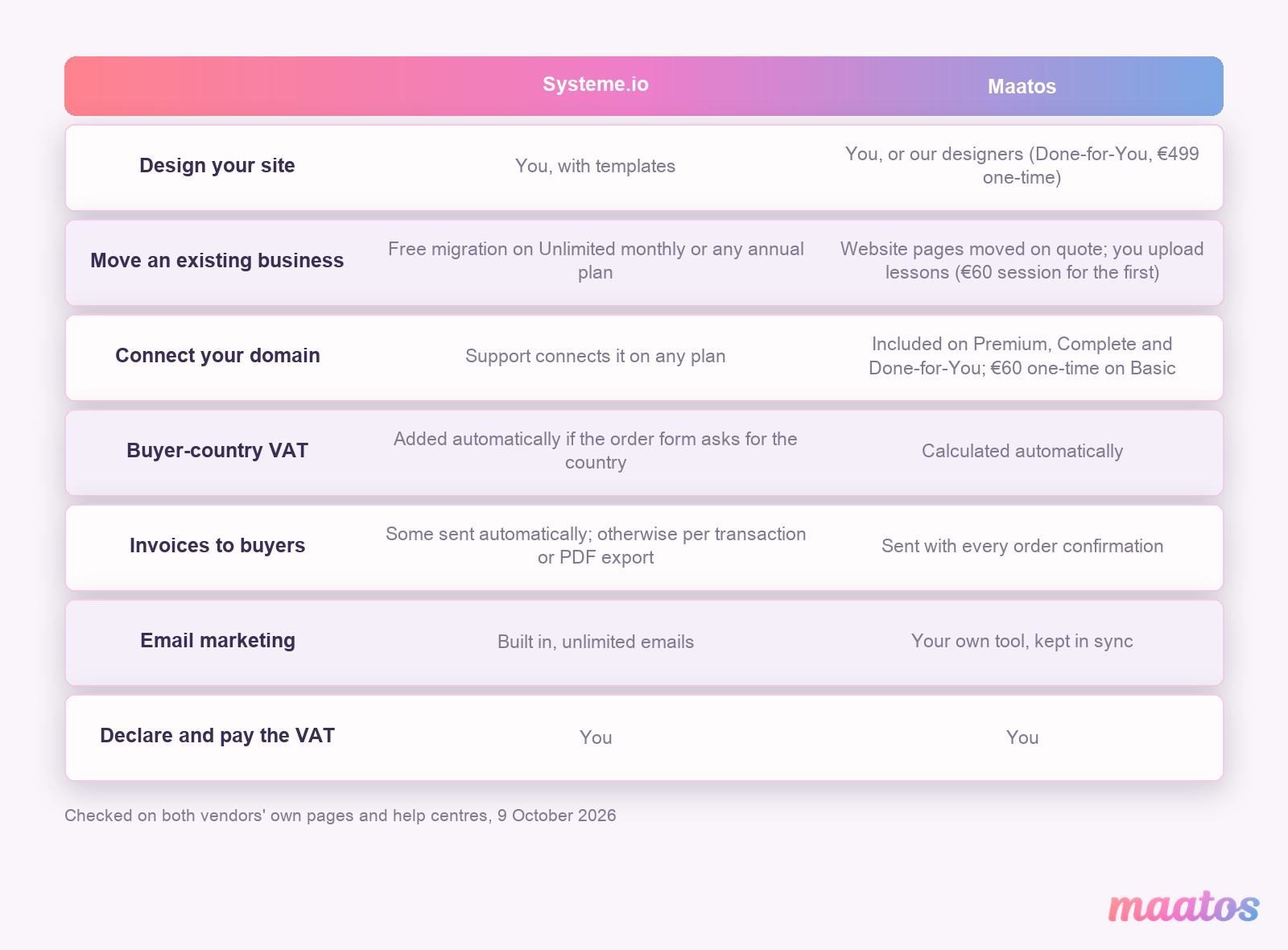
On Systeme.io, you do, with real help on the plumbing: a free migration of your existing business on the qualifying plans, a one-to-one kickstart coaching session on every paid plan and free help connecting your domain. On Maatos, you can do it yourself or have our designers build it with you through the Done-for-You Service for a one-time €499 excluding VAT (a reduced price on 9 October 2026; the page lists it down from €1,399).
We want to be precise about what each of those is, because “done for you” gets used loosely. Systeme.io calls its free migration a “done-for-you business transfer”: its team rebuilds what you already have. It also certifies freelance experts you can hire to build funnels and sites. What we did not find is Systeme.io itself offering a designer who builds a new site with you. Our Done-for-You Service is exactly that: a video call with a designer about your goals and style, a first version of your site within two weeks, your homepage, header, footer and visual identity designed and optimised for every screen, the connections to Mollie, analytics, Search Console and your email tool set up, and a pre-launch check before your first sale. Your own domain is set up as part of it. While we build, you write and upload your course.
What it does not include is moving your course content for you. Existing website pages we can move on a quote, but you upload your lessons yourself, and if you would like a hand with the first one, a one-hour session where we build and publish it together costs €60.
Does Systeme.io handle EU VAT and invoices for you?
Partly, and better than many people assume. Systeme.io adds the VAT rate of the buyer’s country automatically to digital products, provided the Country field is on your order form, and it can produce invoices for your buyers. On both platforms, you as the seller stay responsible for declaring and paying the VAT.
The detail matters. Systeme.io’s VAT article says you set your price excluding VAT and “systeme.io will automatically add the VAT rate of the buyer’s country”, with one catch in its own words: if you do not select the Country field on your order form, “the VAT rate applied will be 0%”. For invoices, its help centre explains how to send an invoice to a customer from the transaction in your sales overview, adding that “if you have multiple invoices to send, you must send them individually”, and how to export invoices as PDFs. Its help centre also describes some invoices going out automatically, so ask how it works for your product type before you choose. We found no help article on OSS reporting or on how EU business customers’ VAT numbers are checked; if you sell to companies across the EU, ask Systeme.io’s support before you rely on it. Maatos does not file your OSS return or decide for you whether a sale is B2B either, so ask us the same question.
Maatos calculates VAT automatically and sends an invoice to your student with every order, without extra work on your side; that is how our features page puts it, and our support documentation describes the invoice going out with the order confirmation. Our pricing FAQ is equally clear about the limit of that: you are the seller, so you are responsible for knowing what to charge and for paying it to the tax authority. Neither platform files your VAT return. If the rules themselves are the fog, our guide to VAT on online courses in the EU walks through them, with a table of rates per country.
Can I use my own domain on either?
Yes, on both, including the cheapest plans. Systeme.io gives you 1 custom domain on the free plan, 3 on Startup, 10 on Webinar and unlimited on Unlimited, and its support will connect it for you. Maatos lets you use your own domain on any plan: setup is included on Premium and Complete and in the Done-for-You Service, and costs a one-time €60 on Basic.
Should you choose Systeme.io or Maatos?
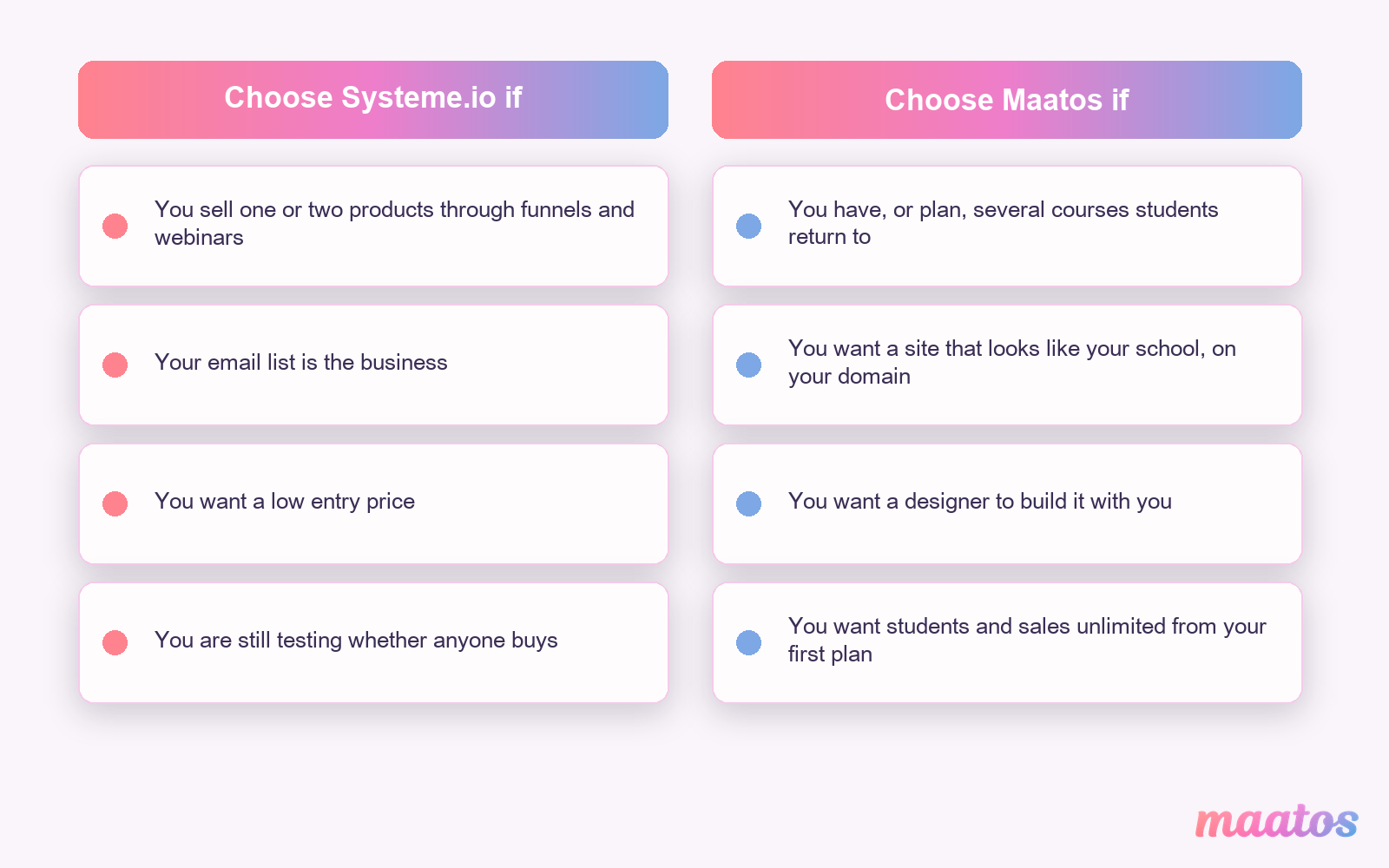
Choose Systeme.io if your business is mostly marketing: you sell one or two products through funnels and webinars, you live in your email list, and you want all of that in one cheap account. Choose it too if you are not yet sure anyone will buy, because the free plan is a fine place to find out, as long as you remember the $10,000 lifetime cap.
Choose Maatos if your business is mostly teaching: you have, or plan to have, several courses that students come back to, you want a website that looks like your school on your own domain, and you would rather a designer built it with you than spend a month of evenings on it. Choose it too if you want the number of students and sales to stay out of your bill from your very first plan (fair use applies, and above about 5,000 active monthly users we talk options); on Systeme.io that is true on the paid plans but not on the free one.
Some people use both for a while: a Systeme.io funnel and list to test an idea, then a course site once the course has proven itself. That is a perfectly sensible order of events, and we would not talk you out of it.
If you are weighing us against the bigger names instead, we have done the same exercise for Maatos vs Kajabi and Maatos vs Podia, and the rest of our thinking on running your own course site lives in the Build Course Website section.
Frequently asked questions
Is Systeme.io really free?
Yes. The free plan has no time limit and needs no credit card. It covers 2,000 contacts, 3 sales funnels, 1 course and 1 custom domain, with unlimited emails. Free accounts stop accepting new sales after $10,000 in lifetime revenue, and the Systeme.io badge cannot be removed on the free plan (checked 9 October 2026).
Can you sell online courses on Systeme.io?
Yes. Systeme.io’s help centre documents quizzes, completion certificates, drip schedules, assignments, bundles and communities. The free plan includes 1 course; Startup includes 5, Webinar 20 and Unlimited unlimited.
Does Systeme.io handle EU VAT and invoices?
It adds the buyer’s country VAT rate to digital products automatically if your order form asks for the country, and it can send and export invoices. You remain responsible for declaring and paying the VAT, as you do on Maatos.
Can I use my own domain on Systeme.io and on Maatos?
Yes on both. Systeme.io includes 1 custom domain on the free plan and more on paid plans. Maatos allows your own domain on every plan, with setup included on Premium and Complete and a one-time €60 fee on Basic.
What does a year cost on each?
Systeme.io on annual billing: $0 (Free), $170 (Startup), $470 (Webinar) or $970 (Unlimited). Maatos on annual billing, excluding VAT: €40.83, €82.50 or €165.83 a month (about €490, €990 or €1,990 a year) for Basic, Premium and Complete, plus a €10 a month Builders plan for building without students. Prices checked on both pricing pages on 9 October 2026.
Can I move from Systeme.io to Maatos without rebuilding everything alone?
The site, yes: with the Done-for-You Service our designers build your Maatos site with you for €499 excluding VAT (a reduced price on 9 October 2026). Your course content you upload yourself, and we can do the first course together in a one-hour session for €60. Our guide to moving your online course to your own platform covers the order to do it in.
Want the course site without the month of evenings?
If you read this and recognised yourself in the “mostly teaching” half, the quickest way from here to a site that looks like your school is to let us build it with you. Tell us about your courses and your style, and our designer will have a first version ready within two weeks while you get on with the lessons. See what the Done-for-You Service includes.