


Here’s the thing most course creators get wrong about lead magnets: they treat them like a transaction. “Give me your email address, I’ll give you this PDF.” The problem with that framing is that it turns your free resource into a bribe — and a bribe only tells someone you’re willing to give things away, not that you’re actually worth learning from.
The better way to think about it: your lead magnet is an audition. It’s the first time a potential student gets to experience what learning from you actually feels like. Someone who downloads your free guide and finds it genuinely useful isn’t just a contact in your list — they’re already forming a judgment about whether your paid course would be worth their time and money. Get the lead magnet right, and you don’t have to work nearly as hard to make the sale later.
This guide covers which lead magnet types work best for course creators and why, how to choose a format that matches your goal, real examples by niche, how to connect your freebie to your email list and start a real conversation, and how to pick a topic that naturally points someone toward your paid course. There’s also a proper FAQ at the end for the questions that come up most often.
What actually makes a lead magnet work?
Before you decide on a format, it’s worth being clear on what separates a lead magnet people genuinely want from one they scroll past. Four things matter.
It solves one specific problem. The most common mistake is going broad. “The Complete Guide to Starting Your Online Course” sounds comprehensive, but it converts terribly because it speaks to everyone and therefore resonates with no one. “The 15-minute lesson outline template for coaches who hate scripting” speaks to a specific person with a specific problem, and they recognise themselves immediately. Narrow always beats broad.
It delivers a result fast. The best lead magnets produce a quick win — ideally something the person can use or feel within an hour. A template they can fill in today, a checklist they can act on this week, a single lesson that teaches one concrete thing. A quick win creates a positive first impression that makes someone far more likely to open your next email and, eventually, buy your course.
It attracts the right people, not just any people. A lead magnet isn’t trying to maximise sign-ups; it’s trying to attract people who would actually buy your course. A freebie so broad that anyone would grab it fills your list with people who never will. A specific lead magnet self-selects: only the people genuinely interested in your topic opt in, which means a smaller list that’s far more valuable.
It shows your teaching. This is the audition element. The lead magnet should feel like you — your way of explaining things, your perspective, your voice. Generic information they could find on any blog doesn’t build trust. A free resource that feels distinctly like learning from you does. That’s your unfair advantage over every other result they could have clicked on.
A useful test before you create anything: would this be good enough that someone would pay for it? If the honest answer is no, it’s probably too thin to build the trust you need.
The lead magnet types that work best for course creators
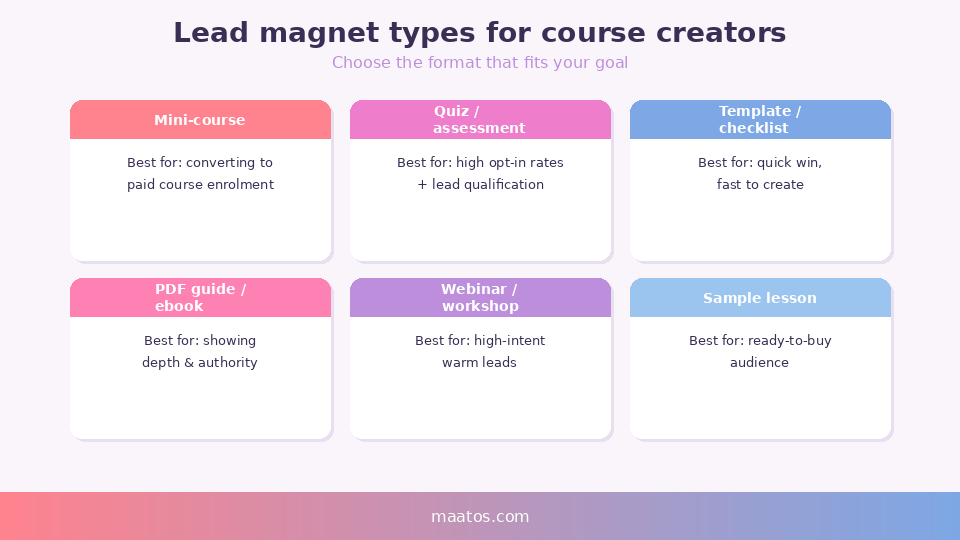
Not every format suits every goal or every creator. Here’s an honest look at what works, what it’s best for, and what makes each one actually good rather than just present.
Free mini-course
For converting leads into paying students, a short free course — three to five focused lessons — is the single most powerful lead magnet a course creator can offer. Why? Because it directly demonstrates the thing you’re selling. Someone who works through your free mini-course and gets a real result has experienced exactly what buying your paid course would feel like. No other format creates that depth of trust.
A fitness coach might offer a free five-day email course on building a sustainable morning routine, then pitch their paid 12-week programme as the deeper transformation. A copywriting teacher might offer a free three-lesson series on writing headlines, positioning the paid course as where you learn the whole system. The conversion path is obvious because the topics connect.
Host the mini-course on the same platform as your paid course where you can. If someone completes your free course and likes how it’s organised and delivered, signing up for the paid version is one familiar step, not a leap into the unknown.
Quizzes and assessments
Quizzes consistently show opt-in rates of 40 to 55 percent — well above most downloadables — because they’re interactive and the personalised result genuinely feels worth an email address. But there’s a second advantage most people miss: quizzes tell you about each person who takes them.
A quiz like “What type of course creator are you?” or “Are you ready to launch your first online course?” captures the email and reveals where the person is in their journey. That lets you send a more relevant nurture sequence — someone who’s just starting gets a different email than someone who’s already created a course but is struggling to sell it. That kind of personalisation is hard to do without the data a quiz gives you.
To make a quiz work, the result has to be genuinely useful, not just a flattering label. A real assessment or a personalised recommendation converts far better than a “you’re a Trailblazer!” badge with no substance.
Templates, checklists and swipe files
The fastest format to create and often the highest-converting, because it delivers something immediately tangible. People love templates because they remove work — a lesson plan template, a content calendar, a course outline framework, a checklist of things to sort before you launch.
What makes a template lead magnet great isn’t the template itself; it’s the specificity. “A social media content calendar” is generic. “A 4-week social media calendar for course creators launching their first cohort” is something a specific person with a specific problem will download immediately because it does the planning work for them.
These also work well in combination with a mini-course or email sequence: the template is the immediate quick win, and the follow-up emails teach people how to use it properly — keeping them engaged and positioned toward your paid offer.
One-page checklists
Checklists shine when the problem is complexity: there are a lot of moving parts and your reader just wants to know they haven’t missed anything. A “Course launch checklist” or “Video recording setup checklist” or “Before you open enrolment: 20 things to check” can be enormously useful because it condenses expertise into something actionable.
Keep them genuinely short and scannable. A checklist that’s really a 10-page guide with tick boxes isn’t a checklist — it’s a guide pretending to be one. A real one-pager that covers everything important is much more shareable and more likely to get used and associated with your name positively.
PDF guides and short ebooks
A focused guide still works well when the topic genuinely needs depth — when a checklist or template would leave important questions unanswered. The key is to resist the urge to be comprehensive. A focused 15-page guide that solves one problem thoroughly converts better than a 60-page everything-guide that overwhelms people before they finish the introduction.
A photography teacher might offer “The 7 camera settings beginners change too soon (and what to use instead)” — a short, opinionated guide that gets people immediate results and positions the author as someone with a clear, useful point of view. That’s more effective than a comprehensive beginner’s photography handbook, which sounds useful in theory but is too much to consume before someone’s formed an opinion about you.
Webinars and live workshops
Live workshops are among the warmest leads you’ll ever capture, because attendees give up time — not just an email address — which is a far stronger signal of intent. The live format also lets you demonstrate your teaching directly, answer real questions in real time, and create a sense of community around your topic before anyone has paid you anything.
The practical upside: the recording becomes a reusable evergreen lead magnet afterward. Run the live session for the relationship-building and high-intent signals; repurpose the recording for ongoing list growth. Pre-selling your course before you have an audience often starts with exactly this kind of live event that builds the list and validates demand at the same time.
Sample lessons and course previews
Offering a sample lesson directly from your paid course is the most transparent lead magnet there is: it’s a literal preview of the product. Someone who watches your sample lesson and finds it genuinely good is one of the most qualified leads possible — they’ve already sampled what they’d be buying.
This works best when you pick your strongest, most self-contained lesson — one that delivers a complete win on its own, not one that feels like it cuts off before the good part. The goal is to leave them thinking “if the free lesson is this useful, the full course must be really good.”
How to match your lead magnet to your paid course
This is the strategic piece most guides skip over, and it genuinely matters. The best lead magnet isn’t just a useful free resource — it’s a natural on-ramp to your specific paid course. When the two are properly connected, the conversion from free subscriber to paying student feels obvious rather than forced.
The model to use: your lead magnet solves the first piece of the problem your course solves completely. It gives the person a quick win on a narrow, early-stage challenge — and the natural next question (“OK, now what?”) is answered by enrolling in your full course.
A few examples of what this looks like in practice:
A business coach whose course teaches how to package and price consulting services might offer a free pricing calculator as the lead magnet. It solves the immediate pain of feeling unsure what to charge, and the natural follow-on question (“great, now how do I find the right clients and close them?”) leads straight to the paid course.
A graphic design teacher whose course covers brand identity might offer a brand audit checklist as the lead magnet. A small business owner uses the checklist, discovers three things their current branding is getting wrong, and wants to know how to fix them — which is exactly what the paid course teaches.
A course on mindfulness for busy professionals might use a five-day email mini-course covering one short practice per day. By day five, the subscriber has experienced real benefit from five minutes a day and wants the full system.
The test: can you draw a straight line from “person uses the lead magnet” to “the most obvious next question is answered by my paid course”? If the line is clear, the alignment is good. If it’s a stretch, the lead magnet is probably attracting the wrong people — and filling your list with people who won’t buy. That’s worse than a smaller list of the right ones.
How to deliver your lead magnet and start a real conversation
A lead magnet without a delivery plan is just a file on your hard drive. The delivery mechanics — how someone actually receives your lead magnet and what happens next — are where most of the value gets left on the table.
The basic flow: someone finds your lead magnet on your website or in your content, fills in a simple opt-in form with their email address, lands on a thank-you page where they access the freebie immediately, and then starts receiving a short email sequence over the following days.
That email sequence is where the relationship is built. Email marketing remains the most reliable channel for turning a lead into a student — not because email is the most exciting channel, but because it’s one where someone has given you direct, personal access and you’re not competing with an algorithm. Three to five emails over a week or two, each genuinely useful, is enough to establish whether someone trusts you enough to consider buying.
For students who do buy, the principles shift: the onboarding email sequence for new students is about welcoming and setting expectations rather than selling — but the same underlying rule applies: each email should earn its place by being useful to the person reading it.
A few things that matter in the delivery:
The thank-you page is underused. It’s the moment when someone’s interest in you is highest — they just signed up. Don’t just confirm the download; briefly introduce yourself, explain what’s coming in the emails, and optionally offer one bonus piece of content or an invitation to connect somewhere else.
Timing and spacing matter. Daily emails feel like spam; monthly emails mean the relationship goes cold. One email every two to three days over the first week or two is usually the right pace — frequent enough to stay present, spread out enough not to be overwhelming.
Sell last, not first. The most common mistake is pitching in email one or two, before you’ve built any trust. Spend the first few emails delivering value. The pitch belongs in emails four or five, once you’ve earned the right to make it. For guidance on what to put on the page when they do arrive ready to buy, the sales page sections that convert are worth reading before you build out the bottom of your funnel.
Common mistakes that kill lead magnet conversion
Most lead magnet problems come down to a handful of predictable errors.
Being too broad. A vague lead magnet for a vague audience converts poorly not because the content is bad, but because the right person doesn’t recognise it as made for them. Narrow the topic, narrow the target audience, and conversion almost always improves.
Making it too long or complex. A lead magnet should deliver a quick win, not a full course’s worth of content before someone has decided they like you. If the answer to “when will someone get value from this?” is “after they’ve read all 60 pages,” it’s too much. Shorter and more focused is almost always better.
Misaligning the lead magnet and the paid course. A lead magnet that attracts the wrong people is actively harmful to your conversion numbers. Align the freebie to the course, or don’t be surprised when your list doesn’t buy.
Neglecting the email sequence. Some creators build a good lead magnet and then send one welcome email and go quiet. The lead magnet opens the door; the email sequence is where the relationship forms. Without it, you’re collecting contacts, not building an audience.
Making the opt-in too complicated. Every extra field on your opt-in form reduces sign-ups. Email address only — or email plus first name — is almost always the right choice. Asking for phone number, country, and profession before someone knows if they like you is asking too much too soon.
For more on the broader marketing system your lead magnet fits into, the Selling Courses guides cover the full picture.
Frequently asked questions about lead magnets for course creators
What is the best lead magnet for a course creator?
It depends on your goal. For converting leads into paying students, a free mini-course is the most powerful option — it directly demonstrates your teaching, which is exactly what you’re selling. For the highest opt-in rates with the least creation time, templates and checklists win. For learning about your leads and personalising your follow-up, a quiz is best. The right choice matches your goal, your audience, and what you can realistically create well.
How do I choose a lead magnet topic?
Start with the question your potential students ask most often, or the specific problem they face right before they need your course. That problem is your topic. Then narrow it: instead of “how to start a course,” try “how to structure your first module so students don’t drop off in week one.” The more specific the topic, the more clearly it speaks to the right person — and the higher it converts.
How long should a lead magnet be?
Short enough to deliver a quick win; long enough to be genuinely useful. A template might be one page; a focused guide might be 15 pages; a mini-course might be three short lessons. Length is never the goal. A focused, immediately usable resource beats a long comprehensive one almost every time. If someone could get real value from it in under an hour, you’re in the right zone.
Should my lead magnet be directly related to my paid course?
Yes — closely. The ideal lead magnet solves the first piece of the problem your course solves, so the natural next step is enrolling in the course for the complete solution. A lead magnet unrelated to your course attracts people who want the freebie but won’t buy. When the freebie and the course are properly aligned, the conversion feels natural rather than like a separate sales push.
How do I know if my lead magnet is working?
Two numbers matter: opt-in rate (what percentage of people who see the lead magnet sign up) and downstream conversion (what percentage of those leads eventually become paying students). A high opt-in rate with low conversion usually means the lead magnet is attracting the wrong people — too broad or misaligned with your course. A low opt-in rate means the offer isn’t compelling or specific enough. Both problems are fixable, but you need both numbers to know which one you have.
Do I need expensive tools to build a lead magnet funnel?
No. The basic requirements are somewhere to host the lead magnet, a simple opt-in form, automated email delivery, and a short email sequence. Most course platforms handle all of this. The funnel doesn’t need to be complicated to work — a simple, well-aligned lead magnet with a three-email sequence outperforms a sophisticated automation system built around a weak freebie every time.
If you want all of this in one place — course hosting, student management, and Stripe payments without platform commissions — Maatos is free to try, and the infrastructure for the full lead-magnet-to-enrolment flow is built in from the start.