
“Just add a payment plan, you’ll sell more.” It’s one of the most-repeated pieces of course-pricing advice going, and almost nobody stress-tests it. It’s often true. It’s also why a creator who had a great launch month ends up, the following spring, writing polite emails about a €115 card decline instead of building the next course.
A payment plan splits one course price across several charges, usually three or six. On higher-priced courses it does tend to lift conversion, because the number on the button stops being the thing standing between someone and the decision. But it costs you in three concrete ways: your cash arrives later, some of it never arrives at all, and you inherit an admin job you didn’t have before. There’s also a fourth thing, in Europe and the UK, that most of that advice predates.
None of which means don’t do it. We’re going to walk you through what a payment plan really involves, how to price one so it’s worth your while, what to do when a charge fails, and when the honest answer is to skip it.
What do people actually mean by a payment plan?
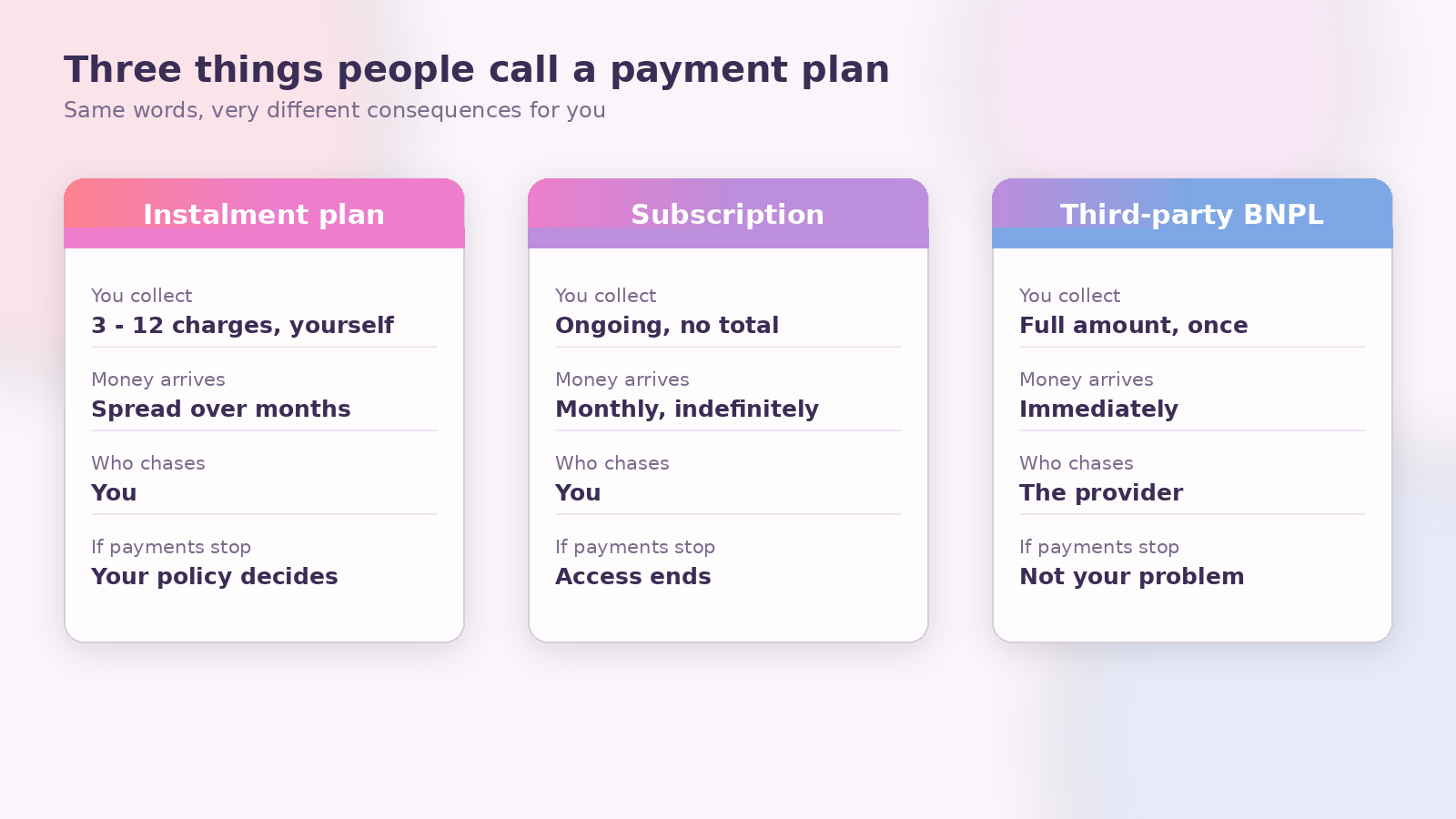
Three different arrangements get called a payment plan, and they behave completely differently for your cash flow, your admin and your legal position.
An instalment plan is one course, sold once, collected in a fixed number of charges. Someone buys a €600 programme and pays it off across six months. They own the course from the moment they buy (or get access as it unlocks); only the payments are spread out. This is what most course creators mean, and it’s what the rest of this article is about.
A subscription is ongoing access in exchange for an ongoing payment. There’s no total and no end date, and if the student stops paying they stop having access, which is a much cleaner arrangement and a genuinely different product. If you’re weighing those two up, our piece on bundles versus subscriptions gets into which one earns more over a couple of years.
Then there’s third-party “buy now, pay later”, where a separate company pays you the full amount immediately and collects from the student themselves. You get your money and none of the chasing. They take a cut, and they own the relationship at exactly the point where it goes wrong.
Does a payment plan really sell more courses?
Usually yes on expensive courses, rarely enough to matter on cheap ones, and the lift comes with a quality trade-off nobody mentions.
The mechanism is simple. A €900 price competes with everything else your buyer might do with €900. A €175 monthly payment competes with the budget they already think in. Removing that comparison is worth real money on a premium programme, which is why certification programmes and cohort courses so often offer one.
Be sceptical of the specific numbers you’ll see quoted, though. Figures like “payment plans increase conversion by 30%” get passed from blog to blog without a source you can actually open and check, and the ones that do have a source usually turn out to be measuring something else. We’re not going to pretend we know what your lift would be. What we can tell you is the part that gets left out: the buyers a payment plan brings in are, on average, the ones for whom the price was a stretch. Some of them will be your best students. Some will refund in week two, or quietly stop paying in month four. If your refund rate creeps up after you introduce a plan, that’s not a coincidence, and our guide to what a high refund rate is telling you is a useful companion here.
So the honest framing isn’t that payment plans make you more money. It’s that they trade certainty for volume. Whether that’s a good trade depends on the numbers below.
What does a payment plan actually cost you?
Three things: delayed cash, failed payments, and your own time. Only the first is obvious.
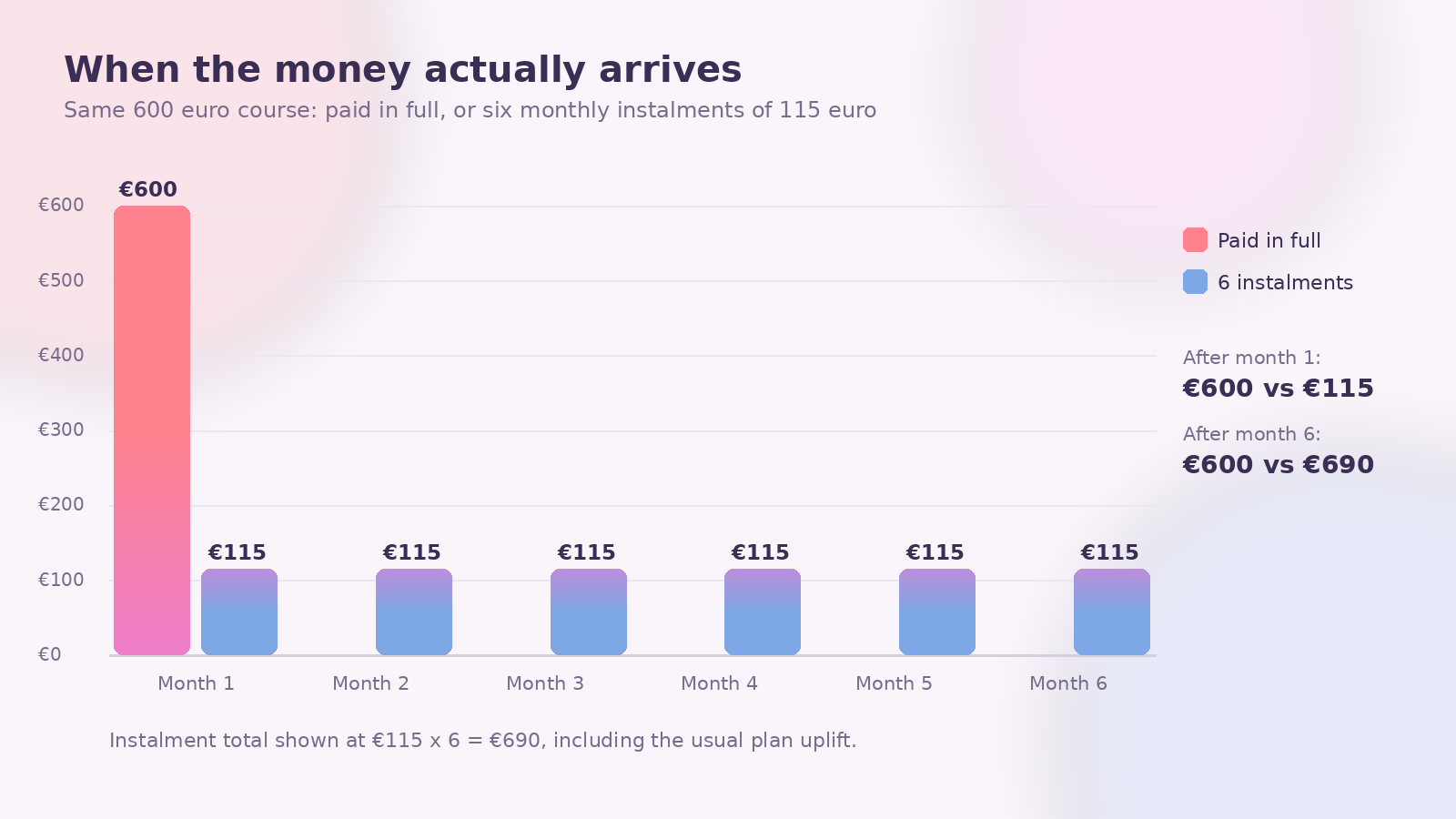
Start with the timing, because it’s the one that changes how your year feels. On a €600 course sold outright you have €600 (less fees and VAT) this month. On six instalments you have a sixth of it this month and the rest scattered across half a year. If you’re funding ads, paying an editor, or just paying yourself, that gap is the whole story. A launch that “did €18,000” and a launch that put €18,000 in the bank are not the same launch.
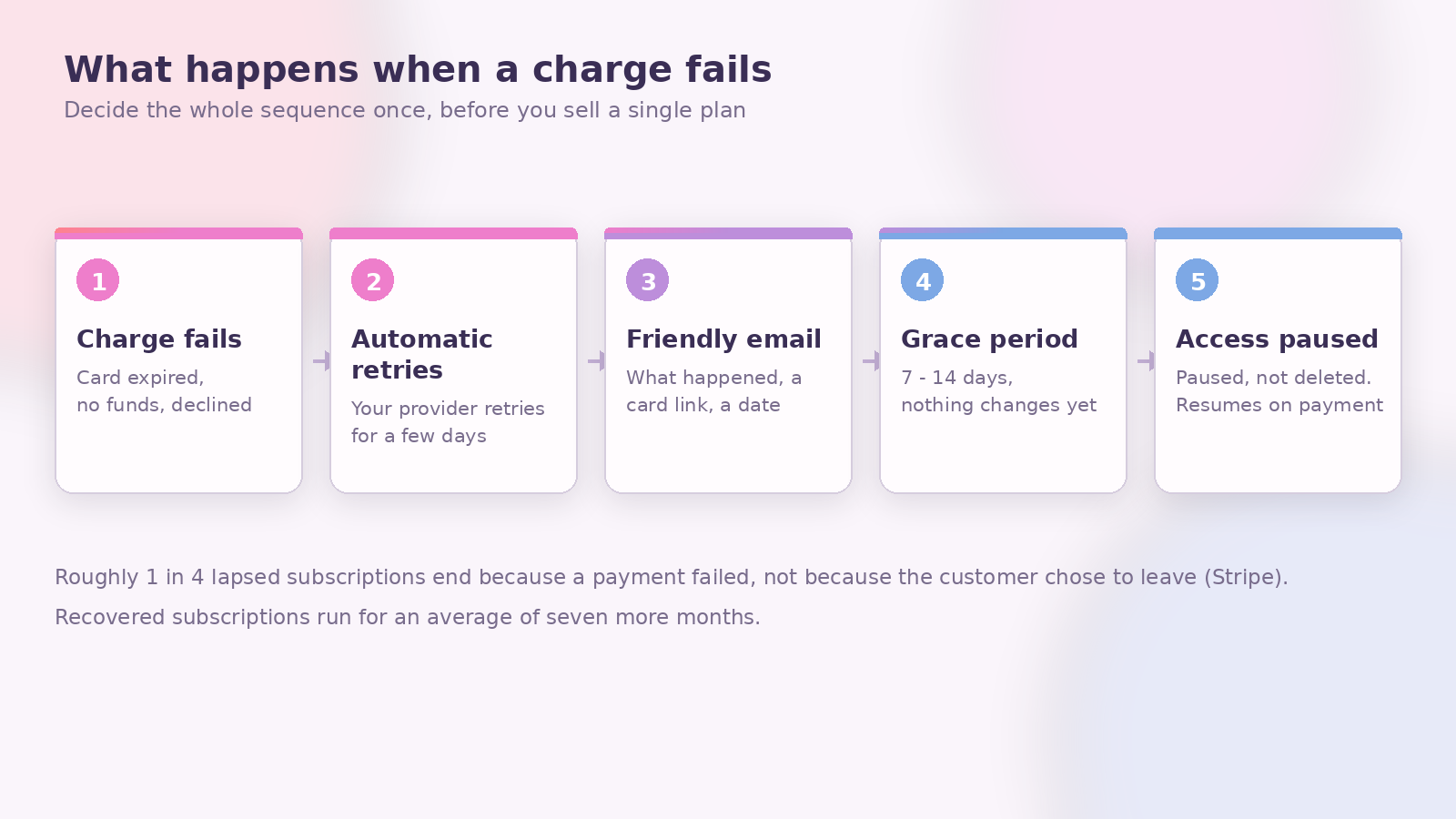
Then there’s the money that never turns up. Cards expire, balances run dry, banks decline. Stripe puts it plainly in its own guidance on involuntary churn: around 25% of lapsed subscriptions end purely because a payment failed, not because the customer decided to leave. That’s a subscription figure rather than a course-instalment one, so treat it as an order of magnitude rather than your number. The direction still holds. On a six-month plan you’re asking a card to work correctly five more times than you would on a one-off sale, and the odds compound.
And you inherit an admin job. Retries, reminder emails, the message from someone whose card was cloned, the decision about whether a student who’s two payments behind keeps watching. On twenty students that’s an afternoon a month. It isn’t catastrophic. It’s just work nobody budgets for and everyone resents.
How much more should the payment-plan total be?
Charge more in total for the plan than for paying in full, and say so on the page. It isn’t a penalty. It’s the price of you carrying the time and the risk.
We’d put the uplift somewhere between 10% and 20% of the single payment, and the arithmetic isn’t complicated. If your course is €600 up front, a three-payment plan at €220 comes to €660, and a six-payment plan at €115 comes to €690. Both are honest numbers: the buyer gets the same course, later money is worth less to you, and a longer plan carries more chances to fail.
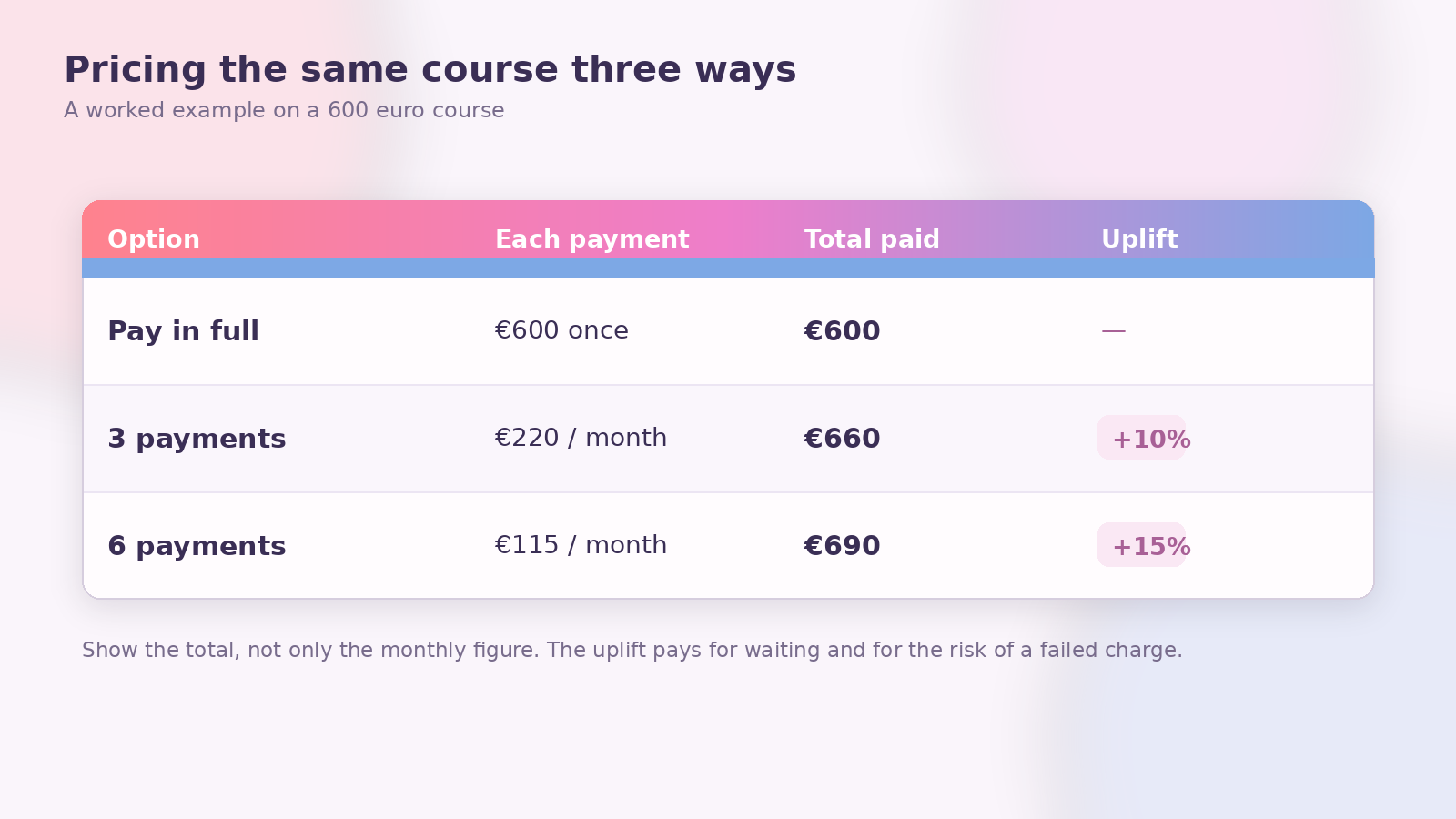
Two things to get right on the page. Show the total, not only the monthly figure. A plan advertised as “6 × €115” with the €690 buried is the kind of thing that gets a chargeback attached to it, and a buyer who works out the total afterwards is a buyer who feels caught. And frame the difference the other way round: “save €90 by paying in full” reads as a reward, while “€90 surcharge for paying monthly” reads as a fine, and it’s the same €90. That’s the same principle at work in our notes on small pricing tweaks that lift revenue.
Where a plan shouldn’t cost more is when it’s really a subscription in disguise. If people are paying monthly for continuing access to something you keep adding to, that’s a different product, and the pricing logic in our course pricing models guide is a better starting point than this one. There’s more of that thinking across our Selling Courses section.
What should happen when a payment fails?
Decide the whole sequence before you sell a single plan, write it into your terms, and then let it run without renegotiating it every time.
A workable default looks like this. The charge fails, and your payment provider retries automatically over the next few days. Stripe does this through its Smart Retries feature, and most providers have some version of it, so check what yours actually does before you assume. If the retries don’t land, the student gets a plain, friendly message: here’s what happened, here’s the link to update the card, here’s the date this needs sorting by. Then a grace period, a week is normal and two is generous, during which nothing changes for them. If that passes, access pauses rather than disappears, and the tone stays warm, because the overwhelming majority of these people are not trying to rob you. They changed banks.
One practical note before you design that email: sending it is your job, not your course platform’s. Most platforms, ours included, will tell you a payment failed but won’t write or send the follow-up for you, so the message needs to live somewhere you control, whether that’s your inbox or your email tool.
It’s worth being persistent about the recovery, because these students aren’t lost causes. Stripe reports that subscriptions rescued by its own recovery tools go on to run for an average of seven more months. The equivalent for you is a student who finishes the programme and tells someone about it, instead of the €345 still owed on a six-month plan and an awkward silence.
What you want to avoid is the improvised version, where every failure becomes a fresh judgement call, half your students get a grace period and half don’t, and you end up resenting the whole thing. Write the policy once.
Do you cut off access when someone stops paying?
Yes, eventually, but where you draw the line is a business decision you should make deliberately rather than at 11pm in your inbox.
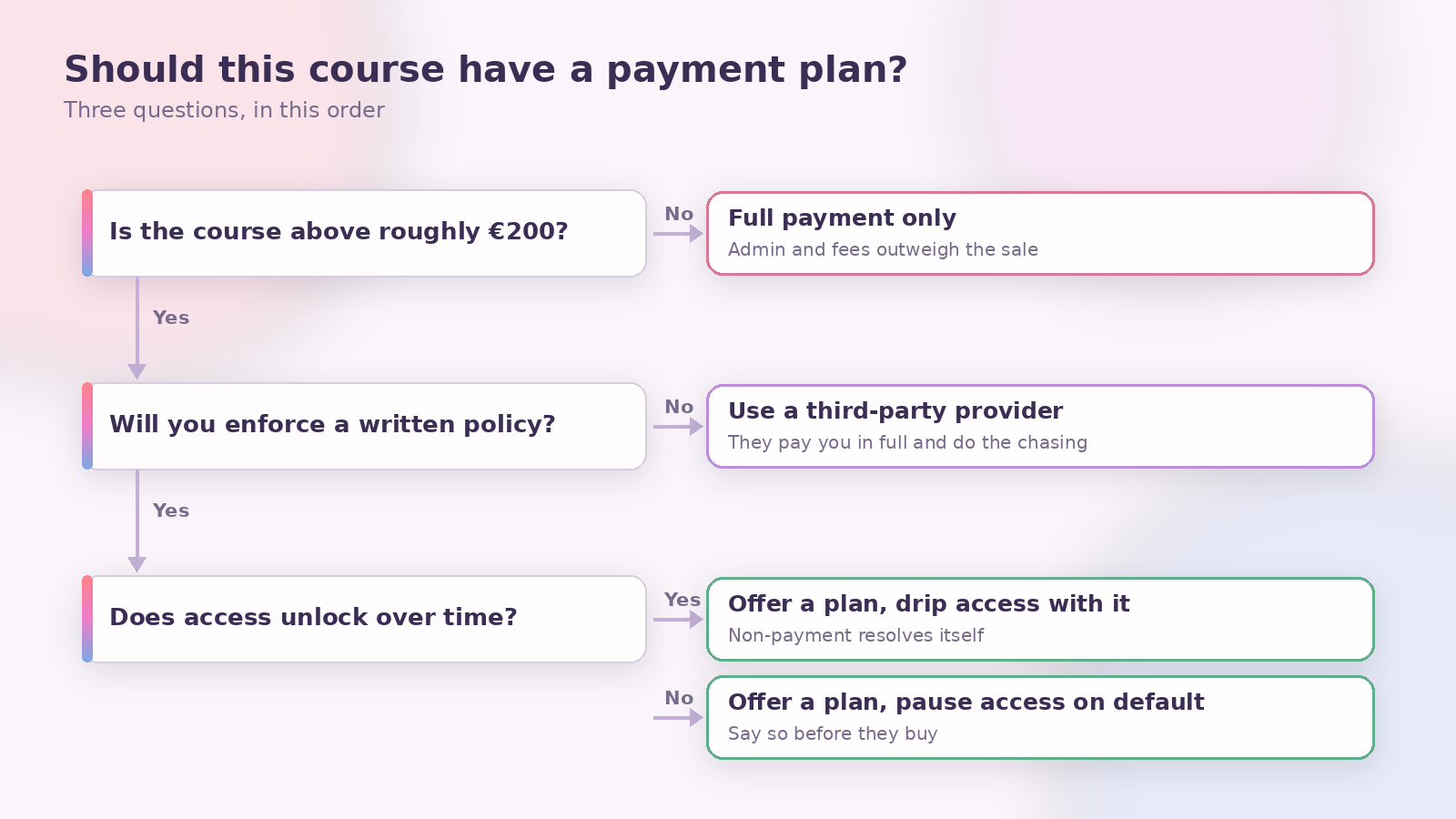
There are three defensible positions. The first is to release access alongside the payments, so month four unlocks when month four is paid. That makes non-payment almost self-resolving and works beautifully for cohort or sequential programmes, though it’s a poor fit for a reference-style course people dip into. The second, and the one most people land on, is full access immediately with a pause on default. The third is full access that you never revoke, treating unpaid instalments as a debt you’ll write off, which is a perfectly reasonable choice to make on purpose and a terrible one to discover by accident.
Whichever you pick, put it in writing where the buyer sees it before they pay, not in a terms page nobody opens. Ambiguity here is what turns a card problem into a dispute, and unclear terms at the point of purchase are exactly the friction our checkout quick wins piece is about removing.
Are course payment plans regulated credit?
If you sell to consumers in the EU, a payment plan you run yourself can fall inside consumer credit law from 20 November 2026. In the UK, the buy-now-pay-later rules that started on 15 July 2026 only catch third-party lenders, not you. Almost no course-marketing article covers this, and the first of those dates is close enough to matter.
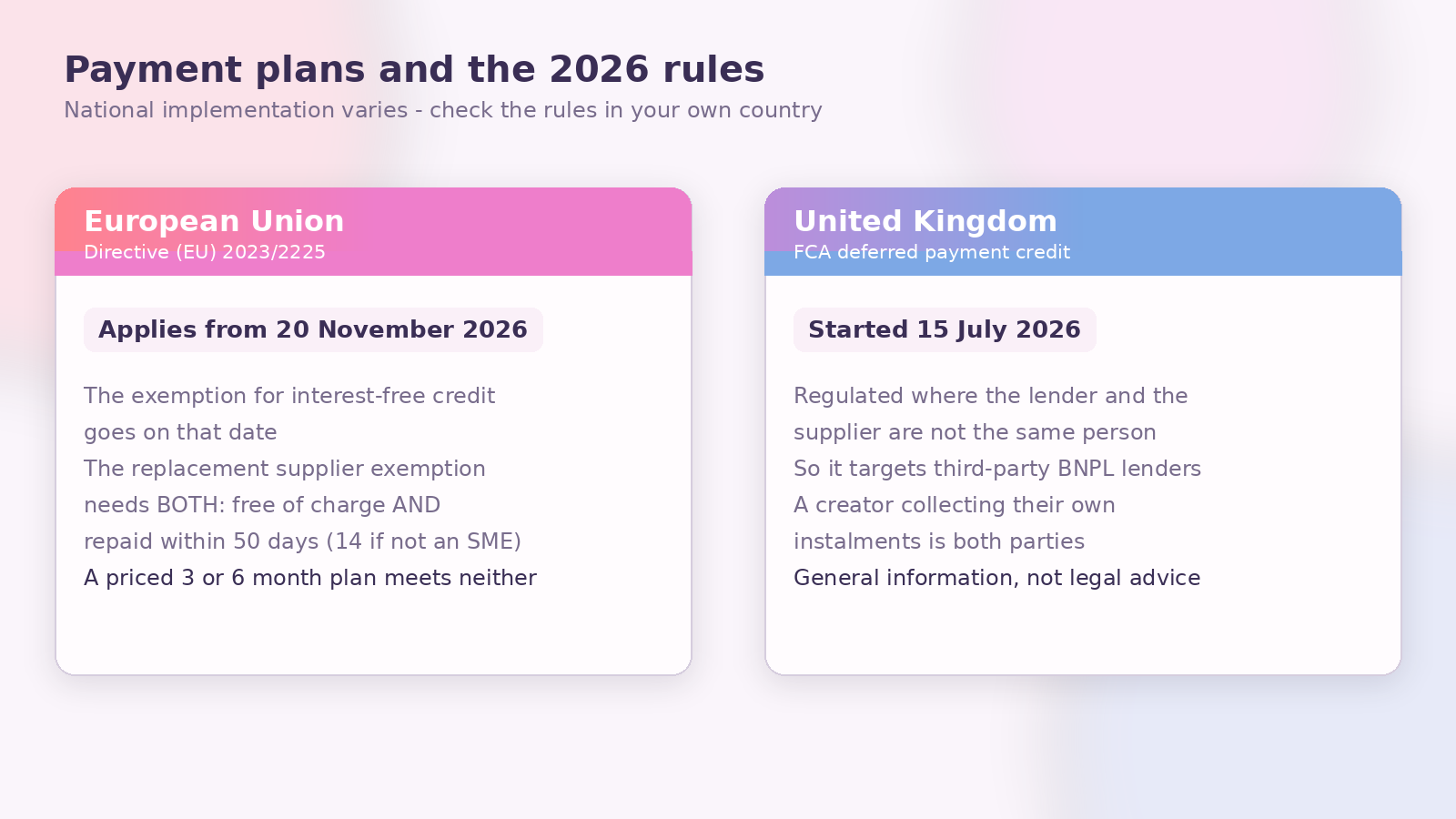
The EU change comes from the second Consumer Credit Directive, Directive (EU) 2023/2225, which member states had to transpose by 20 November 2025 and which applies from 20 November 2026. Today’s regime has a broad exemption for credit granted free of interest, which is what a course payment plan looks like. From November that exemption goes. What replaces it is a narrower exemption for suppliers who offer the deferred payment directly to their own customers, and it has two conditions rather than one: the deferred payment has to be free of charge, and it has to be repaid within 50 days (14 days for larger online sellers that aren’t SMEs).
Read those two conditions against the advice three sections up and you’ll see the problem. A plan with a 10–20% uplift isn’t free of charge, so it fails the first condition. A three-month or six-month plan doesn’t fit inside 50 days, so it fails the second. A typical course payment plan misses on both counts, which is a good thing to know before November rather than after.
Failing the exemption doesn’t automatically make you a licensed lender, though. Member states can disapply some of the advertising and pre-contractual requirements for credit that’s genuinely free of interest and charges, and they can exempt small businesses granting credit as a side effect of selling their own products from the registration requirements altogether. So the practical answer depends entirely on how your own country has implemented it. What has changed is that “it’s interest-free, so it isn’t credit” stops being a safe assumption this November, and if you run long plans for European consumers that’s worth a conversation with an accountant or lawyer in your country between now and then rather than a guess.
The UK went the other way for our purposes. The Financial Conduct Authority began regulating deferred payment credit on 15 July 2026, and its guidance is unusually clear about the boundary: an agreement is regulated where “the lender and the supplier of goods or services are not the same person.” A course creator collecting their own instalments is both, so the new regime isn’t aimed at them.
We’re a course platform rather than a law firm, and this is general information rather than legal advice. The reason we’re raising it at all is that these dates land in the middle of the season when most creators set next year’s pricing.
How do instalments work with VAT and invoicing?
Splitting the payment doesn’t split the sale. You’ve sold one course at one price, and the VAT treatment follows from that rather than from the number of charges.
In practice that usually means each instalment produces its own invoice showing its share of the VAT, and the totals reconcile to a single transaction. What rate you charge still depends on where your student is and on your own registration status, which is a separate topic: our EU VAT guide for course creators and the broader piece on handling VAT and sales tax on digital courses cover it properly. The thing to check with your accountant is timing, specifically when the VAT falls due on a plan that runs across a quarter or a year end.
There’s a practical wrinkle worth knowing before you launch, too: your payment provider’s rules, not just yours, decide what’s possible. Saved-card mandates, what happens when a student’s bank reissues a card, whether a plan can be paused at all, these are Stripe and Mollie questions, and they’re much easier to answer before you’ve sold thirty plans than after. Our Stripe setup notes cover the pitfalls we see most often.
When should you not offer a payment plan?
Skip it when the price isn’t the obstacle, when the sums are too small to be worth the admin, or when you know you won’t enforce the policy you wrote.
Below roughly €150 to €200 a plan rarely changes anyone’s mind and reliably creates work. Two failed charges on a €90 course can cost more in time and fees than the sale was worth. The same goes for impulse-priced products, where the buyer decides in ninety seconds and a monthly commitment actually adds friction rather than removing it. If you hand over instant, permanent, full access and have no intention of ever revoking it, what you’ve built is an honour system rather than a payment plan, which is fine as long as you meant to. And if you already know you won’t send the follow-up emails, an unenforced plan isn’t generous. It’s a discount you didn’t decide to give.
The good news is that this decision isn’t permanent. Adding a plan later to a course that’s already selling is easy, and it gives you a clean before-and-after to judge it by. Removing one after people have bought is much harder.
How does this work if you’re building on Maatos?
Instalment payments sit on the Premium plan (€99 per month excluding VAT, or €82.50 per month billed annually). Basic sells courses at a one-time payment; Premium adds instalments and subscriptions on top. Collection runs through Stripe or Mollie, which you connect yourself, so you’re paid directly rather than waiting on a platform payout. VAT is calculated automatically on your invoices, which saves the arithmetic, though what you’re actually liable for in each country is still something to establish with your accountant.
What we don’t do is decide the policy for you. Maatos won’t write your grace-period rules, chase a student on your behalf, or tell you whether a six-month plan suits your particular course. You can see the full feature list on our features page, and if you’d rather have the whole thing set up properly the first time, that’s what our done-for-you service is for.
Frequently asked questions
Should a payment plan cost more than paying in full?
Yes, in almost every case, and the uplift should be visible rather than buried. The one place we’d make an exception is a plan you’re running as a deliberate favour, say for a student in a country where your normal price is genuinely out of reach. That’s a discount decision dressed as a payment plan, which is fine, as long as you know that’s what you’re doing.
How many instalments should I offer?
Two options beat five, in our experience. Pay in full plus one plan is enough of a choice for anyone, and it keeps your sales page readable. If you’re torn between three and six payments, pick the one that ends closest to when a committed student would realistically finish the course, because a plan that outlives someone’s engagement with the material is the one that stops getting paid.
What percentage of course payment plans fail?
There’s no reliable public figure specific to online courses, and anyone quoting one precisely is guessing. The nearest solid number is Stripe’s 25% of lapsed subscriptions ending because of a failed payment. The practical move is to measure your own: after two launches you’ll have a real completion rate for your plans, and you can price the next one against that instead of against a statistic from someone else’s business.
Can I cut off access if someone stops paying?
You can, provided you said so before they bought. Where creators get caught out is on partial refunds: if you pause access at payment four of six, be clear in advance about whether the student keeps what they’ve already paid for or gets some of it back. Deciding that mid-argument is how a card problem becomes a chargeback.
Are payment plans considered credit?
In the EU, potentially yes from 20 November 2026, because the supplier exemption that replaces the current interest-free one requires the deferred payment to be both free of charge and settled within 50 days, and a typical course plan is neither. In the UK the position is the opposite: the FCA’s rules from 15 July 2026 apply to third-party lenders, and a creator collecting their own instalments isn’t one. National implementation of the EU rules varies a lot, so check with a professional in your country rather than assuming your neighbour’s answer applies.
Is a third-party buy-now-pay-later provider better than running the plan myself?
It depends what you’d rather not deal with. Worth knowing before you decide: a third-party provider runs its own affordability checks, so some of your buyers will simply be declined, and you’ll never find out which ones or why. Running the plan yourself means everyone who wants in gets in, and you carry the consequences of that.
Do payment plans increase refunds?
Often slightly, and the useful thing is to check rather than assume. Tag your plan buyers separately and compare their refund rate and completion rate against your pay-in-full buyers over a couple of launches. If the gap is small, the plan is doing its job. If it’s large, the fix is usually clearer expectations on the sales page rather than pulling the plan.
Try it before you commit to it
If you’re not sure whether a payment plan belongs in your pricing, the cheapest way to find out is to build the thing and look at it. Set the course up, put both options on the page, and see which one people actually choose. Our pricing page shows which plan includes instalments, and every plan starts with 30 days free, so you can have the whole flow working before you commit to anything.