
Make a PDF, attach it to an email, hit send. That is how most of us have invoiced for years, and in Belgium it stopped being good enough on 1 January 2026.
Since that date, almost every business established in Belgium and registered for VAT has to send and receive its business-to-business (B2B) invoices as a structured e-invoice, and in practice that means through the Peppol network. A PDF sent by email is no longer the legal invoice between two Belgian companies. Government invoices (B2G) already worked this way; now it covers companies invoicing each other.
And here’s the part that matters most if you sell courses from outside Belgium: if your business is not established in Belgium, the obligation does not apply to you, even when your customer is a Belgian company. That comes straight from the Belgian tax administration (FPS Finance), and we’ll show you where. It doesn’t mean Peppol is irrelevant to you. It means you get to choose, and there are good reasons to choose it anyway.
In this article we explain what Peppol is and how it differs from UBL, who exactly has to use it (and who doesn’t), what happens if you don’t, where the rest of Europe is heading, and how to set it up calmly if you run your course business on Maatos.
Who does the Peppol obligation apply to?
The rule reaches further than many people expect inside Belgium, and less far than many people fear outside it. Roughly, there are three groups.
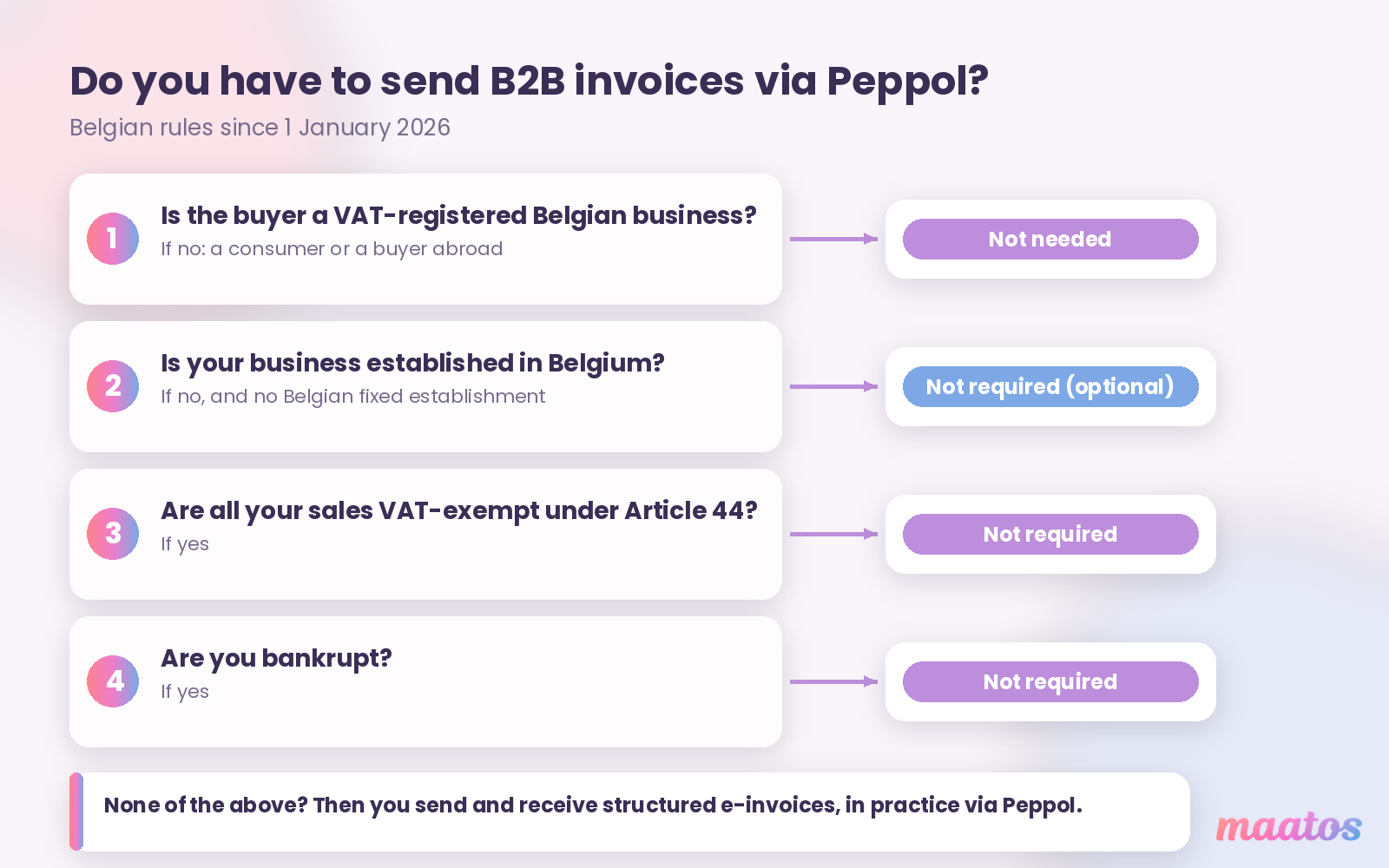
Belgian businesses. Any organisation established in Belgium with a Belgian VAT number that invoices other Belgian businesses has to use structured e-invoices. That includes freelancers, sole traders, small and medium-sized companies, non-profits and large enterprises alike. It also includes businesses on the small-enterprise exemption scheme (annual turnover up to €25,000). Being small does not get you out of it.
International businesses with Belgian customers. This is where a lot of advice online (including an earlier version of this page) gets it wrong. The FPS Finance FAQ states plainly that “VAT-registered persons not established in Belgium without a permanent establishment, even if they are identified for VAT purposes in Belgium, are not subject to the obligation.” So if you are a Dutch, German, Irish or any other non-Belgian course creator selling training, software or coaching to a Belgian company, and you have no fixed establishment in Belgium, Belgian law does not require you to send your invoice via Peppol. The FAQ adds that the legal text was still being updated on this point, so check with your accountant before a big contract, but the administration’s position is clear. Your Belgian customer, meanwhile, is obliged to be able to receive Peppol invoices, which is why many of them will ask you for one.
Maatos users. If you run an online academy on Maatos and sell to Belgian companies, what you need depends on where you are established. A Belgian course creator selling to Belgian businesses needs a Peppol-ready invoicing workflow. A course creator elsewhere doesn’t strictly need one, but will find that Belgian finance departments are much happier to pay a Peppol invoice. Whichever group you’re in, the VAT on the sale is a separate question from how the invoice travels; our guide to VAT and online courses in the European Union and the country page on VAT for online courses in Belgium cover that side.
Not sure whether a Belgian customer is VAT-registered? You can look any Belgian company up in the Crossroads Bank for Enterprises (KBO/BCE). If it says “subject to VAT”, your invoices to them are B2B invoices.
What changed in Belgium on 1 January 2026?
Put simply: from 1 January 2026, e-invoicing is mandatory for B2B invoices between VAT-registered businesses established in Belgium. Invoices to public authorities (B2G) had already gone electronic in phases between 2022 and March 2024; the 2026 step extends the idea to companies invoicing each other.
The legal basis is the 2024 law introducing mandatory electronic invoicing between businesses, with the practical details confirmed in a Royal Decree published in the summer of 2025. It applies to any in-scope invoice drawn up or sent from 1 January 2026, even if the work itself was delivered in 2025.
What does “structured e-invoice” actually mean? The invoice must follow the European standard EN 16931, and the Belgian government names Peppol BIS (in the UBL format) as the standard to use. It is sent through a certified Peppol access point, which in practice is your accounting or invoicing software. You can still email a PDF copy to your customer if you like, but the structured e-invoice is the legal one.
One nuance that often gets lost: Peppol is the default, not the only option. Two businesses may agree to use a different network or format, as long as it complies with EN 16931 (law firm Loyens & Loeff gives the example of long-standing B2G suppliers on other networks). For almost every small business, though, Peppol is simply the way it’s done, and every in-scope Belgian business must at least be able to receive Peppol invoices.
Who is outside the sending obligation?
The exceptions are narrower than “consumers only”:
- Sales to consumers (B2C). Private individuals without a VAT number never need a Peppol invoice. If you only sell to consumers, you have nothing to send, but as a Belgian business you still need to be able to receive e-invoices from your own suppliers.
- Businesses established abroad without a fixed establishment in Belgium, even if they hold a Belgian VAT number.
- Invoices for supplies that are VAT-exempt under Article 44 of the Belgian VAT Code (certain recognised education and training, medical care, financial services and so on). A business that only makes such supplies has nothing to send. Most private course creators charge VAT and are therefore in scope, so don’t assume “I teach” means “I’m exempt”.
- Farmers under the special agricultural scheme, who must be able to receive e-invoices but don’t have to send them yet.
- Bankrupt taxable persons.
What are the fines?
The Royal Decree introduced fixed penalties for not having the technical means to send and receive e-invoices: €1,500 for a first offence, €3,000 for a second and €5,000 for each one after that. A new infringement only counts as the next step up if the tax administration finds it at least three months after the previous one, which gives you time to fix things. The usual penalties for incorrect invoices (wrong dates, missing details) still apply on top.
There was a three-month tolerance period from 1 January to 31 March 2026, but only for businesses that could show they had made reasonable, timely efforts. That window has closed. If you’re a Belgian business still emailing PDFs to other Belgian businesses, now is the time to switch.
Two details people miss
Belgium softened the cost of the switch: small businesses and self-employed people can deduct 120% of the extra costs of e-invoicing (for example the e-invoicing part of a software subscription, when it’s shown separately on the invoice) for income years 2024 to 2027. And the Royal Decree also tightened VAT rounding: VAT is calculated and rounded on the invoice total, not line by line.
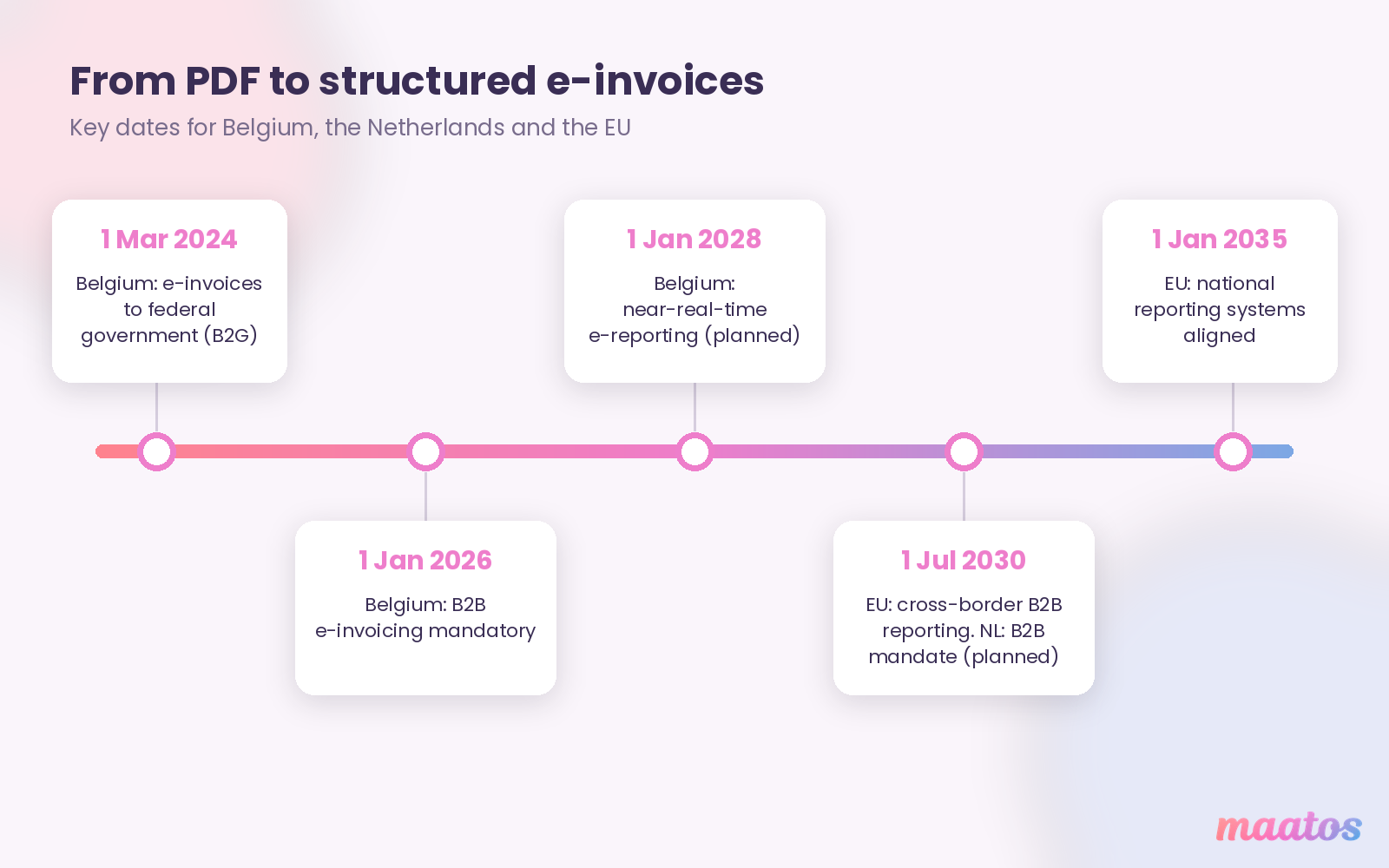
Why is Belgium doing all this? To reduce VAT fraud, modernise tax administration and get businesses ready for the European VAT in the Digital Age (ViDA) rules. Belgium also plans to go a step further from 1 January 2028, with near-real-time reporting of invoice data to the tax authority through the same Peppol set-up; the government approved a preliminary draft law for this in July 2026, and some tax advisers already call the date ambitious, so treat it as planned rather than final.
What is Peppol, exactly?
Peppol was originally short for Pan-European Public Procurement Online. Today it’s simply the name of a secure network, run under the umbrella of OpenPeppol, over which accounting systems exchange invoices and other business documents directly, instead of through PDFs and inboxes.
The easiest way to think about it is as a postal service for invoices. When you send an invoice through Peppol, it doesn’t land in your customer’s mailbox. It lands straight in their accounting system. Every business connected to the network has a unique Peppol ID, usually linked to its VAT or company number, so the network knows exactly where each invoice should go. You don’t need to ask your customers for their Peppol ID: good invoicing software looks it up for you, and you can check anyone yourself in the public Peppol Directory.
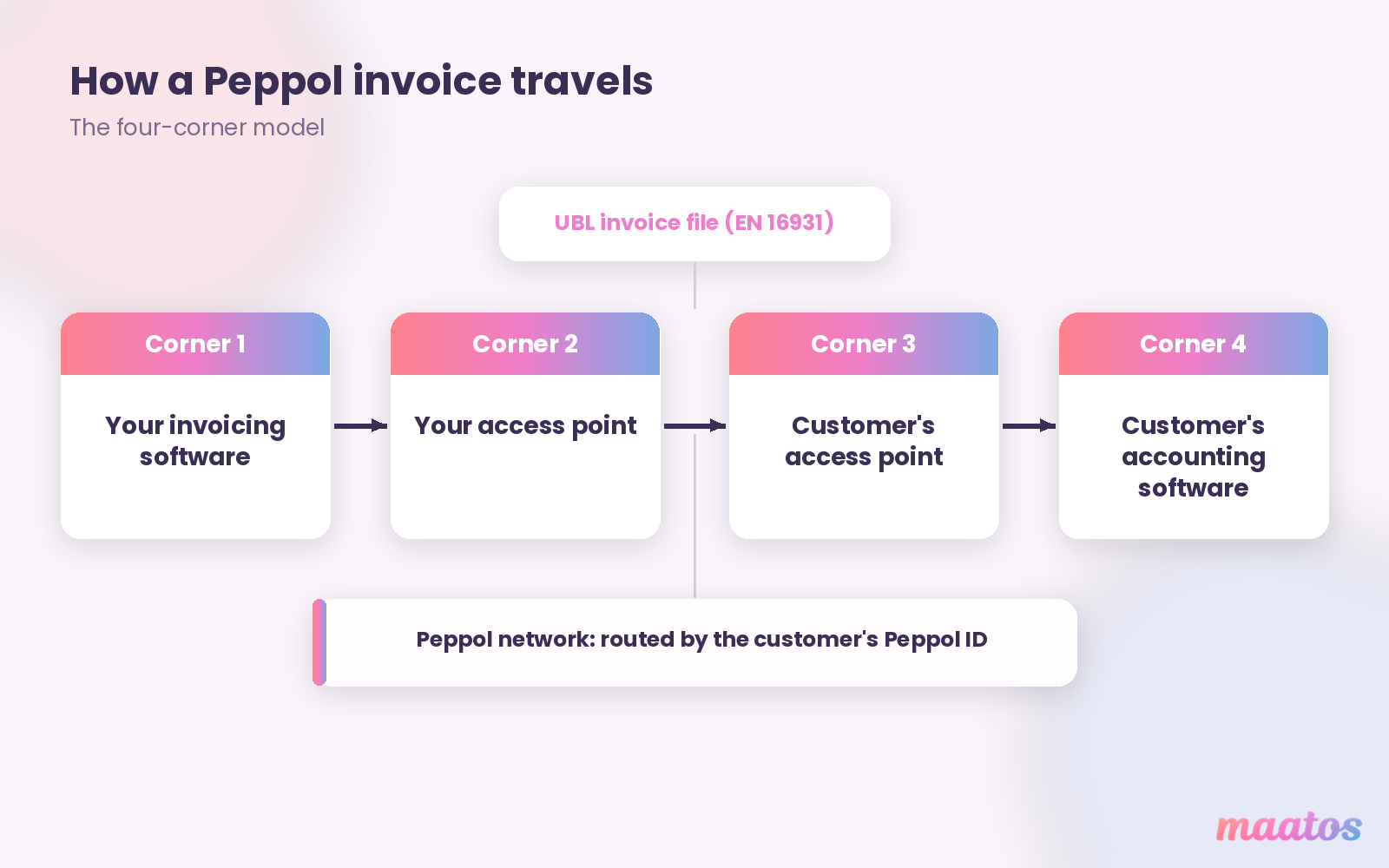
In practice, Peppol means no more emailing or uploading invoices by hand, invoices arriving directly in the right system, fewer errors because the data is structured and validated before it’s sent, and faster processing, which usually means faster payment. It also keeps you compliant with Belgian and European rules without having to think about it invoice by invoice. Because the transmission runs through controlled channels, it’s also much harder for a fraudster to slip a fake invoice with a changed bank account into your customer’s queue.
For Maatos users, Peppol is best seen as the bridge between your course platform and your bookkeeping. Maatos handles the sale, the enrolment and the payment; your accounting software takes care of the legally correct invoice. Each system does what it’s good at.
Many widely used accounting tools already support Peppol, including Moneybird, Exact Online, Odoo, Teamleader and Yuki. Moneybird now also operates in Belgium and says Belgian users are connected to Peppol automatically once their company number is verified.
What’s the difference between Peppol and UBL?
People mix these two up all the time, and it’s understandable. UBL (Universal Business Language) is the format: the structured XML file that software can read. Peppol is the network that carries that file from your system to your customer’s. A Peppol invoice is a UBL invoice delivered over the Peppol network.
If you like analogies: UBL is the language you write your letter in, Peppol is the postal service that delivers it. You need both, but they’re not the same thing. And if you need to send attachments with your invoice (a timesheet, a delivery note), they travel inside the same UBL invoice, not in a separate email; the FPS Finance FAQ is explicit that attachments are legally part of the invoice.
I sell from outside Belgium. Should I use Peppol anyway?
Legally, you usually don’t have to. Practically, it’s often worth it, and here’s how to decide.
If your Belgian customers are consumers, you can stop here: consumer sales never need Peppol, wherever you are.
If you sell to Belgian companies now and then, a PDF invoice from a non-established supplier is still a valid invoice. But put yourself in your customer’s shoes. Their accounts-payable team has just rebuilt its whole process around Peppol. A PDF means someone has to key it in by hand, and in larger organisations that often means your invoice waits. If your accounting software already supports Peppol, switching it on costs you nothing and gets you paid faster.
If Belgian companies are a real part of your business (in-house training for teams, a corporate academy, recurring licences), treat Peppol as the default. You’ll also be ready for what’s coming in your own country: the Netherlands, for example, has announced plans for its own B2B mandate from 2030 (more on that below).
One thing to know before you sign up: according to FPS Finance, being published as a registered Peppol recipient counts as agreeing to receive structured e-invoices over Peppol. That’s rarely a problem (your suppliers’ invoices will simply arrive in your software), but it’s good to know it works both ways.
If you have a fixed establishment in Belgium, say an office or a team running your training there, the exemption doesn’t cover you. Talk to your accountant.
How do you handle Peppol when you sell courses with Maatos?
The short answer: Maatos doesn’t have its own Peppol connection, and it isn’t trying to be your accounting system. What it does do, according to our features page, is calculate VAT automatically and send an invoice to your customer after each purchase. That checkout invoice is a normal invoice, not a Peppol e-invoice. For consumers, that’s all you need. For B2B sales that have to go through Peppol, the invoice has to come out of Peppol-ready accounting software.
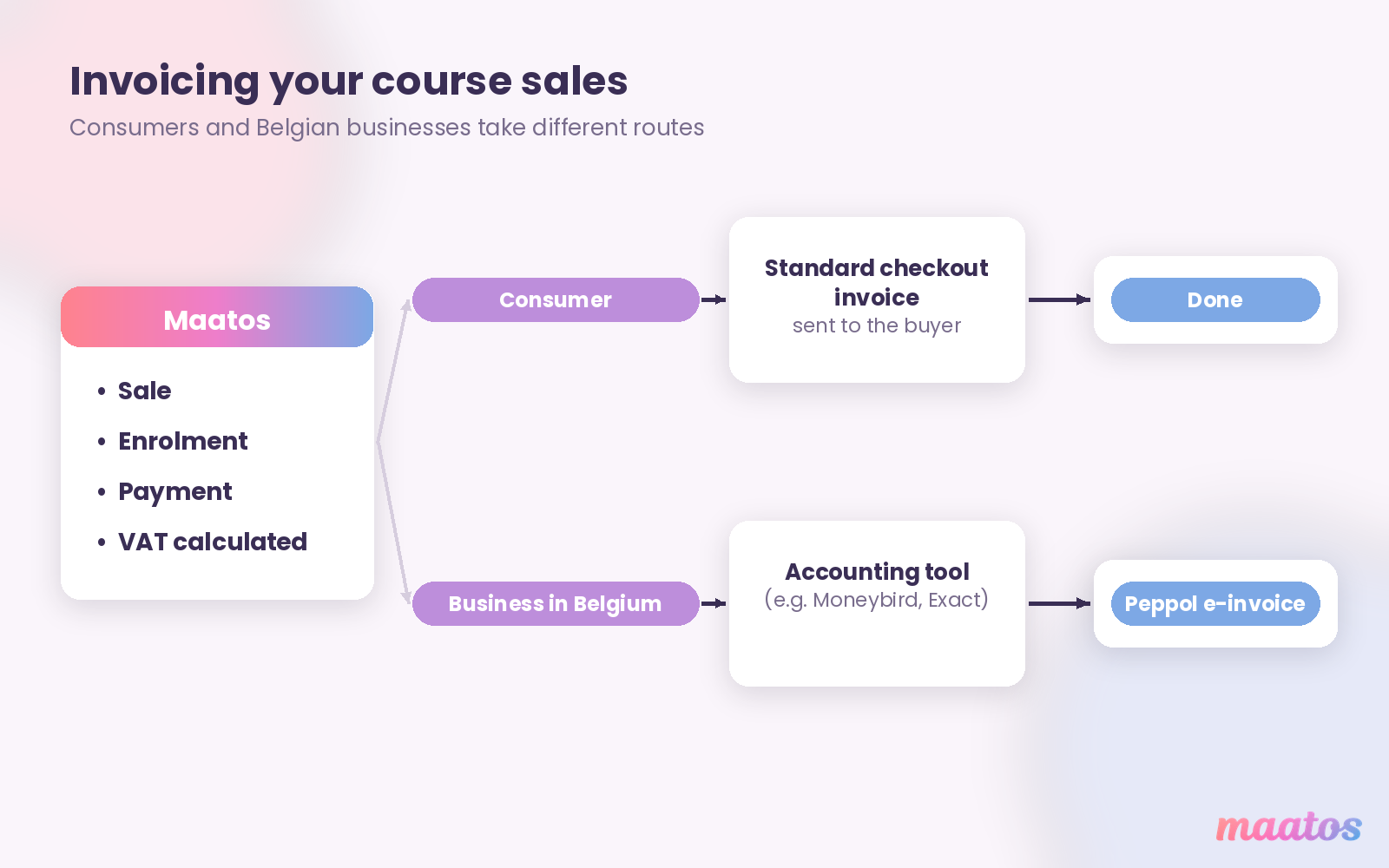
There are two practical ways to set that up.
The first is the Moneybird connection. On the Premium plan and up, the Maatos team can switch on a connection between your Maatos shop and Moneybird. It isn’t on by default and it runs on a separate third-party connector licence, so get in touch with us first and we’ll tell you what it takes for your site. Once it’s live, the invoices for your orders are created and sent from Moneybird, while payment and course access still run through Maatos exactly as before.
The second is simpler and works with any accounting tool: for your B2B customers, issue the invoice from your accounting software yourself and send it over Peppol there. If you sell to businesses only occasionally, this is usually the least effort.
A typical setup looks like this:
- Decide which sales need Peppol. Consumer sales don’t. B2B sales to Belgian businesses do if you’re established in Belgium, and benefit from it if you’re not.
- Connect Maatos to your accounting tool, or invoice B2B orders there. Ask us about the Moneybird connection, or create B2B invoices in Exact Online, Odoo, Teamleader, Yuki or whatever you use.
- Switch on Peppol in your accounting software. In most tools it’s a setting in the invoicing section; some, like Moneybird in Belgium, register you automatically once your company is verified.
- Let the software find your customer. Modern tools detect a customer’s Peppol ID from their VAT or company number. You don’t need to ask for it.
- Use Maatos for selling, not bookkeeping. Maatos handles sales, enrolments and payments; your accounting software makes sure the invoice is compliant.
If you’d rather not set any of this up yourself, our done-for-you service can build and connect your Maatos site for you while you focus on your course. It’s also worth reading how to set up Stripe for your courses without the usual pitfalls, since payments and invoices go hand in hand. To see what the plans include, have a look at our pricing: Basic starts at €49 per month (excluding VAT), the Moneybird connection needs Premium or higher, and the first 30 days are free.
Recommended integrations
These are the two tools we and our users have the most experience with:
- Moneybird: quick to set up, strong automation and full Peppol support, in both the Netherlands and Belgium.
- E-boekhouden.nl: a good fit for Dutch businesses that want deeper accounting automation.
Both links are affiliate links: if you sign up through them, we may receive a small fee at no extra cost to you.
Where is e-invoicing heading in the rest of Europe?
Belgium moved early, and other countries are following. The EU’s VAT in the Digital Age (ViDA) package was adopted on 11 March 2025 and entered into force on 14 April 2025. Since then, member states have been free to make domestic e-invoicing mandatory without asking Brussels for permission first, which is exactly the door Belgium walked through.
What’s the expected timeline?
- Now (since 2025): member states may introduce domestic e-invoicing mandates. Belgium did so for B2B from 2026; Germany, France, Spain and others are rolling out their own versions.
- 1 January 2028 (planned): Belgium adds near-real-time e-reporting of invoice data.
- 1 July 2030: e-invoicing based on EN 16931 plus digital reporting becomes the rule for cross-border B2B transactions inside the EU.
- By 1 January 2035: countries with their own real-time reporting systems must align them with the EU model.
So PDFs and email attachments are slowly on their way out, and machine-readable invoices are becoming the European norm.
Signals from the Netherlands and other markets
The Netherlands has required e-invoicing for invoices to central government for years, largely via Peppol, and Dutch businesses have some of the highest voluntary Peppol use in Europe. On 11 September 2026 the Dutch State Secretary for Finance confirmed the next step in an outline letter to parliament: mandatory B2B e-invoicing for domestic and intra-EU transactions from 1 July 2030, digital VAT reporting for domestic transactions from 1 July 2031, and EN 16931 as the only format. The transmission network hasn’t been chosen yet (according to Sovos, advisory bodies recommended Peppol), and it’s still a policy plan rather than law: a public consultation comes first and the bill is expected before summer 2027.
Beyond the law, the market is moving too. Accounting and ERP platforms increasingly switch Peppol on by default, and procurement departments are more and more likely to push back on PDF invoices. Adopting it early saves you doing the work twice.
And a practical note if you’ve read older advice: Belgium’s free government bridge platform, Hermes, closed on 31 December 2025. You now need a Peppol-connected software provider.
What does this mean for Maatos users?
If you connect Maatos to a Peppol-ready accounting tool, or invoice your business customers from one, you’re ready for Belgian B2B invoicing, for the growing number of Dutch and other EU business customers who prefer Peppol, and for the ViDA rules coming in 2030.
A few habits that help:
- Make Peppol your default for business customers, especially Belgian ones and any customer who asks for it.
- Keep consumer and business sales clearly apart in your checkout and your bookkeeping, so the right invoice goes to the right buyer.
- Write down your invoicing flow (“Maatos → accounting tool → Peppol”). It helps with audits, quality processes and the inevitable customer question.
Compliance is only half the story. Digital invoicing makes your administration faster, tidier and easier to scale, and those are exactly the things that start to matter once your training business grows beyond a handful of customers. While you’re getting the admin side in order, it’s also worth checking whether you’re allowed to issue course certificates the way you do, and how to handle VAT and sales tax on digital courses. You’ll find more in our Selling Courses section.
Frequently asked questions about Peppol in Belgium
Is Peppol mandatory in Belgium?
Yes, for B2B invoices between VAT-registered businesses established in Belgium, since 1 January 2026. Those invoices must be structured e-invoices under EN 16931, and Peppol BIS is the standard format and network. Another format or network is only allowed if both parties agree and it meets the European standard.
Do I need Peppol if my business is not in Belgium?
Not under Belgian law, as long as you have no fixed establishment in Belgium. The FPS Finance FAQ says non-established businesses are not subject to the obligation, even if they have a Belgian VAT number. Many Belgian customers will still prefer a Peppol invoice because it saves them manual work.
Does Peppol apply to small businesses and freelancers?
Yes. Sole traders, freelancers and businesses on the small-enterprise VAT exemption scheme (turnover up to €25,000) are in scope. The main exclusions are Article 44-exempt supplies, bankrupt businesses, non-established businesses and (for sending only, for now) farmers on the special agricultural scheme.
Can I still send a PDF invoice after 1 January 2026?
To consumers, yes: B2C invoices don’t need Peppol. Between two Belgian businesses, the structured e-invoice is the legal invoice; a PDF can go along as a courtesy copy but isn’t enough on its own. A non-Belgian supplier without an establishment in Belgium may still send a PDF.
What are the penalties for not using Peppol?
Fixed fines of €1,500 for a first offence, €3,000 for a second and €5,000 for each further one, with at least three months between one finding and the next. The tolerance period for the first quarter of 2026 has ended.
What if my Belgian customer isn’t ready to receive Peppol invoices?
According to FPS Finance, if your customer can’t receive Peppol invoices yet, you may send the invoice another way (paper, or an electronic method your customer agrees to), and you have still met your invoicing obligation. The customer is the one at risk of a penalty.
Does Maatos send Peppol invoices?
Not by itself. Maatos calculates VAT and sends a standard invoice for every purchase, which is all you need for consumers. For Peppol invoices, you connect an accounting tool: on Premium and up we can switch on a Moneybird connection on request, or you invoice business customers directly from Peppol-ready software.
Is Peppol the same as UBL?
No. UBL is the file format of the invoice; Peppol is the network that delivers it. A Peppol invoice is a UBL file sent over the Peppol network.
Peppol in Belgium in five sentences
- Since 1 January 2026, B2B invoices between VAT-registered businesses established in Belgium must be structured e-invoices, in practice sent over Peppol, and that includes freelancers, non-profits and small businesses on the €25,000 scheme, with only a few narrow exceptions.
- Peppol is a secure European network for e-invoices, built on the UBL format and the EN 16931 standard.
- Businesses established outside Belgium, with no Belgian fixed establishment, are not obliged to use it, but their Belgian business customers often prefer it, so it’s worth turning on if your software supports it.
- On Maatos, consumer sales get a standard invoice automatically; for Peppol, connect Moneybird (Premium and up, on request) or invoice business customers from Exact Online or another Peppol-ready tool.
- Switching now saves time and errors, keeps you on the right side of Belgian law and gets you ready for the EU-wide ViDA rules and the planned Dutch mandate in 2030.
Read more
- Peppol.org: the international Peppol organisation
- e-invoicing in Belgium: the official Belgian government site, and its FAQ on the B2B obligation
- VAT in the Digital Age (ViDA): the European Commission’s overview
- Loyens & Loeff on the Royal Decree: penalties, formats and the grace period
- Sovos on the Dutch 2030 mandate and VATupdate on Belgium’s 2028 e-reporting plans
- Moneybird: sign up, and its Peppol page for Belgium
- E-boekhouden: invoicing and administration including Peppol
This article explains the rules as published by the Belgian and Dutch authorities and the European Commission, checked on 1 October 2026. We’re a course platform, not tax advisers: for your own situation, check with your accountant.
Selling to Belgian businesses, or planning to? Build your academy on Maatos, let the checkout handle payments and standard invoices, and plug in your accounting tool for Peppol when you need it. Try Maatos free for 30 days, or send us a message if you’d like to talk through the Moneybird connection for your situation. Good luck with the admin. It’s one of those jobs that feels much lighter once it runs by itself.